
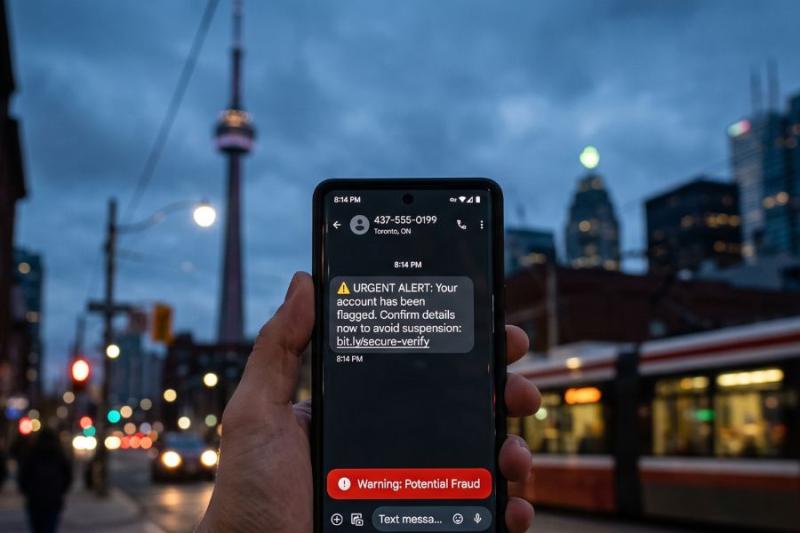
Attackers hijack Toronto's overlay area code to bypass natural skepticism, exploiting local trust to compromise credentials and drain bank accounts.
Key Takeaways
According to the Canadian Anti-Fraud Centre (CAFC), Canadians lost a record CA$704 million to fraud in 2025. With under 10% of victims reporting, actual impact estimates reach billions.
The CRTC introduced Telecom Decision 2026-140, enabling carriers to implement automated network-level blocking against phishing infrastructure. Despite this, spoofed local calls remain a primary entry point for cybercriminals.
The 437 area code is an overlay code for Toronto alongside 416 and 647. Criminals use Voice over Internet Protocol (VoIP) software to display this local code on caller IDs worldwide, buying virtual numbers in bulk to blast automated texts and calls.
What this means: A text displaying a 437 number provides zero assurance that the sender is in Canada.
Smishing relies on artificially created urgency rather than long-form persuasion. The goal is forcing rapid action before you can verify the sender.
Scammers spoof 437 numbers while posing as major telecom representatives (e.g., Rogers, Bell, Telus). They offer exclusive phone upgrades, place an unauthorized device order under the victim's legitimate account, and ship it to the victim's address. The scammer then calls back claiming a shipment error, persuading the victim to courier the brand-new device directly to a fraud-controlled address.
Threat actors deploy localized 437 spoofing and search manipulation to target Canadian employees. The texts direct victims to fake Microsoft 365 or corporate HR portals. Once victims authenticate, adversary-in-the-middle (AiTM) tools steal session tokens to quietly alter direct-deposit banking information.
Attackers send fake security alerts via a local 437 SMS instructing the victim to contact a toll-free number. Calling back connects the victim directly to a fraudulent agent who uses high-pressure tactics to harvest banking credentials.
The ScamAdviser URL checker evaluates links sent from unknown numbers. Pasting a domain into the tool reveals domain registration date, hosting location, and reported malicious activity.
Enable Carrier-Level Filtering
Activate built-in spam controls within your mobile messaging app to filter unknown senders, and forward junk SMS to 7726 (SPAM) so carriers can flag the sending source.
Replying to unsolicited messages, even to say "wrong number", confirms your line is active. Active numbers are indexed and resold across criminal networks, increasing targeted phishing scams.
A local area code is no longer proof of a local caller. Treat every unexpected message containing a call-to-action as a potential exploit attempt until verified through official channels.
See More interesting articles from ScamAdviser:
Adam Collins is a cybersecurity researcher at ScamAdviser who operates under a pseudonym for privacy and security. With over four years on the digital frontlines, he specialises in translating complex threats into actionable advice. His mission: exposing red flags so you can navigate the web with confidence.
