
You come across an app that claims its AI can trade for you while you do almost nothing. You put in a few hundred dollars, check back later, and the balance has already gone up. A few successful-looking trades appear on the screen, and suddenly the whole thing starts to feel possible.
That is exactly what makes AI money-making app scams convincing. They borrow real ideas from automated trading and artificial intelligence, then mix them with promises that no legitimate investment service can safely make. The problems usually become clear when you try to withdraw the money you supposedly earned.
Quick Summary
An AI money-making app scam usually starts with a simple promise: put money into the app, let its AI system do the work, and collect the returns.
Some platforms call themselves AI trading bots. Others talk about automated crypto trading, passive income, arbitrage, forex, or AI-powered investments. The wording changes, but the idea is often the same. You are told that software can make money for you with very little effort.
There is one detail worth separating from the scam itself. Automated trading exists, and financial companies do use algorithms and AI tools. The CFTC, however, warns that AI cannot predict sudden market changes or guarantee future returns.
So if an app tells you its AI has removed the risk from investing, that claim deserves much closer attention. The same applies to platforms that promise fixed daily income or almost perfect win rates. These are common signs seen in investment scams.
You usually do not lose money the moment you open the app. The scam needs you to trust what you are seeing first.
It may start with a social media ad, a video, an influencer-style post, or a message sent directly to you. Someone claims they made thousands of dollars after letting an AI bot trade for them.
Sometimes the promotion goes further. Investor.gov has warned that scammers can use AI-generated videos and fake celebrity endorsements to promote fraudulent investments. A familiar face can make an unknown platform feel safer than it really is.
You may hear about a “secret algorithm,” automated market analysis, or software that finds trades before ordinary investors can react.
This is where technical wording does a lot of the selling. You do not necessarily get a clear explanation of how the system works. Instead, you get impressive-looking claims about accuracy, win rates, or daily profit.
The first payment may not look huge. That makes it easier to take the chance.
In our AI Wealth Matching investigation piece, for example, we covered that the platform promoted automated passive income and pushed users toward an initial deposit of around $250. It also advertised earnings that could reach hundreds or even thousands of dollars per day.
This is often the point where people start believing the app works.
You may see green numbers, completed trades, charts moving in real time, and a balance that keeps increasing. Investor.gov has warned that scammers can manipulate online accounts and show fake trading activity.
That distinction matters. A number displayed inside an app is simply information controlled by whoever runs the platform. It does not prove that a real asset was purchased or that your supposed profit exists outside that screen.
Once the account looks profitable, another opportunity appears.
You might be told that a larger deposit unlocks better trades. An account manager may contact you about a premium strategy. The app may even show how much more you “could have made” if you had invested a larger amount.
This is where many users first realize something is wrong.
The withdrawal may remain pending. Support may tell you that you first need to pay a “tax,” “processing fee,” “security deposit,” or “commission.”
You pay one charge, then another requirement appears. This pattern closely matches advance-fee fraud, where scammers ask victims for additional money before supposedly releasing money that is already theirs.
A fake trading app does not need to look fake.
It can have polished charts, customer support, transaction histories, professional branding, and even an app-store listing. Investor.gov specifically warns that appearing in a well-known app store does not prove that an investment app or the activity behind it is legitimate.
Some scammers also use what FINRA calls AI washing. This means a company exaggerates or invents its use of artificial intelligence to make a product sound more capable than it really is.
You may see claims that the bot can predict markets, react faster than professional traders, or make profitable decisions almost every time. Those claims can sound technical without giving you anything you can independently verify.
When an AI trading bot scam starts to feel convincing, forget about the futuristic branding for a moment and look at what the company is actually asking you to believe.
Watch for signs such as:
The FTC warns that guaranteed investment income is a common sign of fraud. Real investments can lose money, even when sophisticated software is involved.
You may also come across apps that barely mention investing.
Instead, they tell you that you can earn money by completing simple tasks. You might rate products, click buttons, boost listings, or complete something described as “AI optimization.”
These can be task scams rather than traditional investment scams, but the money flow can look surprisingly similar.
The app gives you a balance. You complete a few easy jobs. Sometimes you even receive a small payment at the beginning. The FTC says some task scammers send roughly $5 to $20 at first because that small payout makes the system feel genuine.
Later, the app tells you that you need to deposit your own money to continue working, complete a higher-paying task, or withdraw the balance.
At that point, you are paying the platform that supposedly hired you.
You can usually learn quite a lot before sending any money.
Domain information can also give you useful context. A newly registered website does not automatically mean fraud, but it becomes more suspicious when the company also claims it has been operating successfully for many years.
If the platform tells you to send more money before you can access your balance, stop paying.
Save screenshots of your account, conversations with support, payment receipts, wallet addresses, transaction IDs, and the website address. These records can become useful when you contact your bank, card provider, crypto exchange, or authorities.
Act quickly if you sent money through a service that may still be able to stop or trace the payment. You should also secure any accounts or passwords you shared and report a scam so there is a record of the platform.
Be very careful if support tells you that one final payment will solve everything. Scammers can keep introducing new charges because each payment shows them that the victim is still willing to send money.
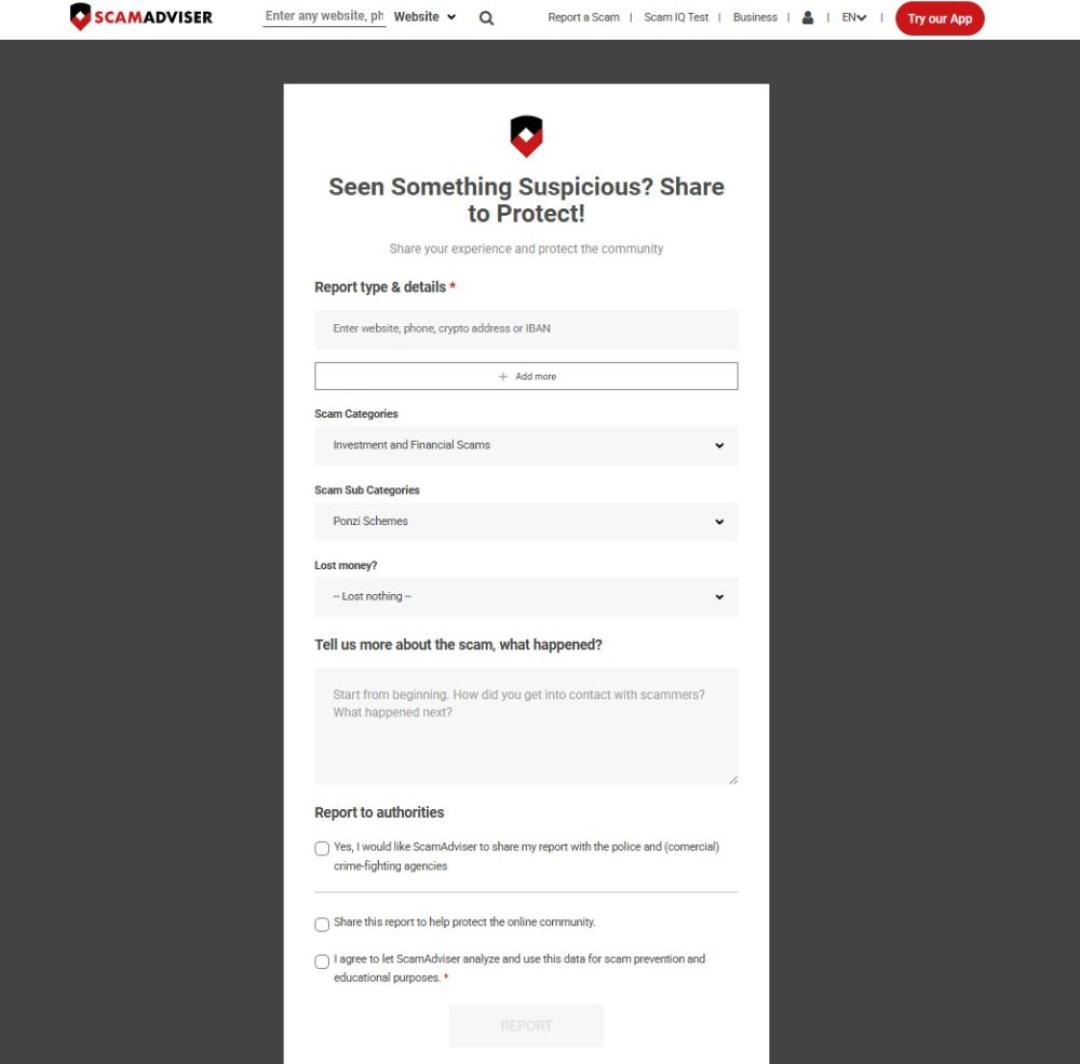
You can easily report a scam using ScamAdviser and take part in our goal to make the internet a safer place (Image Credit: ScamAdviser)
Losing money through a fake investment app can put you in front of another group of scammers.
They may contact you after you post about the problem online. Someone might claim to be a recovery specialist, blockchain expert, lawyer, or government representative who has found your stolen cryptocurrency.
Then comes another fee.
Investor.gov has warned that previous investment scam victims can be targeted again with recovery schemes. ScamAdviser also covers crypto recovery scams, where victims are asked to pay for services that never recover the missing funds.
Treat anyone who guarantees they can recover stolen crypto with the same caution you would give someone guaranteeing investment profits.
AI money-making app scams can look believable because the technology they talk about is real. AI is already used in finance, and automated trading does exist. What you should judge is the promise being made to you, who controls your money, whether the company can be verified, and what happens when you ask for your money back.
Can an AI trading bot guarantee profits?
No, AI can assist trading decisions, but it cannot remove market risk or guarantee profitable trades.
Why does my AI trading app show profits but not let me withdraw?
A scam platform can display invented profits inside your account even when no genuine trading took place.
Why is the app asking me to pay tax before withdrawing?
A demand for another payment before releasing your existing balance can match an advance-fee scam pattern.
Can a fake investment app appear in an official app store?
Yes, an app-store listing does not prove that the company or investment service behind the app is legitimate.
What should I do after paying an AI investment scam?
Stop further payments, save your evidence, contact the payment provider quickly, secure affected accounts, and report the fraud.
