
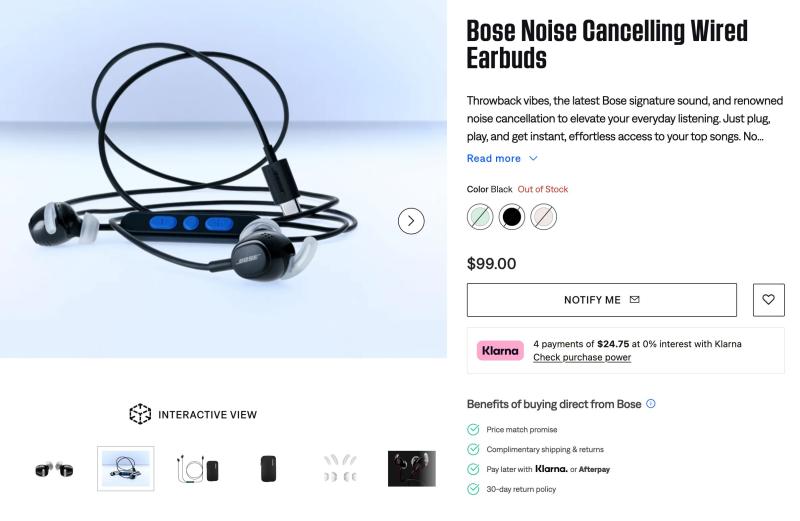
To be entirely clear from the outset, the Bose Noise Cancelling Wired Earbuds are a completely legitimate product manufactured by a reputable brand; the product itself is not a scam. Instead, because this trending gadget has captured significant public attention, malicious third party scammers may attempt to misuse the product's name and popularity to deceive shoppers.
This article provides a completely unbiased review of the Bose Noise Cancelling Wired Earbuds to evaluate whether they may be worth your investment, while also highlighting the external scams that may exploit the product's name.
These earbuds utilize a direct USB-C connection to draw power directly from a compatible source device, which allows the built-in digital signal processor to operate. Publicly available specifications indicate a cable length of approximately 128 cm and an IPX4 water resistance rating.
Because they rely on a wired configuration, they appear to eliminate the audio lag typically associated with wireless Bluetooth connections, positioning them as a potential option for mobile gaming and video consumption.
Battery-Free Operation:
The design allows the earbuds to run without an internal battery, which means users may not have to worry about battery degradation over time or recharging a case.
Active Noise Cancellation:
The inclusion of Bose QuietControl technology means the product may successfully mitigate low frequency ambient sounds, a feature that is relatively rare for wired USB-C earphones.
Zero-Latency Audio:
A physical USB-C connection suggests that audio transmission may remain instantaneous and lossless, which could benefit users who edit media or play fast-paced games.
Physical Controls and Comfort:
The packaging includes multiple sizes of ear tips and stability bands, alongside an inline remote that may offer convenient volume and playback management.
Premium Pricing:
At $99 USD, the cost may seem relatively high when compared to basic, non-ANC wired USB-C alternatives available on the market.
Device Compatibility Limits:
The product relies exclusively on a powered USB-C port, which means it may not function with older 3.5 mm headphone jacks, even if an adapter is utilized.
Physical Tethering:
The 128 cm cord means users remain physically attached to their devices, which may not appeal to those who prefer the total freedom of wireless alternatives.
ANC Thresholds:
Based on early public feedback, the noise cancellation performance may not fully match the isolating depth found in Bose's higher-end wireless flagships, such as the $299 Bose QuietComfort Ultra Earbuds (2nd Gen). This variation appears to stem from a four-microphone layout compared to the more comprehensive acoustic arrays found on premium models.
Due to the product's unique features and $99 price tag, bad actors may attempt to target unsuspecting shoppers. Consumers should remain vigilant against several potential deceptive practices that misuse the product name. To help shoppers identify fraudulent channels, official consumer warnings regarding unauthorized sellers can be found directly on the Bose Counterfeit Products Guide. Potential buyer vulnerabilities include:
Scammers may create unauthorized, lookalike e-commerce websites or sponsor misleading social media advertisements. These listings may advertise the product at heavily discounted prices, such as $29 or $39, under the guise of a "clearance sale" or something similar. Buyers who engage with these sites may receive low quality generic items, or they may expose their financial information to unauthorized third parties.
Phishing campaigns via email, text, or pop-up messages may claim that the user has won a free pair of these earbuds or is eligible to receive them after completing a brief survey. These schemes frequently request a small "shipping fee", which appears to be a tactic designed to harvest credit card details for fraudulent, recurring charges.
Unverified sellers on third party marketplace platforms may offer "open-box" or "unwanted gift" items at slightly reduced prices to appear legitimate. While the external packaging and physical shell may look identical to the genuine product, the internal components may lack the sophisticated digital processing required to run active noise cancellation through a USB-C port.
In conclusion, the Bose Noise Cancelling Wired Earbuds present a highly specialized value proposition for modern audio consumers. Publicly available details indicate that for individuals prioritizing zero-latency audio transmission, consistent battery-free active noise cancellation, and freedom from charging cycles, the $99 USD investment may appear well justified.
Conversely, those who favor total freedom of movement, deep app-based customization, or the audio isolation profiles found in the brand's premium $299 wireless offerings may feel the product does not align with their preferences.
Ultimately, because the Bose Noise Cancelling Wired Earbuds remain a highly trending topic, the market may continue to see external bad actors attempting to exploit the product name. To mitigate the risk of falling victim to deceptive listings, counterfeit hardware, or online financial scams, sourcing the earbuds directly from the official manufacturer or verified, authorized retail partners appears to be the safest path forward.
If an online promotion or retail pricing threshold for these earbuds seems unusually low, it remains highly prudent to treat the offer as unauthorized.
The information provided in this article is intended for general informational, educational, and awareness purposes only. The product evaluations, potential pros, and potential cons discussed herein are based strictly on publicly available specifications and early industry reviews; they do not represent definitive laboratory testing or permanent product performance guarantees.
References to external fraudulent schemes, lookalike websites, or potential counterfeits represent an analysis of common consumer threats within the e-commerce landscape and do not imply that the legitimate manufacturer is associated with, responsible for, or involved in any fraudulent activity.
The names, images, logos, and brands mentioned, including "Bose" and specific product models, are the registered trademarks of their respective owners. Readers are strongly advised to perform their own independent research, verify pricing thresholds directly on official corporate platforms, and double check physical retail authorization credentials before sharing financial data or making purchase decisions.
This article has been written by a Scam Fighter Contributor, De-Reviews.com Team. If you believe the article above contains inaccuracies or needs to include relevant information, please contact ScamAdviser.com using this form.
De-Reviews.com Team is a group of scam researchers, editors, and online safety advocates dedicated to exposing online fraud and helping consumers stay safe online. The team has been investigating scams, fraudulent websites, phishing campaigns, and other online threats since 2014. Read the Full Author Profile.
