
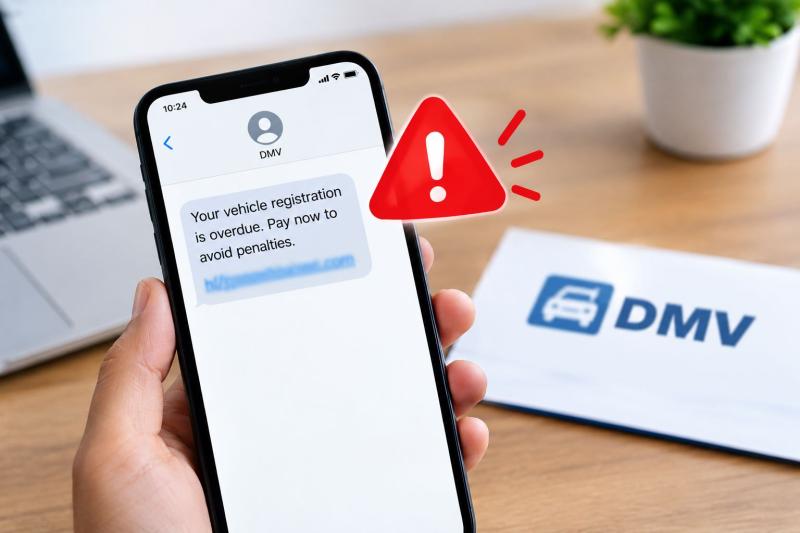
Dmvkwt, Dmvkpd, and Dmvcks text or email messages claiming to be from the "DMV" should be treated as scams when they unexpectedly demand payment through unfamiliar links. The Department of Motor Vehicles (DMV) is a legitimate government agency, although the agency's name can differ from state to state. The concern is with messages that impersonate a DMV and pressure people into clicking a link, paying an alleged traffic balance, or providing sensitive information.
Recently, many drivers have reported receiving unexpected text messages and emails containing links to websites such as Dmvkwt, Dmvcks, or Dmvkpd. These messages may claim that the recipient has an unpaid traffic ticket, registration problem, or another violation and must act immediately to avoid serious consequences.
Before clicking any link or entering credit card details, it is important to examine how the message works and whether it matches the normal communication methods of the relevant government agency.
These messages commonly follow a specific pattern. First, they create high urgency. The recipient may be told that immediate action is required to prevent license suspension, vehicle registration suspension, vehicle impoundment, additional fees, or other enforcement measures.
Next, the message provides a direct action. You may be instructed to click a link containing a name such as Dmvkwt, Dmvcks, or Dmvkpd to pay a supposed balance or update your information.
The sender may also use a vague identification, such as:
The message may look official, but an official sounding sender name does not prove that the communication actually came from your state's DMV.
DMV impersonation texts claim that recipients have overdue traffic tickets and threaten suspension of driving privileges, registration, additional fees, prosecution, or damage to their credit if they do not pay.
One of the first things to examine is the website address. Official government websites generally use government-controlled domains, and many state DMV websites use .gov. USA.gov provides a state-by-state directory that helps people locate official motor vehicle services.
By contrast, links using unfamiliar or randomized names such as Dmvkwt, Dmvcks, or Dmvkpd should not automatically be trusted simply because they contain the letters DMV.
Platforms using Dmvkwt, Dmvcks & Dmvkpd typically rely on commercial extensions like .com, .net, or .org. A state agency will not use randomized letter strings to process official citizen records or financial transactions.
The communication method is another important point. Traditional government notices concerning matters such as license points, registration problems, or fines may be sent through documented channels, including the U.S. Postal Service to the address on file, depending on the state and the type of notice.
This does not mean every legitimate government communication must arrive by mail. Some states allow residents to opt in to text messages or emails for routine matters, such as registration renewals reminders, they rarely initiate first time contact regarding strict penalties, fines, or legal threats via SMS.
The important distinction is that an unexpected message demanding immediate payment for a serious penalty should not automatically be trusted simply because it mentions the DMV. A first time text threatening severe legal or driving related consequences deserves independent verification.
Another major warning sign is the type of information the linked website asks you to provide.
A suspicious payment page may request:
Government agencies already maintain information about the people and vehicles they regulate. If an unexpected link suddenly asks you to provide highly sensitive information merely to see an alleged traffic notice, stop before entering anything.
Be particularly cautious when the website requests your SSN, full banking credentials, or credit card number immediately.
Here is an example of the type of notification people may receive:
"[State] Department of Vehicles (DMV) Final Notice: Enforcement Penalties Begin on [Date].
Our records show that as of today, you still have an outstanding traffic ticket. In accordance with [State] Administrative Code 15C-16.003, if vou do not complete payment by [Date], we will take the following actions:
1. Report to the DMV violation database
2. Suspend your vehicle registration starting [Date]
3. Suspend driving privileges for 30 days
4. Transfer to a toll booth and charge a 35% service fee
5. You may be prosecuted and your credit core will be affected
Pay Now:
[Dmvkwt, Dmvcks, Dmvkpd, or similar links]
Please pay immediately before enforcement to avoid license suspension and further legal disputes.
(Reply Y and re-open this message to click the link, or copy it to your browser.)"
There are several warning signs in this example which include:
The message creates fear through an immediate deadline. It threatens serious consequences, including registration and driving privilege suspension. It demands payment through an unfamiliar link and encourages the recipient to reply "Y" to activate the link.
It also contains unusual wording and typographical errors such as "vou" instead of "you" and "credit core" instead of "credit score." When these details are combined with an unexpected payment request and an unfamiliar website, they should raise serious concerns.
The same basic approach can appear in different forms.
"Final Notice" Text:
A message may say:
"Final notice: Your driver's license will be suspended unless you pay your outstanding traffic balance today."
It then provides a payment link.
QR Code Message:
Another version may contain a QR code and claim that you must scan it to pay a traffic violation or avoid a court hearing. Such links or QR codes may be used to collect personal information, steal money, or deliver malicious software.
Registration Renewal Message:
A message may claim that your vehicle registration has expired and ask you to pay a small amount immediately. The low amount can make the request appear harmless, but the payment page may be designed to collect your card information.
License Verification Message:
Another version may claim that your driver's license information needs to be verified and ask you to enter your driver's license number, SSN, date of birth, or payment information.
The specific story can change, but the basic goal remains the same: make you react quickly instead of verifying the message.
Scammers know that people are more likely to make mistakes when they are frightened.
A message saying:
is designed to push you into making a quick decision. Do not allow the deadline in a text message to decide what you do next.
If you really have an unpaid traffic ticket, you can verify it independently through the appropriate state or local government agency.
Do Not Click the Link:
Do not click links in unexpected DMV texts or emails. Unsolicited links can take you to unverified landing pages and may potentially trigger unwanted downloads, redirects, or other harmful activity.
Do Not Reply "Y":
If the message tells you to reply Y or another letter to activate a link, do not do it. Responding can also confirm that your telephone number is active.
Verify Independently:
If you suspect you truly owe a traffic fine or have a registration issue, open your browser and manually type in the official address of your local state's DMV (ensuring it ends in .gov). Log into your official state portal or call the customer service line found on your physical driver's license to check your status.
Never Pay Through the Suspicious Link:
If you really owe a traffic fine, pay it through the verified government or court website, not through a payment page supplied by an unexpected text.
Report the Message:
Unwanted texts can be reported through your phone's junk or spam reporting function. You can also forward unwanted text messages to 7726 (SPAM), which helps wireless carriers identify and address unwanted messages, helping block the distribution of similar messages to other consumers.
Do not panic, but take the situation seriously and act immediately as below:
If you want to quickly check unfamiliar websites before interacting with them, you can download and use our app to check websites such as Dmvkwt, Dmvcks, Dmvkpd, and other unfamiliar domains.
While the Department of Motor Vehicles is a fully legitimate government institution, the specific text messages and emails pointing to domains like Dmvkwt, Dmvcks and Dmvkpd lack the security protocols, domain structures, and verified channels used by official state agencies.
Because these platforms deviate entirely from the mandatory “.gov” architecture required for official digital government services, interacting with them carries severe security risks.
For your safety, these specific communications should be treated as entirely unauthorized, and all vehicle or license inquiries should be handled directly through official state channels.
The safest rule is simple: Do not let an unexpected DMV message tell you where to pay. Verify the issue first, then use the official government channel.
The information in this article is provided for educational and awareness purposes. Company names, phone numbers, sender names, and other details referenced may have been impersonated, spoofed, or otherwise misused by scammers. Their appearance in this article does not necessarily identify the legitimate company, owner of a phone number or account as being involved in fraudulent activity.
This article has been written by a Scam Fighter Contributor, De-Reviews.com Team. If you believe the article above contains inaccuracies or needs to include relevant information, please contact ScamAdviser.com using this form.
De-Reviews.com Team is a group of scam researchers, editors, and online safety advocates dedicated to exposing online fraud and helping consumers stay safe online. The team has been investigating scams, fraudulent websites, phishing campaigns, and other online threats since 2014. Read the Full Author Profile.
