
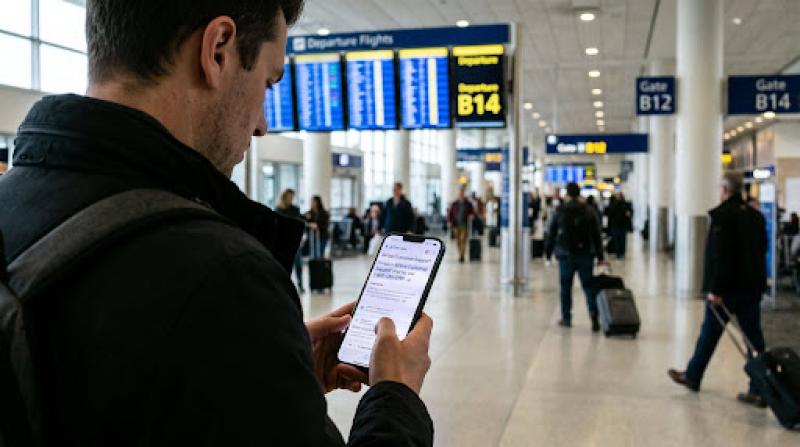
Marcia Hannon just wanted to fix a tight connection. She was organizing flights for a group of six travelers in their 70s and 80s flying from Boston to Geneva through Zurich when Swiss International Air Lines changed one of their itineraries. The phone number listed on their tickets was disconnected, and the airline's customer service chat queue was backed up with dozens of people ahead of her.
So she did what millions of travelers do every day: she asked Google.
The number Google displayed connected immediately. The "representative" on the line promised to rebook the group, cancel the old flights, and issue a refund. He then emailed a payment authorization form featuring an official Swiss logo. Minutes after signing, American Express alerted Hannon to an attempted $4,500 charge originating from an unrelated online marketplace. Fortunately, Amex flagged the fraud before the money left her account.
Hannon's near-miss serves as the centerpiece of an in-depth investigation by Michelle Couch-Friedman, ombudsman columnist at The Points Guy. The report reveals how fraudulent call centers are exploiting Google's AI Overviews and AI Mode to feed travelers bogus customer service numbers.
The technique is known in cybersecurity circles as authority hijacking.
Instead of building new scam websites from scratch, fraudsters target highly trusted, reputable domains—especially university (.edu) and government (.gov) platforms. Scammers identify weak security settings, outdated software, or unauthenticated public document-upload forms to host keyword-stuffed web pages and PDF files loaded with fake "helpline" and "customer service" numbers.
Because search engines treat .edu and .gov root domains as authoritative, these malicious uploads get indexed quickly. The pages are not designed for human eyes; they are written specifically to trick web crawlers.
Google’s AI tools then scrape those rogue files, synthesize the text, and present the fraudulent numbers at the top of the search page as official direct-support channels or "secret escalation lines" designed to bypass automated phone trees. Because the AI displays the number right on the results page, users call it without ever viewing the source URL.
Couch-Friedman traced bogus numbers scraped by Google's AI to:
The fraud is not limited to air travel. When researchers tested queries for help changing a Royal Caribbean reservation, Google’s AI Mode presented a scam phone number alongside the real support line, citing a compromised .gov page as its source.
In another test searching for Expedia’s 24-hour customer service, Google’s AI surfaced only one number—leading directly to an offshore scam call center. The source citation? A spam page hosted directly on a Google.com sub-domain.
While Google removed the flagged pages after being alerted, bad actors continually rotate domains. Subsequent searches surfaced new rogue files hosted on municipal portals, such as the City of Freeport, Texas, and community sites in Florida.
A Google spokesperson told The Points Guy that its anti-spam systems prevent the vast majority of malicious content from indexing, noting that the company takes rapid action to take down policy-violating pages as soon as they are identified.
Once a traveler calls, the fake agent operates with calculated urgency:
If you suspect you have spoken to an impersonator, call your bank immediately to halt pending transactions, notify your carrier that your booking code has been compromised, and verify unknown booking links using ScamAdviser's website checker. You can also log incidents on ScamAdviser’s Report a Scam page.
Adam Collins is a cybersecurity researcher at ScamAdviser who operates under a pseudonym for privacy and security. With over four years on the digital frontlines, he specialises in translating complex threats into actionable advice. His mission: exposing red flags so you can navigate the web with confidence.
