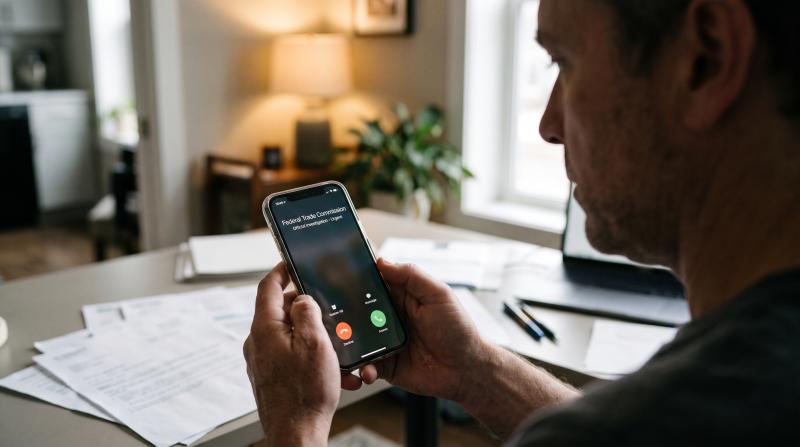
Your phone rings. The caller claims to be an agent with the Federal Trade Commission (FTC). They say a mobile number registered in your name is actively being used to orchestrate fraudulent schemes in another country. To make it sound official, they rattle off a badge number. Then comes the ultimatum: cooperate immediately, or your phone number will be disconnected within the hour.
It sounds alarming. That panic is calculated.
The FTC has issued an urgent warning outlining this multi-layered variation of the classic government impersonator scam. The agency’s stance is unequivocal: the genuine FTC never calls consumers to threaten phone deactivations, and anyone making that claim is an impostor.
How the Fake FTC Call Plays Out
The scheme operates in coordinated phases designed to break down a victim's skepticism:
- Stage 1: The Manufactured Crisis. A bogus "FTC investigator" tells you your personal identity and phone account are linked to serious overseas criminal operations. They cite fabricated badge numbers and case files, warning that non-compliance will lead to immediate service termination and referral to prosecutors.
- Stage 2: The "Police Officer" Transfer. To simulate procedural legitimacy, the caller transfers the line to a supposed "law enforcement officer" or "detective" to document an official statement. If you hesitate, the caller may even tell you to hang up and look up the department yourself—dictating specific, manipulated search terms or spoofed local agency directories that route you straight back to the fraud ring's call center.
- Stage 3: Isolation and Intimidation. The phony detective requests photos of your government-issued ID, Social Security number, and employment details under the guise of building your defense file, explicitly instructing you not to discuss the matter with anyone due to an active gag order.
- Stage 4: The Extortion Demand. The situation escalates to an imminent threat of extradition or arrest for the crimes tied to your number. The caller presents an escape hatch: wire a refundable "security deposit" or "court bond" via cryptocurrency, wire transfer, or payment apps to temporarily freeze the warrant while the case is cleared.
None of it is True
The FTC notes that federal agencies operate under strict regulatory procedures. A real FTC representative will never:
- Demand money, ask for payment to clear a legal inquiry, or connect you to third parties demanding funds.
- Threaten to cancel, shut off, or deactivate your mobile phone service.
- Direct you to keep investigations secret from family, attorneys, or financial institutions.
- Send text messages containing photos of official badges or federal credentials as "proof" of identity.
Why This Scam Bypasses Common Sense
This scam manipulates two powerful psychological levers: sudden panic and the illusion of control. Accusations of transnational criminal involvement trigger immediate distress, while the threat of losing phone access makes targets act impulsively.
By inviting the victim to "verify" the situation through transfers or scripted online lookups, the fraudsters create false confidence. In reality, the victim remains trapped inside the scammers' communications loop the entire time.
The demand for absolute secrecy is the linchpin. Fraudsters know that a five-minute conversation with a bank teller, friend, or relative will expose the deception. Isolation keeps the pressure intact until funds are transferred.
What to Do If You Receive This Call
- Hang up immediately: Do not debate the caller, share identifying data, or confirm partial information they read to you.
- Never use numbers provided by the caller: If you wish to confirm an agency's contact, search the official agency website directly (.gov domains) using a separate web browser.
- Break the silence: Discuss unexpected legal threats with someone you trust before taking financial action.
- Do not pay to avoid arrest: No legitimate government agency accepts payment via gift cards, peer-to-peer apps, cryptocurrency, or wire transfers to cancel legal action.
If an incoming caller directs you to an unfamiliar link or portal, inspect the URL with ScamAdviser’s free website checker, and use the ScamAdviser app to filter suspicious calls. Report impersonation attempts directly to the FTC at ReportFraud.ftc.gov and submit the details through ScamAdviser’s Report a Scam page.
Adam Collins is a cybersecurity researcher at ScamAdviser who operates under a pseudonym for privacy and security. With over four years on the digital frontlines, he specialises in translating complex threats into actionable advice. His mission: exposing red flags so you can navigate the web with confidence.
See Full Bio