
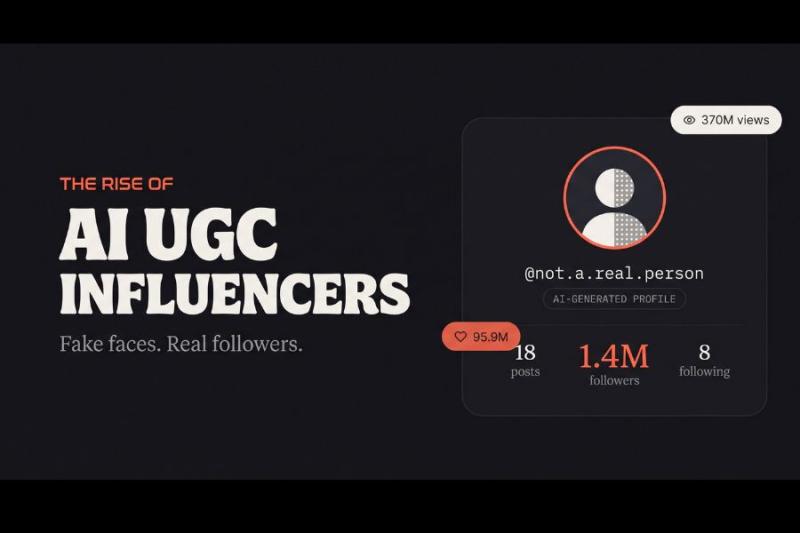
A few years ago, a fake person with millions of views would have sounded like science fiction. Today, one creator with the right tools can build one in days.
Just look at two Instagram accounts that went viral in late 2026. Between them, charles.robinson62 and abu.shalab have gathered roughly 1.4 million followers and hundreds of millions of views, and the men in their videos appear to be entirely AI-generated.
Here's what AI UGC influencers are, why they're multiplying so quickly, how they make money, and how to tell when you're looking at one.
Key Takeaways
UGC stands for user-generated content: posts that look like they were made by an ordinary person, such as product reviews, demos, reactions or "day in my life" videos.
An AI UGC influencer is a made-up person who posts that kind of content. The face, the voice and the videos are created by AI tools, but the account is presented as if a real human runs it.
That's the key difference from traditional virtual influencers like Lil Miquela, whose digital nature is part of the brand. Many AI UGC accounts are designed to pass as real.
The clearest illustration of this trend is a pair of accounts highlighted in an October 6, 2026 analysis by Opinion AI, which stated plainly that neither man is real.


Both accounts follow the same formula: an instantly memorable character, placed again and again in attention-grabbing videos, with a money link waiting in the bio.
Read our full breakdowns: Is Charles Robinson62 Real or Fake? and Is Abu Shalab Real or AI?
AI video tools can now keep a face consistent across dozens of clips, make it talk and drop it into realistic settings. According to Dupple's 2026 guide to creating an AI influencer, a single person can now build a convincing character from scratch, with no actors, film crews or locations required.
The same guide reports that micro AI influencer accounts with 10,000 to 50,000 followers can charge $500 to $2,000 per sponsored post, while accounts with more than 100,000 followers can command $5,000 to $20,000. At the top end, it says Lil Miquela earns over $100,000 a month from brand deals.
Opinion AI estimates that Charles Robinson62 and Abu Shalab together may have already generated between $369,000 and $1.8 million. That figure is the author's estimate and has not been independently confirmed.
The broader virtual influencer market is growing at a remarkable pace. The Business Research Company projects it will grow from $11.22 billion in 2025 to $15.9 billion in 2026, and reach $62.67 billion by 2030.
Opinion AI sums up the playbook in three steps:
AI UGC accounts typically monetize their audience through one or more of these channels:
That last model is already industrial in scale. A 404 Media investigation reviewed more than 1,000 AI-generated Instagram accounts and found it is now trivially easy to create and monetize them with off-the-shelf tools. In another case, The Washington Post exposed "Jessica Foster," an AI persona that gained about 1 million followers and steered users to subscription platforms before Instagram removed it. Researchers at Indicator separately identified half a dozen synthetic influencers with roughly 1 million combined followers, most of which never disclosed they were AI.
On August 31, 2026, Instagram announced its "AI-generated profile" label for accounts whose main person is AI-made. It replaces the older, optional "AI creator" label.
Instagram says it will detect unlabeled AI profiles and may limit their reach, while accounts that believe they were flagged by mistake can appeal through Account Status.
Importantly, Instagram isn't banning virtual influencers. It simply wants people to know what they're watching.
Studying the face is no longer enough. AI image and video quality has improved so much that visual checks alone are unreliable. Behavior gives far more away.
Detection tools aren't perfect, and operators who read checklists like this one can adjust to avoid them. Use several signals together rather than relying on just one.
Most of these accounts may be pure entertainment. The risk begins when a fake face earns trust and then points that trust at a purchase.
A real influencer can be held accountable for what they promote. A fictional character can't. When an account uses a synthetic person to send you somewhere money moves fast, such as a crypto token or a paid subscription, it's time to slow down.
Frequently Asked Questions
What is an AI UGC influencer?
An AI UGC influencer is a fictional, AI-generated person who posts ordinary-looking social content such as reviews, demos and lifestyle clips, often while presenting as a real human.
Are Charles Robinson62 and Abu Shalab real people?
All available evidence suggests no. Opinion AI's October 2026 analysis identified both as AI-generated characters.
How much do AI influencers make?
Earnings vary widely. Industry guides report $500 to $2,000 per sponsored post for accounts with 10,000 to 50,000 followers, and $5,000 to $20,000 for accounts above 100,000 followers.
Is it illegal to run an AI influencer?
Running an AI influencer isn't inherently illegal, but Instagram now expects such accounts to carry its AI-generated profile label and may limit the reach of those that don't.
How can I tell if an Instagram influencer is AI?
Look for rapid growth on a new account, a thin online identity, repetitive comments, money links in the bio, visual glitches and the absence of any presence outside Instagram.
AI UGC influencers are no longer a niche experiment. With cheap tools, viral formulas and a market projected to quadruple by 2030, expect many more accounts like Charles Robinson62 and Abu Shalab.
The faces may be fake, but the views, the money and the risks are real. Stay curious, check before you trust, and keep your wallet closed.
Adam Collins is a cybersecurity researcher at ScamAdviser who operates under a pseudonym for privacy and security. With over four years on the digital frontlines, he specialises in translating complex threats into actionable advice. His mission: exposing red flags so you can navigate the web with confidence.
