
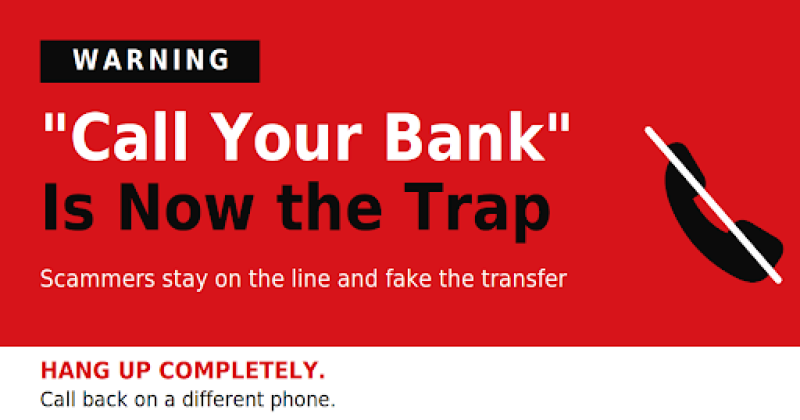
"Hang up and call the number on the back of your card." It is one of the most common pieces of anti-scam advice. Now scammers are turning it against their victims.
In a new twist on bank impersonation scams, fraudsters tell you to call your bank's official number, then pretend to connect you to it while you are still talking to them. You dial a number you trust, hear what sounds like a bank representative, and never realise the scammers are still on the line. These fake "official phone" calls are part of a wider wave of impostor scams that, in some cases, have drained retirement savings worth millions.
WSPA 7News in South Carolina reported on an Upstate woman, identified as Pitts, who was caught by this trick. It started with a pop-up on her computer showing a 1-800 number. When she called, a man claimed her bank accounts had been hacked.
Then came the clever part. He told her to call the customer service number on the back of her own bank card to put her accounts on a high-security alert for 48 hours. Because she dialled the number herself, Pitts told WSPA, she felt the call was legitimate.
In reality, the scammers claimed to have moved her to a "secure line" so she could reach the bank, but they never did. She was still talking to them the whole time. Her husband, David, only realised what was happening when he looked at her computer and saw the framed pop-up with the 1-800 number.
The stakes can be enormous. NBC4 Investigates reporter Dennis Broad reported that a retired senior in the San Fernando Valley was targeted in a $5 million phone scam that played out over about six months, according to the LAPD.
Police said a man calling from abroad told the victim his identification had been misused and he was in legal trouble. The caller then persuaded him to deposit his money into several accounts so it could supposedly be checked. The victim eventually told a family member, and the LAPD was brought in. As of the report, no arrests had been made and the money had not been recovered.
The LAPD warned that groups are targeting seniors to obtain details such as dates of birth and passwords to access bank accounts, and urged anyone with doubts to contact their bank and the police directly.
The scam usually follows a script:
Scammers may also use spoofed caller ID so their number looks like your bank, the police or a government agency.
Call your bank's fraud team immediately using the number on your card or statement, from a separate phone. Report the scam to local police, the FBI's Internet Crime Complaint Center (IC3) and the FTC at ReportFraud.ftc.gov. You can also Report a Scam to help warn others, and check suspicious websites with a website checker.
Dialling a trusted number only protects you if you are really calling that number on a fresh line. Scammers are now faking the transfer itself, so always hang up completely and call your bank yourself.
Adam Collins is a cybersecurity researcher at ScamAdviser who operates under a pseudonym for privacy and security. With over four years on the digital frontlines, he specialises in translating complex threats into actionable advice. His mission: exposing red flags so you can navigate the web with confidence.
Sources: WSPA 7News and NBC4 Investigates (NBC Los Angeles), reporting by Dennis Broad.
