
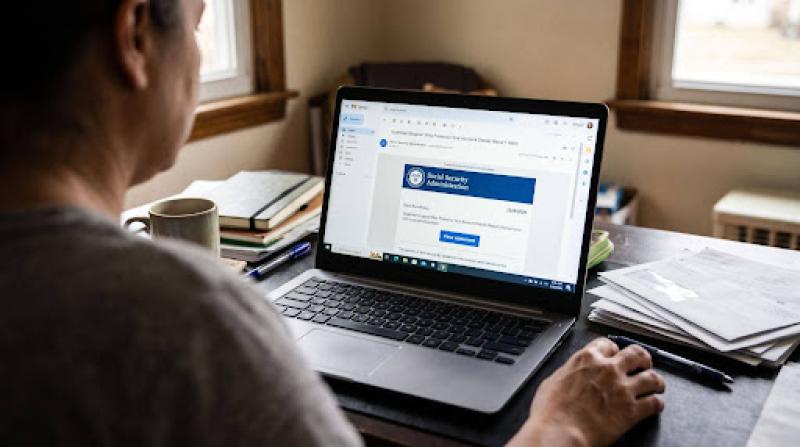
No threats. No countdowns. No demands for payment. Just a polite email saying your Social Security statement is ready, with a neat blue button inviting you to take a look.
That is exactly what makes this message so dangerous.
Tech journalist Kurt "CyberGuy" Knutsson on Fox News flagged a highly deceptive email campaign that has been actively landing in inboxes, illustrating how cybercriminals are adopting a quieter, more convincing approach. It marks an ongoing wave of fraud that prompted the Social Security Administration (SSA) Office of the Inspector General (OIG) to issue an urgent surge warning after identifying a massive spike in bogus "Statement Ready" emails.
The message arrives with a non-threatening, bureaucratic subject line: "Statement Support Was Posted to Your Account Details Report." The sender’s name appears as "Social Security Administrator," which seems legitimate at a first glance.
Inside, the email carries the official Social Security Administration logo, standard government-style formatting, and realistic-sounding text. It announces that your Social Security statement is available, inviting you to review your earnings record and benefit estimates online.
There is a tidy box showing the statement status as "Ready" and a prominent blue "View statement" button. It even displays what appears to be the official Social Security web address at the bottom to give it an extra layer of credibility.
For anyone skimming their inbox during a busy workday, it easily passes as a routine notification. Scammers know that the SSA does, in fact, send occasional email reminders to people with a my Social Security account—typically three months before their birthday—and they have meticulously copied the template.
The elaborate disguise falls apart the moment you expand the sender details. Behind the "Social Security Administrator" display name is a random, third-party address hosted on a domain like loradmiadministraciones.com (or similar non-government URLs), which has absolutely no connection to the federal government and does not end in .gov.
Email display names can be set to anything, meaning an official-looking title is worthless without a matching official sender address. Other subtle red flags include generic greetings like "Dear Beneficiary," rather than your actual name.
The "View statement" button is the trap. Links in fake SSA emails redirect you to sophisticated, lookalike websites designed to harvest your credentials. If you enter your username, password, or Social Security number (SSN), the scammers can use them to:
According to Assistant Inspector General for Audit Michelle L. Anderson, fraudsters use problems, benefits, or official-looking documents to steal personal information or money.
You never need to click an emailed link to check your benefits. Always bypass the email and go directly to the source:
Report any fraudulent Social Security emails directly to the SSA OIG at oig.ssa.gov/report. You can also run suspicious URLs or messages through ScamAdviser’s free website checker and help warn the public by sharing details on the ScamAdviser Report a Scam page.
Adam Collins is a cybersecurity researcher at ScamAdviser who operates under a pseudonym for privacy and security. With over four years on the digital frontlines, he specialises in translating complex threats into actionable advice. His mission: exposing red flags so you can navigate the web with confidence.
