
Looking for a safe place to watch or sell porn videos? Before you subscribe or upload content, here's what you need to know about Fansly's security, scam risks, and whether it's a platform you can actually trust.
In a Nutshell
Fansly exists because OnlyFans made one of the biggest corporate missteps in recent internet history. In August 2021, OnlyFans announced it was banning adult content. Creators panicked. Thousands migrated to Fansly overnight. OnlyFans reversed the ban within days — but the damage was done. Fansly had its moment, and it never looked back.
Today, Fansly hosts over 5 million creators and has paid out hundreds of millions of dollars in creator earnings. It is one of the fastest-growing adult content platforms in the world, and it is doing something its larger rival still refuses to do: helping subscribers actually discover new creators through a built-in Explore page.
But "fast-growing" and "safe" are not the same thing. Fansly is a legitimate platform. It is not a scam. ScamAdviser rates fansly.com as High Trust with a Tranco popularity ranking of 180, a valid SSL certificate, and clean signals from DNSFilter and Maltiverse. What it is, however, is a younger platform with less mature moderation infrastructure, a scam ecosystem that has grown up specifically around it, and a few policies that can genuinely hurt creators and subscribers if they don't know about them going in.
Quick verdict: Fansly is safe to use. It is not a scam site. The platform processes real payments, pays out to creators, and has solid security fundamentals. The risks are behavioral and ecosystem-level: fake management agencies, phishing attacks, the $100 payout threshold, and an AI content policy that was reversed in late 2025 and is being enforced inconsistently. Read the full picture before you sign up.
ScamAdviser analyzed fansly.com and returned a high trust rating. The domain has been active since 2020, carries a valid SSL certificate, and registers a Tranco popularity ranking of 180 — placing it firmly in the high-traffic tier of the web. Both DNSFilter and Maltiverse classify it as safe. No malware flags, no phishing indicators, no blacklist listings.
The positive technical signals:
The two flags ScamAdviser notes:
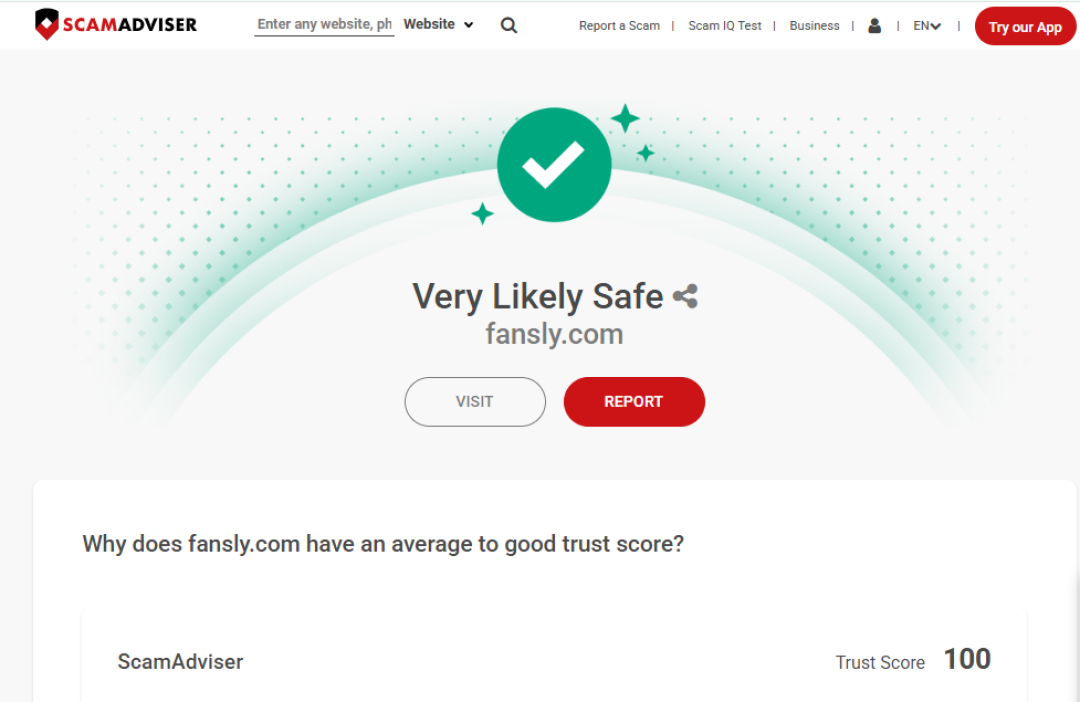
The technical conclusion is clear: fansly.com is not a fraudulent site. Your device will not be infected, your card details are not at risk from the platform itself, and your payments go through legitimate infrastructure. The risks that matter on Fansly are not in the code. They are in the ecosystem that has grown up around it.
Most Fansly reviews compare it to OnlyFans on features. That comparison matters for safety too, because the differences between the two platforms create specific risk profiles that users need to understand.
Fansly's signature feature is its Explore page: a browsable, filterable discovery system that surfaces creators to potential subscribers based on tags, categories, and engagement. OnlyFans has no equivalent. You cannot browse OnlyFans without knowing who you're looking for.
This is genuinely useful. It means subscribers can find new creators without relying on external social media. But it also means Fansly attracts a higher volume of new, unverified-by-reputation creators. On OnlyFans, most subscribers find creators through social media links, which adds an informal trust layer. On Fansly, you might subscribe to someone you found through the Explore page with no prior context. That increases the risk of encountering a creator who doesn't deliver.
Fansly takes a flat 20% commission on all earnings. This is identical to OnlyFans and significantly better than ManyVids' 40% on clip sales.
The flat rate is transparent and consistent. No hidden tiers, no category-based variations. For subscribers, this matters because it signals a platform that isn't squeezing creators into desperation — which tends to correlate with fewer scammy behaviors on the creator side.
Fansly has no iOS or Android app. Due to Apple App Store and Google Play policies on adult content, Fansly operates exclusively through web browsers. This is not a safety risk in itself, but it does mean there is no app-store verification layer. Anyone who sends you a link to "the Fansly app" is sending you to a phishing site or malware. There is no legitimate Fansly app.
Fansly's platform security is solid. The risks that actually affect users have almost nothing to do with the platform's code — they come from the scam ecosystem that has grown up around it, and from a few policies that can catch users off guard.
This is the most prevalent and damaging scam targeting Fansly creators in 2026. It works like this: a stranger contacts you — via Fansly DMs, Instagram, Twitter, or Discord — claiming to be a "management agency" that will grow your account, handle your marketing, and increase your earnings. They ask for an upfront fee or a percentage of your future revenue.
Legitimate agencies do not cold-message creators on Fansly. The entire fake management ecosystem exists because Fansly's creator base skews newer and less experienced than OnlyFans. New creators are more likely to believe they need professional help and less likely to know what a real agency relationship looks like.
If someone contacts you unsolicited offering to manage your Fansly account, it is a scam. Every time.
Fansly creator accounts have real monetary value. A compromised account with an established subscriber base can be drained of earnings, used to push scam content to subscribers, or held for ransom. Phishing attacks arrive as:
Always navigate directly to fansly.com rather than clicking links in emails or messages. Enable two-factor authentication immediately after creating an account.
Any creator asking you to pay outside Fansly — via Venmo, Cash App, PayPal, Zelle, or crypto — is either running a scam or violating Fansly's terms of service. Off-platform payments offer no buyer protection. If the creator doesn't deliver, you have no recourse. This is the subscriber equivalent of the fake management agency scam: it bypasses every protection Fansly provides.
In late 2025, Fansly reversed its position on AI-generated content. A staff member confirmed in the r/OfficialFansly community: "AI-generated content is strictly prohibited on Fansly... this policy has been revised, and AI content is no longer acceptable under any circumstances."
The problem is enforcement. Creators report AI-generated content still flooding Fansly's Explore page while accounts posting it are terminated inconsistently, often at payout time. For subscribers, this means there is a real risk of subscribing to what appears to be a human creator but is actually an AI-generated persona. Fansly's moderation systems are not yet mature enough to catch all of it.
Fansly has stronger content protection than most platforms. It uses DRM to prevent direct video downloads, applies automatic watermarks to all content, and detects screenshots on mobile devices. None of this is foolproof.
For creators, this means content security is ultimately your responsibility. Fansly's tools reduce the risk; they do not eliminate it.
Fansly is a legitimate platform. It is not a scam. ScamAdviser's technical analysis of fansly.com confirms it as a high-trust site with clean security infrastructure, real payment processing, and genuine traffic. The platform has paid out hundreds of millions of dollars to creators since 2020. It is not going anywhere.
The risks are real, but they are behavioral and ecosystem risks, not platform risks. The platform will not steal from you. The scammers who have set up shop around it might.
For subscribers, the main risks are off-platform payment requests and AI-generated personas. Both are avoidable with simple rules:
For creators, Fansly is a strong platform with a genuine discovery advantage. The $100 payout threshold is frustrating but manageable. The AI content ban is real and being enforced, just inconsistently. The fake management agency scam is the biggest threat to your account and your income. Treat any unsolicited management offer as a scam by default.
The platform's content protection tools are better than most. Enable every one of them: automatic watermarking, geo-blocking for regions where you have personal privacy concerns, and two-factor authentication on your account. Treat the Fansly Vault as a content management tool, not a security solution. Your content is only as protected as your account credentials.
Not sure whether a Fansly creator page or a site claiming to be Fansly is legitimate? Run it through ScamAdviser app before entering any payment details.
See more interesting articles:
Is ManyVids Safe to Use? ScamAdviser Review
Is OnlyFans Safe to Use? ScamAdviser Review
14 Safe Porn Sites Worth Using in 2026
Is Fansly a scam?
No, Fansly is a legitimate adult content platform with a high trust rating, though scams are more likely to come from impersonators than the platform itself.
Is Fansly safe for subscribers?
Yes, provided you avoid off-platform payments and stay alert for fake or AI-generated creator profiles.
Does Fansly have an app?
No, Fansly is web-only, so any "Fansly app" download is likely a phishing or malware scam.
What is the Fansly payout minimum?
Creators must earn at least $100 before they can withdraw their funds.
Is AI-generated content allowed on Fansly?
No, AI-generated content is prohibited, although enforcement can be inconsistent.
How do I spot a fake Fansly site?
Only use fansly.com, as any variation of the domain is likely a phishing site.
What if a creator asks me to pay off-platform?
Never pay outside Fansly's checkout system, as off-platform payment requests are a common scam.
This article has been written by a scam fighter volunteer. If you believe the article above contains inaccuracies or needs to include relevant information, please contact ScamAdviser.com using this form.
Adam Collins is a cybersecurity researcher at ScamAdviser who operates under a pseudonym for privacy and security. With over four years on the digital frontlines, he specialises in translating complex threats into actionable advice. His mission: exposing red flags so you can navigate the web with confidence.
