
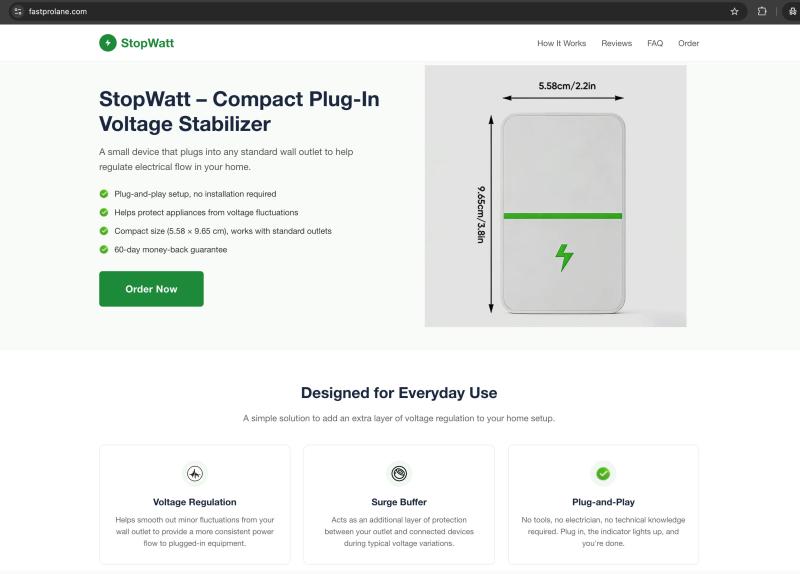
Fastprolane.com offers the StopWatt Plug-In Voltage Stabilizer and describes it as a passive device intended to help with voltage regulation. However, several aspects of the website and product information may warrant closer consideration before making a purchase. These include the site's own statement that it does not guarantee electricity bill savings, the limitations associated with a passive single-outlet device, limited customer service information, the unclear corporate connection, conflicting return policy timeframes, and testimonials that are not independently verified.
These observations do not by themselves establish the outcome of any individual purchase, but they are useful factors for consumers to review when deciding whether the product and website meet their expectations.
When consumers look into "voltage stabilizers," a common question is whether stabilizing household power will impact their monthly expenses. Fastprolane.com addresses this directly on its Frequently Asked Questions (FAQ) page.
Under the question "Will it lower my electricity bill?", the website explicitly states: "Results vary by household, appliance type, and local electrical conditions. StopWatt is designed to help with voltage regulation; we make no specific guarantee of bill savings. Individual results differ."
By explicitly noting that there is no guarantee of financial savings, the platform places the responsibility entirely on the buyer's unique home conditions. Consumers searching for a definitive method to reduce utility costs should take note of this clear disclaimer before purchasing.
According to the website, the StopWatt is a plug and play device that "connects to a standard wall outlet to help stabilize the flow of electricity" and "works passively."
As per publicly available information, in electrical engineering, true voltage stabilization for a whole house typically requires robust, heavy-duty equipment installed directly at the main breaker panel or inline with heavy appliances. These systems physically step voltage up or down during sags or surges.
A small, passive plug-in device typically contains a basic internal capacitor or a small surge protector element. While capacitors can smooth out minor electrical noise (often referred to as "dirty electricity"), they operate passively and locally. They do not alter the overall active power (kilowatt-hours) consumed by major household appliances like refrigerators or HVAC systems, which is what residential utility companies measure for billing.
A key factor in establishing consumer trust online is the availability of open corporate communication. Established e-commerce brands generally provide a physical headquarters address, a direct customer service telephone number, and verifiable corporate identity records.
A review of the Fastprolane.com infrastructure highlights a few areas where information is restricted which include:
Section 8 of the Refund Policy tells users to reach out via "the contact information available on our official website," yet a direct, copy-pasteable customer service email address or operational telephone number is missing from the legal footers.
The site features no icons or links connecting to official Facebook, Instagram, or X (formerly Twitter) brand pages. This lack of a public facing social media ecosystem prevents shoppers from seeing real time public feedback, user comments, or official brand updates.
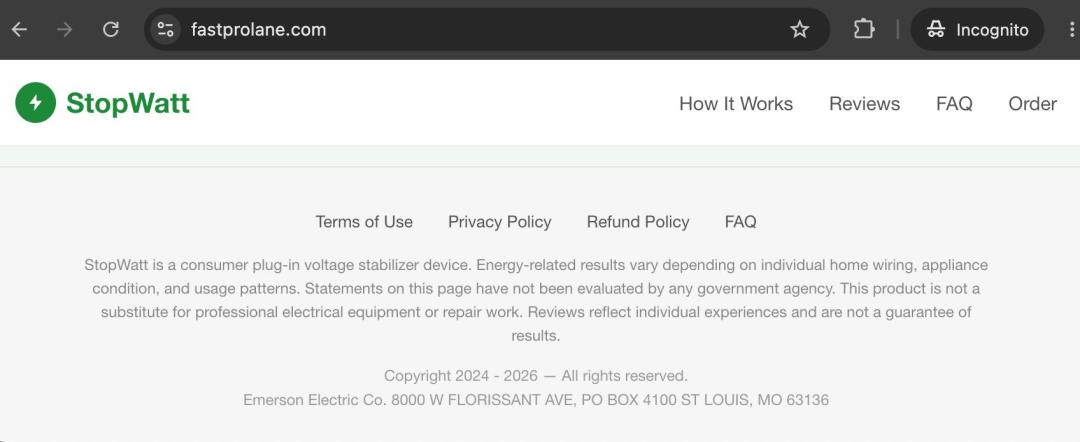
A look at the footer of Fastprolane reveals a corporate attribution listing Emerson Electric Co. at 8000 W Florissant Ave, St. Louis, MO 63136. For consumers researching the platform, this corporate association is a major point of confusion. Emerson Electric Co. is a massive, publicly traded global engineering and industrial conglomerate.
Historically, major enterprise manufacturers do not distribute small, generic consumer plug-in devices via independent, single-product websites under separate domain names. The website does not provide an official corporate registration number or a direct customer support phone number to verify how this specific storefront relates to the large industrial entity listed in the footer.
The legal pages display a clear internal contradiction regarding the timeline allowed for product returns. The Refund Policy page explicitly states under Section 1 that "Refund requests must be submitted within 60 days from the date of delivery". However, Section 6 of the Terms of Use page directly contradicts this window, stating: "If you are not satisfied with your purchase, please contact our support team within 30 days of delivery".
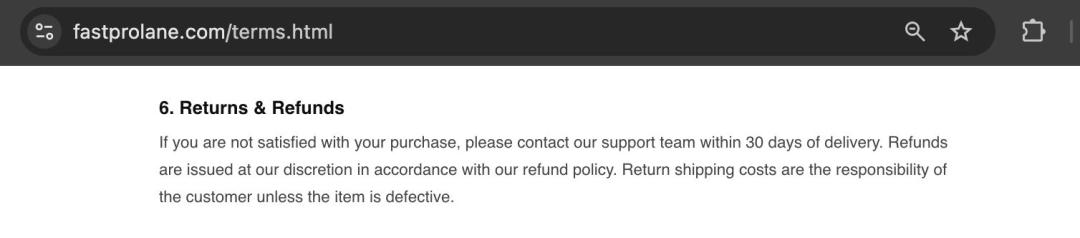
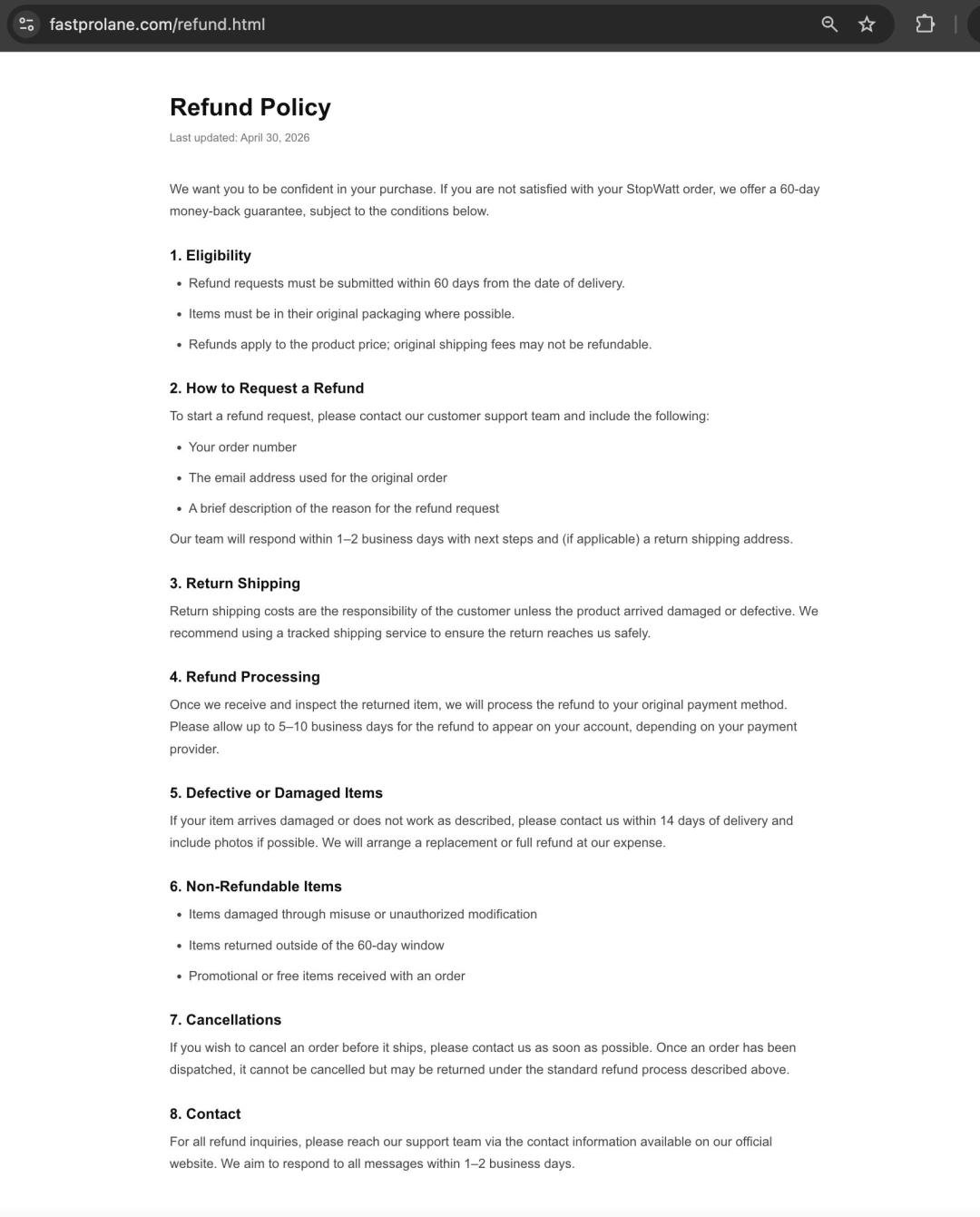
By dictating that return shipping costs are the sole responsibility of the customer, Fastprolane introduces a financial barrier for anyone seeking a full refund. Because tracking services for packages can be expensive, buyers may find themselves spending a significant portion of the product's original cost just to send it back. If the return is lost in transit without tracking, the consumer loses both the money and the item, shifting all financial risk away from the business and onto the shopper.
The platform includes a dedicated "Reviews" section featuring positive feedback and a comparative chart pitching StopWatt against generic alternatives based on baseline design traits like "reinforced casing."
It is important for shoppers to notice that these testimonials are hard-coded directly onto the webpage layout. Because they are not handled by an independent, verified third party review platform (such as Trustpilot or a verified buyer system), independent verification of these customer experiences is unavailable to outside visitors. Furthermore, at the time of writing, there is not a single independent review or profile listing available for Fastprolane on Trustpilot to cross-reference these claims.
Fastprolane features several structural elements and technical realities that warrant careful consideration before a consumer completes a purchase. The website is transparent in its fine print that the StopWatt device does not guarantee a reduction in electricity bills, framing it strictly as a passive voltage regulator. Because the device works passively from a single standard wall outlet, its impact on a home's overall electrical footprint is inherently limited compared to professional, panel-mounted power conditioners.
Furthermore, Fastprolane.com exhibits several details that depart from standard retail transparency. These include the listing of a massive conglomerate's corporate address in the footer, an explicit textual conflict between a 30-day and a 60-day return window, and the total absence of verified social channels or a direct customer service phone number.
Because the site openly clarifies in writing that it offers no guarantee of utility savings, shoppers looking for verified home efficiency upgrades are strongly advised to carefully weigh these technical limitations and policy inconsistencies. Anyone choosing to move forward with a transaction should protect their financial data by utilizing highly secure payment methods that offer robust fraud protection.
Disclaimer: This review is an independent analysis intended strictly for educational and informational purposes. All references to specific website policies, disclaimers, and corporate addresses are quoted directly from publicly accessible records. The technical evaluations presented are based on established electrical engineering principles and general industry consensus. This content does not allege illegal conduct, fraud, or statutory violations, nor does it replace professional legal, financial, or engineering counsel. The author assumes no liability for actions taken by readers based on this content.
This article has been written by a Scam Fighter Contributor, De-Reviews.com Team. If you believe the article above contains inaccuracies or needs to include relevant information, please contact ScamAdviser.com using this form.
De-Reviews.com Team is a group of scam researchers, editors, and online safety advocates dedicated to exposing online fraud and helping consumers stay safe online. The team has been investigating scams, fraudulent websites, phishing campaigns, and other online threats since 2014. Read the Full Author Profile.
