
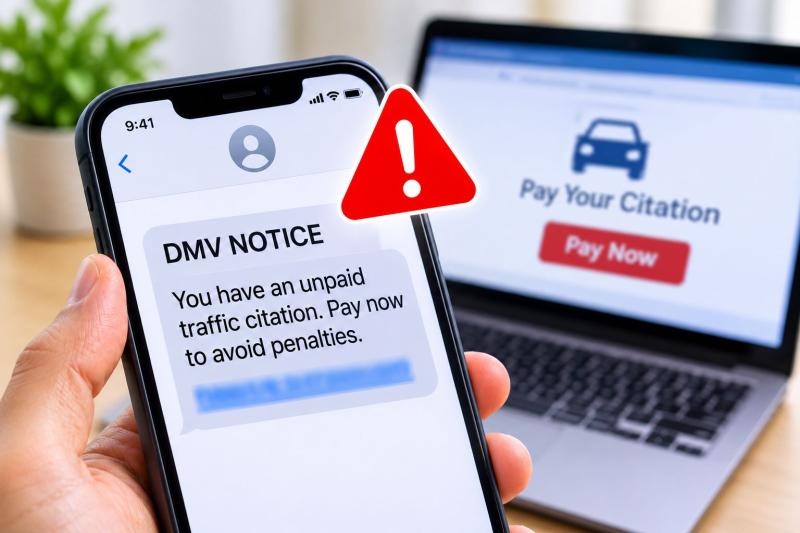
Have you recently received a text message or email claiming that you have an unpaid traffic ticket and must pay immediately to avoid penalties? Be careful. Fraudulent messages pretending to come from the Department of Motor Vehicles (DMV) are being used to trick drivers into visiting suspicious websites and sharing their personal and financial information. Reports have identified websites such as Dmvdf, Dmvkwd, Dmvdm, Dmvhlm, Dmvkwf, and Dmvkpd in connection with these DMV impersonation attempts.
The legitimate DMV is a government agency responsible for services such as driver licensing, vehicle registration, and driving records. However, scammers frequently misuse its name to make fraudulent messages appear trustworthy.
In this article, we will examine the fake DMV text messages, explain how these impersonation attempts work, identify their warning signs, and discuss what you should do if you receive one.
These messages usually claim that the recipient has an unpaid traffic citation, overdue fine, or other vehicle-related penalty. They often include a link to a website where the recipient is asked to review the alleged violation and make a payment.
The main purpose is to create fear and urgency. By threatening late fees, license suspension, registration problems, or legal action, the sender hopes that the recipient will act quickly without checking whether the notice is genuine.
One of the most concerning aspects of these messages is their use of urgent and threatening language. They often claim that recipients have limited time to settle a traffic citation and may face additional consequences if they fail to act.
Here is an example of the fraudulent messages associated with DMV:
Example 1:
"This is an urgent notice. Traffic citation notice. Your traffic citation requires prompt attention. Please visit dmvkwd.com to review the details and pay the amount due by November 20, 2026, or follow the instructions on your citation to contest it. Failure to pay by the deadline will result in late fees, and the court may suspend your driving privileges."
Other variations may use similar language while changing the website address, payment deadline, or threatened consequences.
Example 2:
"FINAL NOTICE: According to our records, you have an outstanding traffic violation. Your payment must be completed immediately to prevent additional penalties and possible suspension of your driving privileges. Click the link below to resolve this matter."
Example 3:
"Department of Motor Vehicles: Your vehicle has an unpaid traffic citation. Please verify your information and settle the outstanding balance before the deadline to avoid further administrative action."
Example 4:
"IMPORTANT DMV NOTIFICATION: Your driving privileges may be affected due to an unresolved traffic violation. Failure to complete payment by the specified date may result in additional fees and legal consequences."
Example 5:
"Your vehicle registration is currently at risk due to an outstanding payment. Please verify your vehicle details and complete the required payment immediately to prevent registration restrictions."
These examples are illustrative variations of common DMV impersonation messages, not verified copies of messages sent by the specific websites discussed in this article.
If you receive a message with similar wording, do not assume it is genuine simply because it mentions a traffic violation or uses official-sounding language.
Several reports describe websites using DMV-related names and traffic citation payment messages. The reported domains include Dmvdf, Dmvkwd, Dmvdm, Dmvhlm, Dmvkwf, and Dmvkpd.
These reports describe a recurring pattern: unfamiliar DMV-related domains, unexpected messages, payment requests, and warnings about possible penalties. These domains should not be treated as official DMV payment portals.
The process often begins with an unexpected text message, email, or phone call. The sender claims that the recipient has an unpaid traffic ticket or needs to resolve a vehicle-related issue.
The message then directs the recipient to a website that may use DMV-related wording, official looking designs, or government style language. Once there, the visitor may be asked to provide information such as:
The information may then be used for payment fraud or other forms of identity misuse.
These attempts are not limited to text messages. The report involving Dmvdf.com includes a reader's account of receiving phone calls that directed people to the website. This is a reminder that an impersonation attempt can arrive through more than one communication channel.
The Dmvkpd report also highlights messages that may come from ordinary mobile numbers or numbers with international country codes, rather than familiar government contact numbers. However, sender numbers and caller IDs can be misleading or spoofed, so they should never be treated as proof that a message is genuine.
No, the suspicious payment demands should not be treated as genuine government notifications. Several state motor vehicle agencies have issued warnings about unsolicited messages demanding immediate payment for unpaid traffic tickets, tolls, or appointment fees.
For example, the California DMV, DC DMV, and Nevada DMV have warned consumers about impersonation attempts involving fake payment requests.
These messages may be accompanied by phone calls. Therefore, do not assume a phone call is genuine simply because the caller knows something about your vehicle or claims to represent a government department. Always verify the information independently.
Watch for these common red flags before responding to any message claiming to be from the DMV:
Unexpected payment demands:
Be cautious if you receive a message about a traffic ticket that you were not previously aware of. An unexpected demand for immediate payment deserves independent verification.
Threats and urgent deadlines:
Words such as "Final Notice," "Pay Now," and "Immediate Action Required" are often used to pressure people. Threats of license suspension, registration cancellation, legal action, or extra fees are also common warning signs.
Suspicious website addresses:
Check the complete web address before opening a link. A domain containing the letters DMV is not automatically an official government website. Lookalike domains can be designed to appear legitimate.
Requests for sensitive information:
Be careful if an unfamiliar website asks for your driver's license number, Social Security number, banking details, or card information to resolve an alleged citation.
Unusual sender numbers:
Messages from random mobile numbers or unfamiliar international numbers should be treated cautiously. However, even a familiar looking sender name or number can be misleading.
Unusual payment instructions:
Requests to pay through gift cards, cryptocurrency, wire transfers, or other unusual methods are strong warning signs. Do not make a payment simply because a message claims that your driving privileges are at risk.
If you are worried that the message might be genuine, do not use its link or telephone number. Instead, verify the information independently.
Visit your state's official DMV website by typing its known address directly into your browser. You can also contact the relevant traffic court or local authority using contact details obtained from an official government source.
Keep in mind that traffic citation procedures differ between states and local jurisdictions. In some cases, the court rather than the DMV handles payment and citation records. Therefore, check with the correct authority for your location.
The Federal Trade Commission (FTC) has also warned about messages pretending to come from the DMV and demanding payment for overdue traffic tickets. Its advice is to avoid clicking unexpected links and contact the relevant agency through a website or phone number you already know is genuine.
If you receive an unexpected DMV text or email, follow these precautions:
If you have already entered your card details, contact your bank or card issuer immediately. Ask them to block or replace the card if necessary, check for unauthorized transactions, and dispute any charges you did not approve.
If you shared your Social Security Number or other sensitive personal information, visit IdentityTheft.gov for guidance on protecting your identity. If you clicked a suspicious link, remember that clicking alone does not automatically mean your phone has been infected. However, avoid downloading anything from the website and run a security check if you suspect that harmful software may have been installed.
Before visiting an unfamiliar website or following a payment link, checking its reputation can help you make a more informed decision as it helps users check website trust signals and identify potentially risky websites. In order to quickly check websites like Dmvdf, Dmvkwd, Dmvdm, Dmvhlm, Dmvkwf, and Dmvkpd, you can download and use our app.
The Department of Motor Vehicles (DMV) is a legitimate government agency, but criminals can misuse its name to send fraudulent traffic citation messages and direct people to suspicious payment websites.
Several domains, including Dmvdf, Dmvkwd, Dmvdm, Dmvhlm, Dmvkwf, and Dmvkpd, may be associated with DMV impersonation or phishing attempts. These domains should not be treated as official DMV payment portals. If you receive a message directing you to any of these websites, avoid clicking the link, sharing personal information, or making payments through it.
The safest approach is simple: ignore unexpected payment demands, verify any alleged traffic citation directly with the relevant government agency or court, and report suspicious messages. Taking a few minutes to check a notice independently can help protect your money, personal information, and driving records.
The information in this article is provided for educational and awareness purposes. Company names, phone numbers, sender names, and other details referenced may have been impersonated, spoofed, or otherwise misused by scammers. Their appearance in this article does not necessarily identify the legitimate company, owner of a phone number or account as being involved in fraudulent activity.
This article has been written by a Scam Fighter Contributor, De-Reviews.com Team. If you believe the article above contains inaccuracies or needs to include relevant information, please contact ScamAdviser.com using this form.
De-Reviews.com Team is a group of scam researchers, editors, and online safety advocates dedicated to exposing online fraud and helping consumers stay safe online. The team has been investigating scams, fraudulent websites, phishing campaigns, and other online threats since 2014. Read the Full Author Profile.
