
Short answer: It appears so. Within a single day, Carziqo blamed hackers, cancelled all withdrawals, announced a "system upgrade" and then locked every member's account. Its websites have since gone offline. This sequence shows strong signs of an exit scam, where an alleged Ponzi scheme stops paying out and disappears with investors' money.
Carziqo marketed itself as an AI and autonomous vehicle investment platform. Here is how its collapse unfolded, based on the notices sent to members, and why investors should be careful about what comes next.
Source: FB
"CARZIQO Emergency Notice
This morning, CARZIQO Group’s server was maliciously attacked by a hacker group. CARZIQO Technology Department immediately strengthened security and restored the normal operation of the server in a short time.
This hacker group used a specific penetration technology to change the users’ bank card connection information and then withdraw money. Their purpose was to steal users’ money.
CARZIQO Technology Department has already introduced updated and improved security measures to prevent such incidents from happening in the future. CARZIQO Board of Directors has made the following decisions:
1. Before the security upgrade, a small number of users’ money was stolen. CARZIQO Group will fully compensate for this small amount of money loss. Please contact your senior manager for compensation.
2. Since hackers have changed a large number of users’ bank card information and the bank’s defenses were very weak, there is a risk of further money theft.
Therefore, the Board of Directors has decided: All withdrawals will be canceled on 10-12-2026, so as to preserve users’ money and give the CARZIQO Technology Department time to find the remaining vulnerabilities.
3. It is expected that withdrawals will be resumed if you are here in the official carziqo group.
4. All cars products are working normally and income has not stopped. Please wait for the final inspection and security measures of the app."
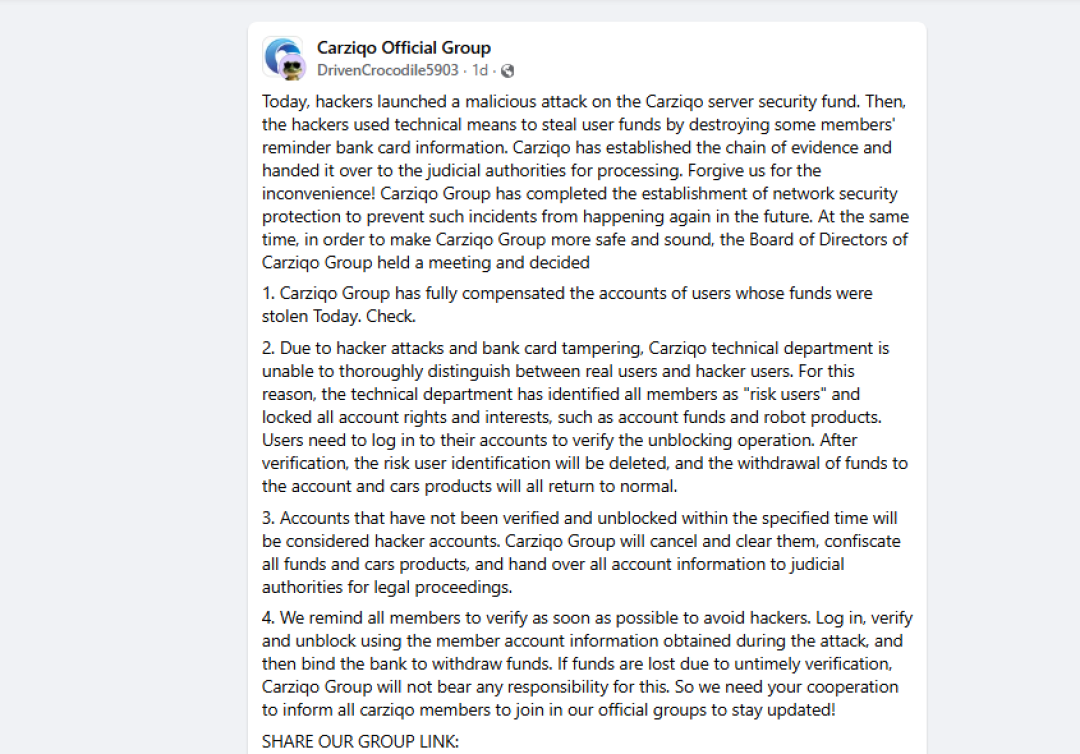
The first sign of trouble was a "CARZIQO Emergency Notice." It claimed that a hacker group had attacked the company's server that morning and used a special penetration technique to change users' linked bank card details and withdraw money.
The notice said the technology department had quickly restored the server and added new security. It then announced several decisions from the "Board of Directors":
In other words, members were told their money was safe and still growing, but they could not take any of it out.
Source: behindmlm.com
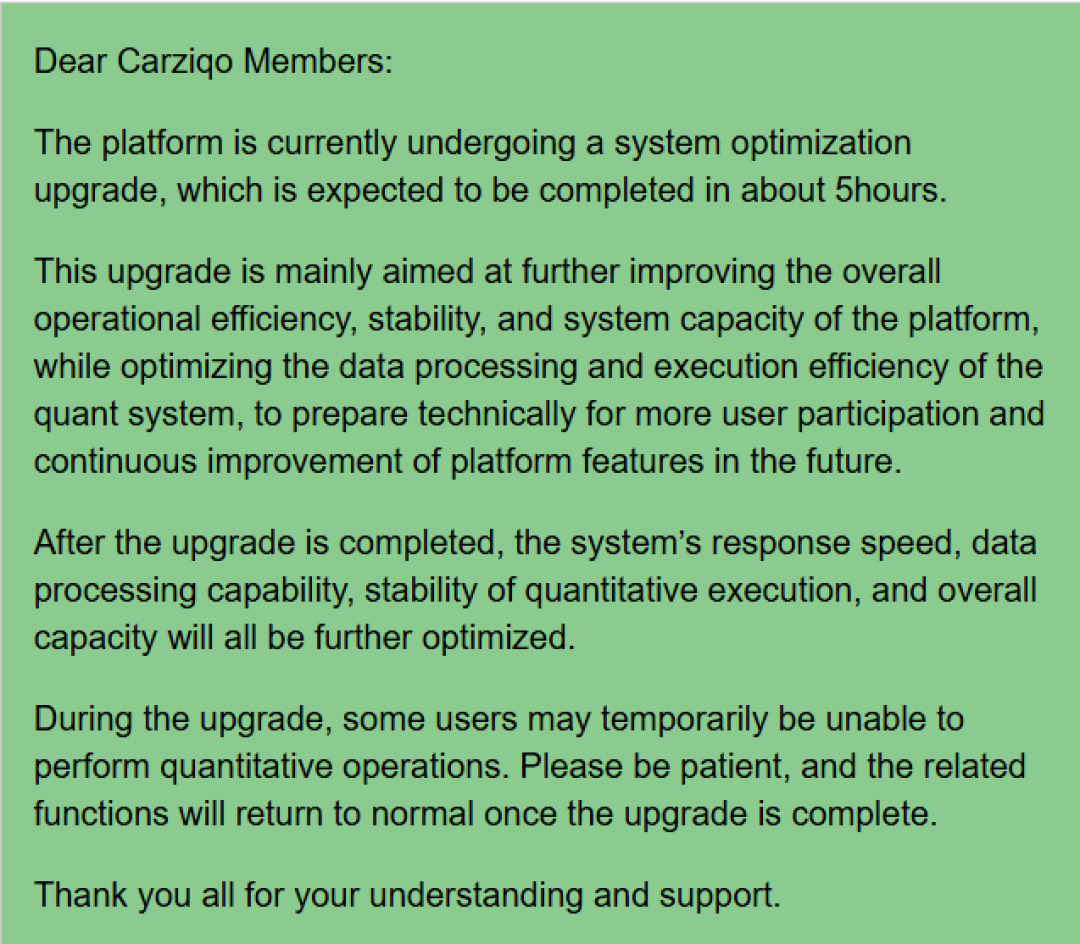
With the websites down, a second message told members the platform was undergoing a system optimisation upgrade that would take about five hours. It promised faster response times, better data processing, more stable "quantitative execution" and capacity for more users.
The message also warned that some users might be unable to carry out quantitative operations during the upgrade, and asked everyone to be patient.
The story had already shifted. A morning hack became a planned upgrade, and the upgrade was framed as preparation for growth. Changing explanations like this are a classic stalling tactic designed to keep investors calm and hopeful.
Source: behindmlm.com
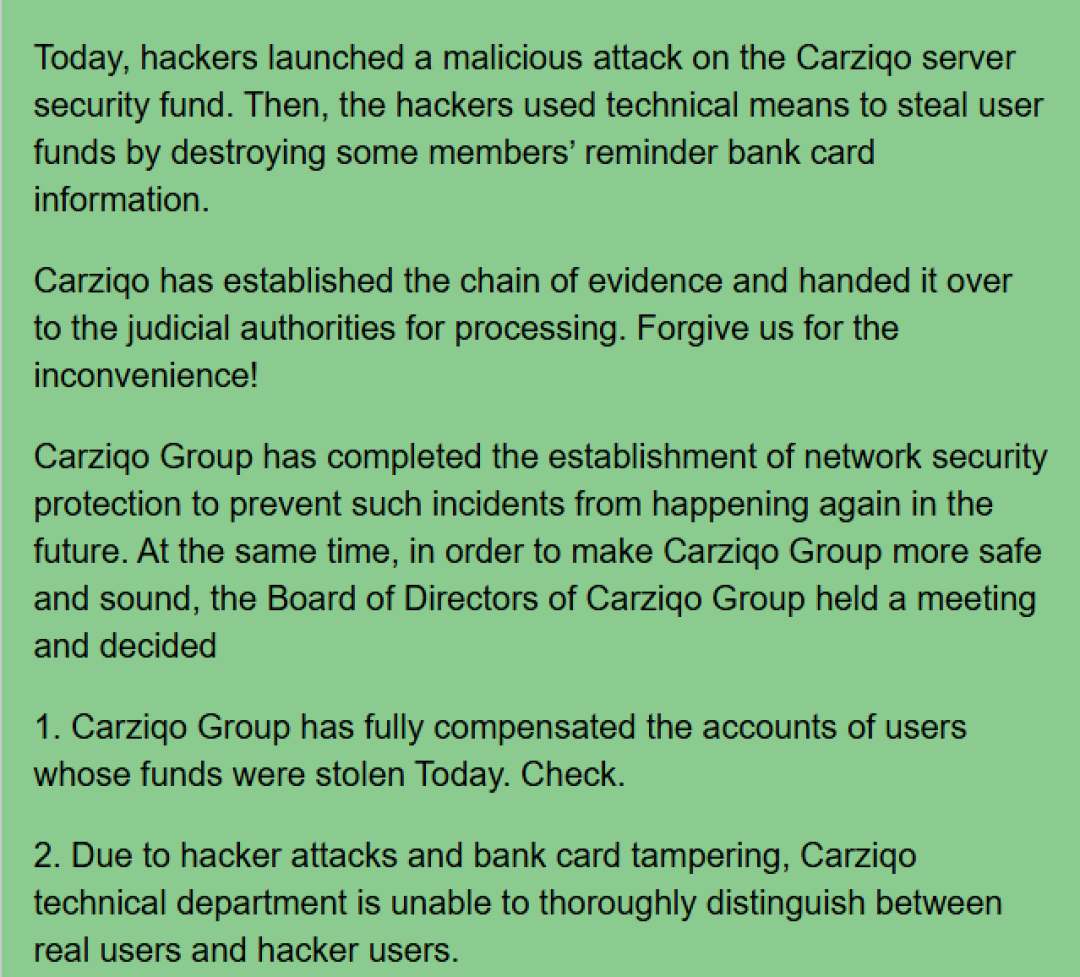
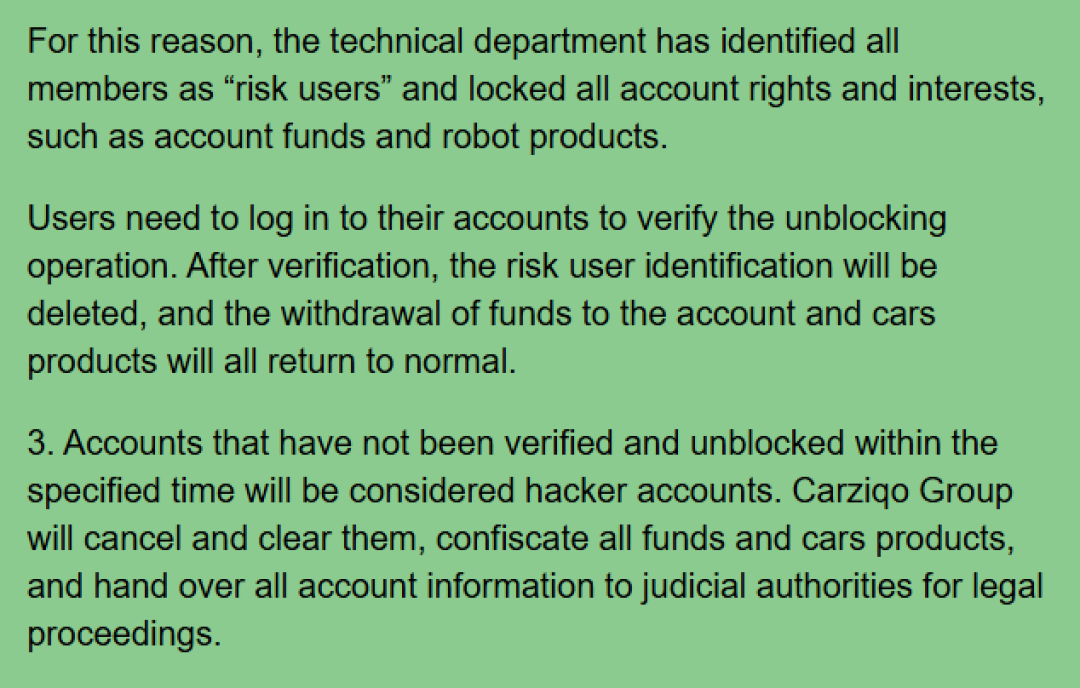
About 30 minutes later, a third notice arrived. It claimed hackers had attacked Carziqo's "server security fund" and stolen user funds by tampering with members' bank card information. Carziqo said it had gathered evidence and handed it to the judicial authorities.
The notice then made its most important announcement:
This last point is a threat dressed up as security. It pressures investors to act fast, out of fear of losing everything or being reported to the police.
Carziqo shows the hallmarks of an exit scam. The pattern is familiar: the platform pays early users, likely using money from newer investors, which builds trust and positive reviews. Once deposits slow or the operators decide to leave, a crisis is announced and withdrawals stop.
The warning signs in Carziqo's case include:
Following the collapse of the alleged Ponzi scheme, Carziqo investors may face a second risk: demands for more money to regain access to their accounts or withdraw their funds.
Investors who try to log in through the Carziqo app may be asked to pay a fee to "verify" or unlock their accounts. These requests are often described as security deposits, taxes, verification charges or anti-money-laundering fees. There is no guarantee that paying will restore access or allow withdrawals. In similar schemes, each payment is usually followed by another demand.
Investors should be very cautious about making further payments, as these could increase their losses without solving the withdrawal problem.
Carziqo appears to have exited the market. A sudden hack, frozen withdrawals, locked accounts and offline websites point to a high possibility of an exit scam. The safest move now is to stop all payments and report what happened.
Adam Collins is a cybersecurity researcher at ScamAdviser who operates under a pseudonym for privacy and security. With over four years on the digital frontlines, he specialises in translating complex threats into actionable advice. His mission: exposing red flags so you can navigate the web with confidence.
