
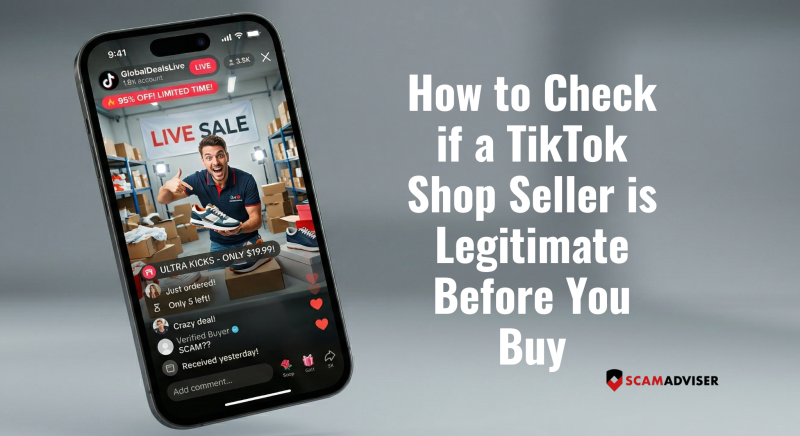
TikTok Shop shuts down hundreds of thousands of seller accounts every year for violations ranging from counterfeit goods to outright fraud — averaging thousands of removals every single day. While the platform's moderation is aggressive, many "burn and turn" sellers manage to process thousands of orders before the ban hammer falls.
In a Nutshell
You have likely seen the ads: a $400 Dyson Airwrap for $29, or a "clearance" on Samsung tablets that seems too good to pass up. In the high-speed world of social commerce, your brain is wired to act on impulse before your internal alarm goes off. To protect your money, you need a repeatable process to identify a fake TikTok Shop seller in under five minutes.
This guide gives you a clinical, 5-step framework to verify any seller before you buy. By the end, you will know exactly which signals to look for — and which red flags mean a scammer is hiding behind a polished video. For a broader look at the risks on the platform, read our full guide on whether TikTok Shop is safe.
The blue checkmark on TikTok Shop is the first line of defence, but most users misunderstand what it actually means. According to TikTok's Shop Recognition Programme, a blue tick confirms that TikTok has verified the account as the official representative of the brand it claims to be. If you are looking at a shop claiming to be "Nike Official" or "Sony Store" and that blue tick is missing, you are very likely looking at a fake TikTok Shop seller.
To find this, tap the seller's profile name directly from the product listing and look for the small blue badge next to the shop name at the top of their profile. Legitimate international brands will almost always have this because it protects their intellectual property on the platform.
However, the absence of a tick does not automatically mean a scam. Thousands of legitimate small businesses and independent creators operate without one. Think of verification as a "disqualifier" — if a major brand lacks it, treat them as fake; if a small brand lacks it, move on to the next checks.
One final warning: scammers often try to mimic the blue tick by uploading a profile photo that includes a fake checkmark inside the image itself. Always look for the system-level badge that appears next to the text of the shop name. If it disappears when you scroll or looks embedded in the circular photo, it is a graphic trick.
Time is the enemy of the scammer. Most fraudulent operations on TikTok Shop rely on a short-window strategy — open a shop, run aggressive ads for 30 days, collect as much revenue as possible, and disappear before the wave of "item not received" complaints triggers an automatic shutdown. This makes the shop's age one of the most reliable signals of legitimacy.
To check this, tap the seller's name and select "View Shop." In most regions, the "About" or shop details section lists when the seller joined the platform. If a shop was created in the last 30 to 60 days but already has thousands of sales for high-value electronics or designer apparel, your risk level is at a maximum.
Legitimate businesses investing in TikTok Shop usually have a history — content posted over several months, responses to comments, and a consistent digital footprint. A recently registered shop with no previous video history is a classic shell account used for moving fake products.
Be particularly wary of shops that appear to have "renamed" themselves. Some scammers buy aged accounts with existing followers and rebrand them as a shop. If you scroll back through their video history and see content that has nothing to do with what they are currently selling — old memes or lifestyle content in a different language — you are likely looking at a hijacked account, a common tactic to bypass TikTok's new-seller restrictions.
TikTok Shop requires a confirmed delivery before a user can leave a review, which makes it harder to fake than many other platforms. However, scammers have found a workaround known as "brushing" — sending empty envelopes to accomplices who then post glowing 5-star reviews to pad the shop's rating. To verify a TikTok Shop seller properly, you must look past the star rating and analyse the patterns.
Open the reviews and look at the dates. Legitimate reviews accumulate organically over time. If you see a cluster of 50 reviews all posted within a 48-hour window followed by weeks of silence, those reviews were likely purchased or manufactured — created to build a social proof mask before a major ad campaign.
Read the language used. Generic phrases like "Very good," "Highly recommend," or "Fast shipping" with no specific product details are a red flag. Real buyers mention fit, colour accuracy, or how the packaging arrived. Also look for photo reviews — a legitimate seller will have customers posting real-world photos of the item. A shop with hundreds of reviews but zero customer photos is a serious warning sign.
Finally, filter by 1-star reviews. If multiple people are reporting "I received a different item" or "The tracking number says delivered but nothing arrived," believe them. Scammers frequently use fake tracking numbers — real numbers assigned to packages delivered to other addresses — to trick the system into marking an order as complete. The FTC's online shopping guidance recommends always checking reviews across multiple sources before buying from an unfamiliar seller.
A legitimate seller uses their own photos or authorised distributor assets. A scammer steals them. To check whether a listing is genuine, take a screenshot of the main product image and run a reverse image search using Google Lens. If that exact photo appears on dozens of different dropshipping sites or has been lifted from a high-end designer's official account, the seller almost certainly does not have the stock.
The Price Logic rule is your most powerful tool. If a pair of genuine Air Jordan sneakers retails for $180 everywhere else but a TikTok seller has them for $45, they are either counterfeit or the seller will send you nothing at all. As the FTC notes, if expensive brand-name items are offered at bargain prices, they could be counterfeit or stolen — there is no secret warehouse or liquidation deal that allows a random seller to undercut the manufacturer by 75%.
Also examine the product description for keyword stuffing. Scammers often use long strings of unrelated brand names in the title — such as "Nike Adidas Sony Samsung High Quality Bag" — to appear in more searches. A legitimate brand or authorised reseller has a professional, focused listing and does not need to hijack other brand names to find customers.
Finally, check the "Shipping From" location where available. If a seller claims to be a US-based small business but tracking shows the item originating from a known counterfeit hub overseas, they have misrepresented themselves. Lying about your location is a foundational sign of a dishonest business model.
Many TikTok Shop sellers include a link to an external website in their bio or send links via Direct Message. This is a critical danger zone. Security researchers have documented tens of thousands of fake TikTok Shop domains created specifically to harvest credit card data and install malware. Before you tap any link, you must verify the domain independently.
Copy the URL from the seller's profile and paste it into the ScamAdviser website checker. ScamAdviser's algorithm analyses over 40 technical signals, including domain age, server location, and SSL certificate validity. If a seller claims to have been in business for years but their website was registered two weeks ago, the Trust Score will reflect that risk immediately.
A low ScamAdviser Trust Score is often the only way to see what TikTok's interface conceals. It can identify whether a website is hosted on a server known for fraudulent content, or whether the owners are using identity-redaction services to hide who they are. For a legitimate business, there is no reason to hide registration data behind a privacy wall while asking for your credit card details.
For real-time protection while browsing TikTok on your phone, download the ScamAdviser app for free on iOS and Android. If a seller sends you a discount link in a DM, the app identifies suspicious domains in seconds — without you ever leaving the TikTok interface.
If a seller has gone silent or provided a fake tracking number, do not wait for the estimated delivery date to pass. Open the TikTok app, go to your "Orders" tab, select the item, and use the "Report a Problem" or "Request Refund" button immediately. TikTok's Buyer Protection programme gives you 90 days to file a dispute, but the sooner you act, the better your chances of recovery.
Document everything — screenshots of the original listing, your order confirmation, and any messages sent to the seller. If the seller tries to move the conversation to WhatsApp or Telegram, stop communicating. This is a deliberate tactic to move you away from TikTok's monitored environment so they can pressure you into dropping the refund claim.
If you paid by credit card or PayPal, you have a second layer of protection. If TikTok's dispute process stalls, contact your bank and initiate a chargeback for a fraudulent transaction. In the US, you can also file a report with the FTC at ReportFraud.ftc.gov. In the UK, report to Action Fraud. Never pay via "Friends and Family" transfers or direct bank wire — TikTok cannot help you recover money sent outside their official payment system.
Frequently Asked Questions About TikTok Shop Sellers
How do I know if a TikTok Shop is real?
Check for consistent posts, genuine reviews over time, clear contact details, and verify their website using ScamAdviser plus the domain’s registration date.
What does the TikTok Shop blue tick mean?
It means TikTok has verified the seller’s identity and confirmed they represent the brand shown.
Can TikTok Shop sellers steal your payment information?
Not through official checkout, but they can if they redirect you to a fake external site designed to capture your details.
Is it safe to buy from unverified sellers on TikTok Shop?
Yes, but only if you carefully check their shop history, reviews, and independently verify their website before spending.
Why are there so many fake products on TikTok Shop?
Because fast viral trends and easy seller access attract counterfeiters trying to profit before platforms and laws like the INFORM Consumers Act catch up.
Adam Collins is a cybersecurity researcher at ScamAdviser who operates under a pseudonym for privacy and security. With over four years on the digital frontlines and 1,500+ days spent deconstructing thousands of fraud schemes, he specialises in translating complex threats into actionable advice. His mission: exposing red flags so you can navigate the web with confidence.
