
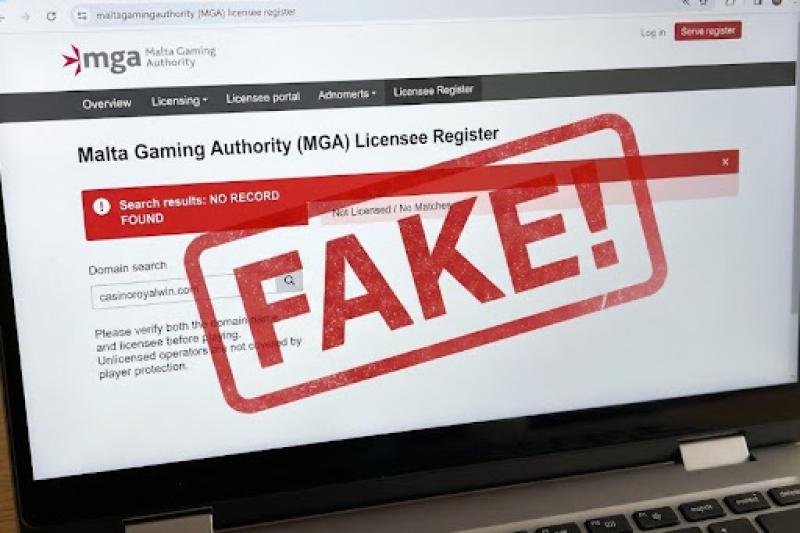
Almost every online casino shows a licence logo in its footer. Many of those logos are copied, expired or link nowhere. A fake licence is the cheapest thing a scam casino can make.
The only proof is the regulator's own public register. If the casino isn't listed there under the same name and domain, it isn't licensed, whatever the footer says.
A licence means a regulator has checked who owns the casino, that its games are fair and that player money is protected. It also gives you somewhere to complain when things go wrong.
Scam casinos skip all of this. They let you deposit easily and win on screen, then refuse to pay out. Without a real licence, there's no regulator to stop them.
Scroll to the footer or the "About" or "Terms" page. A licensed casino should state the regulator, the licence number and the name of the company that operates it. If any of these is missing, treat the site as unlicensed.
Tip: Vague wording such as "licensed and regulated" with no regulator named or licence number is a red flag.
A genuine seal usually links to a validation page on the regulator's own domain. A fake seal is often just an image, or it links to a page on the casino's own site.
Tip: Check the address of the page the seal opens. It must be the regulator's real domain, not the casino's.
Don't rely on the seal's link. Go to the regulator's website by typing its address, open the licence register and search the licence number or company name. Common registers include:
Scam casinos sometimes copy a real licence number from another operator. On the register, check that the company name and the website domain you're using are listed under that licence, and that the licence is active, not suspended or expired.
Tip: Many registers list every domain a licensee operates. If yours isn't on the list, it isn't covered.
Gambling law is national, and in the US it's set state by state. A Curaçao or Malta licence doesn't make a casino legal in the UK, the Netherlands or a US state that requires its own licence. Some countries, such as Australia, ban most online casinos altogether.
Tip: Check your own country's regulator for a list of approved operators. Playing on an unapproved site usually means no protection if things go wrong.
Curaçao replaced its old "master licence and sub-licence" system with a new law (the LOK) that took effect on 24 December 2024, and its regulator is now the Curaçao Gaming Authority (CGA). Transitional provisional licences were extended only to 24 December 2025. A site that still claims a sub-licence under an old master licence is operating without a valid licence under the new regime. Ignore these outdated claims and check for a direct CGA licence status.
Tip: Check a Curaçao licence on the CGA's own website, not via a seal hosted elsewhere.
A real licence is necessary but not enough. Check independent player reviews and complaint sites for withdrawal problems. Run the casino's domain through ScamAdviser to see its age and trust signals.
Tip: Read the bonus terms. Wagering requirements of 50x or more, or withdrawal caps on winnings, are designed to stop you cashing out.
Search the licence number and company name on the regulator's own website. If the casino and its domain aren't listed, the licence isn't real.
A valid CGA licence means the operator is regulated, but protection is weaker than in strict markets, and it may not be legal where you live.
It delay payments for legitimate checks, but a licensed casino that won't pay can be reported to its regulator.
Some are, many aren't. Apply the same checks, and remember crypto payments are very hard to recover.
That depends on your country. Even where it isn't illegal for players, you have little protection if the casino doesn't pay.
Related reading: How to Recognize a Scam · 10 Legit Bitcoin Exchanges and Trading Platforms · How to Get Your Money Back
Adam Collins is a cybersecurity researcher at ScamAdviser who operates under a pseudonym for privacy and security. With over four years on the digital frontlines, he specialises in translating complex threats into actionable advice. His mission: exposing red flags so you can navigate the web with confidence.
