Think you've found a scam website? Whether you've lost money or simply spotted something suspicious, reporting it quickly can help prevent others from becoming victims.
In this guide, we'll show you exactly how to report a scam website to ScamAdviser, Google Safe Browsing, your national fraud authority, your payment provider, and even the website's registrar and hosting company. We'll also explain what evidence to collect first and how your report can help get fraudulent websites taken down faster.
In a Nutshell
You found a website that doesn't feel right. Maybe the prices are suspiciously low, the contact page is a dead end, or you paid for something that never arrived. Whatever tipped you off, you're now asking the same question millions of people ask every year: what do I actually do about it?
The answer matters more than most people realize. Reporting a scam website isn't just about getting your own money back. It's about stopping the next victim. Scam sites rarely target one person in isolation. They run at scale, and every day they stay live, more people get hurt.
The good news: reporting is faster and more effective than it used to be. Australia's National Anti-Scam Centre referred more than 8,000 websites for takedown in 2024 alone, with 92% of those subsequently removed. In California, 42 fake cryptocurrency websites were shut down in a single year after victims came forward, with those sites having already stolen at least $6.5 million from consumers.
Reports work. Here's exactly where to send them.
Scam websites disappear fast. Operators know that once reports start coming in, their window is closing. Before you do anything else, capture proof that the site existed and what it was doing.
What to screenshot and save
One extra step that most people skip: archive the page at web.archive.org using the "Save Page Now" feature. Scammers can delete a site within hours of being reported, but an archived snapshot is permanent and can be referenced by investigators long after the domain goes dark.
Once you have your evidence, you're ready to report. Start with ScamAdviser.
When you report a scam website to ScamAdviser, you're doing more than filing a complaint. You're feeding data into a system that protects millions of people.
ScamAdviser scans over 1 million new websites every month and serves between 3 and 4.5 million users who check websites before handing over their money or personal information. Every report you submit becomes part of the trust score algorithm that flags dangerous sites for those future visitors. A single report can prevent dozens, or hundreds, of other people from falling for the same scam.
The process takes about two minutes:
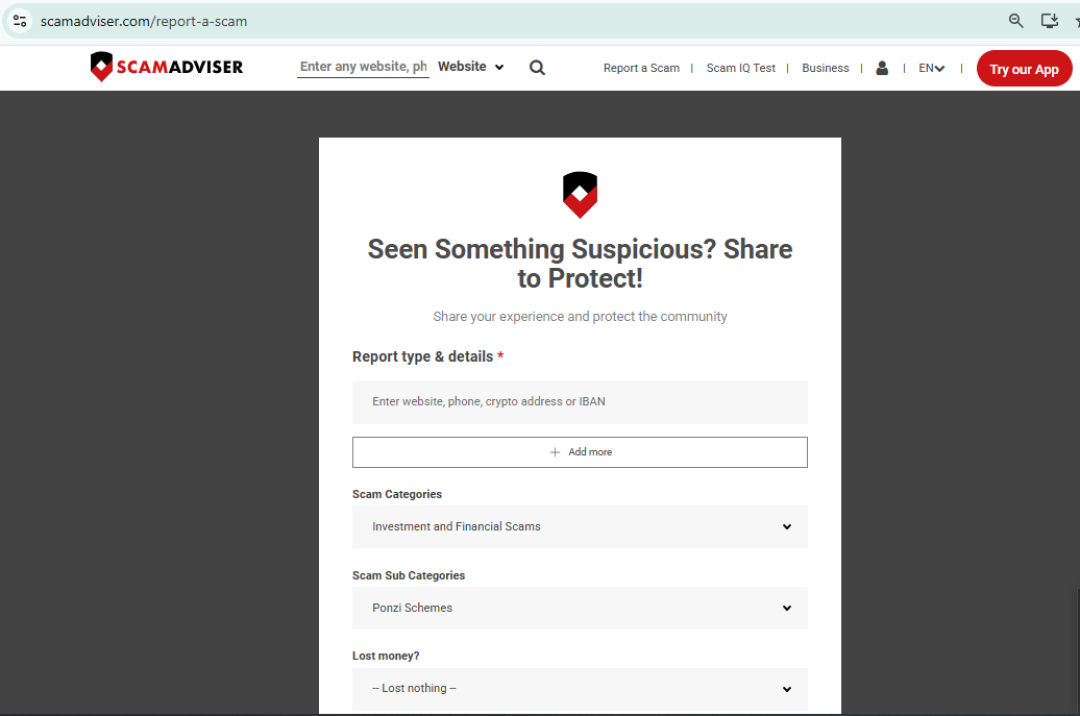
That last option is worth enabling. ScamAdviser coordinates with law enforcement and commercial fraud-prevention partners, meaning your report can travel further than the platform itself.
Your submission contributes to ScamAdviser's scoring engine, which evaluates sites based on technical infrastructure signals, blacklist status, hosting reputation, and user-generated reports. A site with multiple reports from real users gets flagged faster. The more people who report the same domain, the stronger the signal, and the quicker the site gets surfaced as high-risk to everyone who looks it up.
Why this matters: Most scam sites aren't run by lone operators. They're part of networks that reuse infrastructure, payment processors, and templates. Reporting one site helps identify the broader network.
The impact of scam reporting isn't theoretical. Here's what it looks like in practice.
Quantum AI was a fraudulent investment platform that claimed to use artificial intelligence and quantum computing to generate outsized returns. The site used fake celebrity endorsements, including fabricated quotes attributed to Chris Hemsworth and Elon Musk, to lure investors in with low initial deposits and promises of unrealistic gains.
After consumer reports began flowing in, Australia's securities regulator ASIC activated its takedown capability and disrupted the operation. The site was taken offline, and ASIC issued a public investor alert to warn anyone who might have already been targeted.
An even faster outcome came from a single report about Dexa Trade Markets, a cryptocurrency investment scam that falsely claimed international regulation, billions in trading volume, and millions of investors. One Australian consumer filed a report after losing money. ASIC referred the website to its takedown provider, and the site was pulled within an hour of the referral.
That's the power of a single report filed with the right organization.
Between July 2023 and August 2024, ASIC coordinated the removal of more than 7,300 phishing and investment scam websites. The lesson: regulators have the tools to act quickly, but they need the reports to know where to look.
ScamAdviser is your first stop, but the most effective approach is to report in parallel across multiple channels. Each channel does something different, and together they cover the full takedown pipeline.
Go to safebrowsing.google.com/safebrowsing/report_phish and submit the URL. Once Google flags a site, Chrome, Firefox, and Safari all display a red warning screen before visitors can reach the page. This is one of the fastest ways to reduce the site's reach.
Different countries have different reporting channels. Use the one that applies to you:
See How to Get Help After a Scam by country.
The FTC's fraud reporting database feeds into the Consumer Sentinel Network, which is used by more than 3,000 law enforcement partners. Reports filed there don't disappear into a void; they're actively used to build cases.
Every website is registered through a registrar like GoDaddy, Namecheap, or Tucows. Look up the registrar using lookup.icann.org, then find their abuse contact (usually listed as abuse@[registrar].com). A documented abuse complaint can result in the domain being suspended entirely, which takes the site offline rather than just removing it from search results.
The registrar controls the domain name. The hosting provider controls the actual server where the site lives. WHOIS lookup (available at lookup.icann.org) also reveals the hosting provider. Email their abuse address with your evidence. Hosting providers often act faster than registrars because they face greater liability for allowing fraudulent content on their infrastructure.
If you lost money, contact your bank, credit card company, PayPal, or whichever payment method you used immediately. Dispute the charge and report the fraud. Even a single chargeback flags the merchant account and can freeze further withdrawals, cutting off the scammer's revenue while the site is still live.
The most common reason people don't report scam websites is the belief that nothing will happen. That belief is both understandable and wrong.
Scam websites stay live for as long as they go unreported. The FTC's investigation into impersonation scams found 13 websites that were fraudulently impersonating the FTC itself, including domains like ftc.reportfraud.tech and ftcgrant.com. These sites existed specifically to deceive fraud victims into handing over money or personal data. They were only taken down after the FTC identified them and contacted registrars directly.
The California Department of Justice shut down 42 fake cryptocurrency websites in 2024, but only after victims came forward. Those sites had already extracted at least $6.5 million, with an average loss per victim of $146,306. Every victim who stayed silent was a victim the operators could afford to replace.
Silence is what scam operations depend on. Reporting breaks that cycle.
Sometimes people are unsure whether what they've encountered is genuinely a scam or just a poorly built legitimate business. Here are the most reliable warning signs, based on patterns identified across thousands of reported sites.
Red flags that appear on most scam websites
If you're unsure, check the site on ScamAdviser before engaging. The free trust score check takes seconds and evaluates the domain against hundreds of signals. If the score is low, trust your instincts and don't proceed.
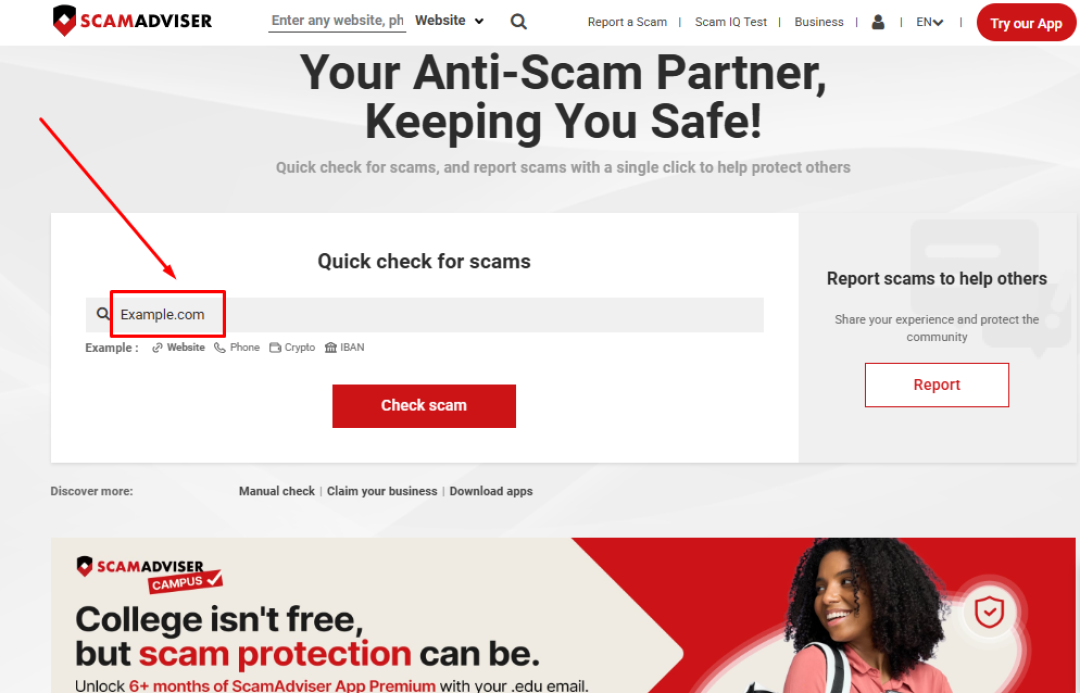
Quick check before you buy: Paste any website URL into ScamAdviser's checker at scamadviser.com. You'll get an instant trust score, a breakdown of why the score is what it is, and any user reports that have already been filed against that domain.
If you've found a scam website, here's the complete action sequence. Work through it in order.
Each of these steps takes between two and ten minutes. Together, they create a paper trail that investigators can act on and a warning system that protects the next potential victim before they reach the site.
Scam websites thrive in the gap between people who notice something is wrong and people who actually do something about it. Closing that gap is what reporting does.
Adam Collins is a cybersecurity researcher at ScamAdviser who operates under a pseudonym for privacy and security. With over four years on the digital frontlines, he specialises in translating complex threats into actionable advice. His mission: exposing red flags so you can navigate the web with confidence.