
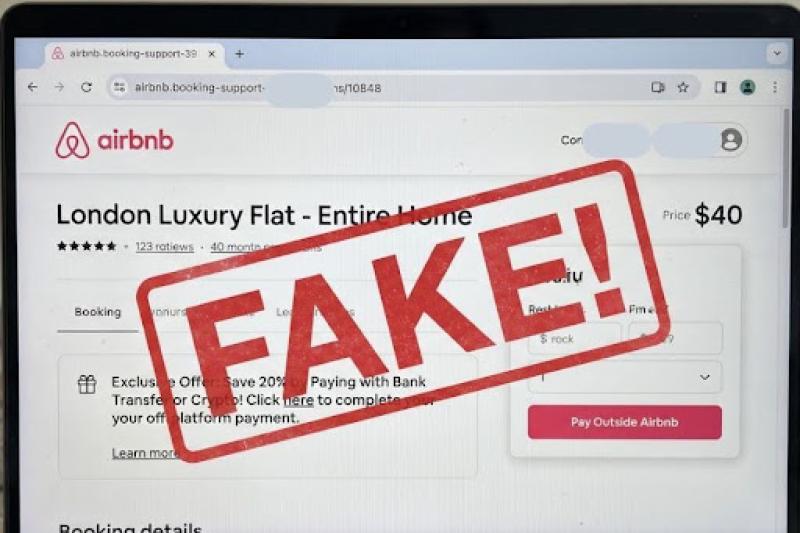
Rental scams work because good homes are hard to find. A fake landlord posts a lovely flat at a fair price, says many people are interested and asks for a deposit to "hold" it. The flat may be real. The landlord isn't.
The rule that stops almost every rental scam: never pay anything before you have seen the property in person and confirmed who owns it.
There are two common versions. In the first, the scammer copies a real property's photos and description, often from a listing that is for sale, and posts it for rent at a low price. In the second, the property doesn't exist at all.
Either way, the "landlord" can't show the home, creates urgency and asks for money first. Students, people moving to a new city and anyone renting from abroad are targeted most because they often can't view in person.
Run the listing photos through Google Lens or TinEye. If the same photos appear on another listing, with a different price, agent or address, the listing is likely fake.
Tip: Also search the listing's description. Scammers often copy the text word for word from the original.
In many countries, ownership is public. In the US, county property or assessor records show the owner. In the UK, HM Land Registry lets you buy the title register for a small fee. The landlord's name should match the owner or a letting agent who can show they act for them.
Tip: If the owner's name doesn't match and the "landlord" can't explain why, walk away.
A real landlord or agent will arrange a viewing. Scammer accounts have excuses: they're abroad, working on an oil rig or a missionary, and the keys will be posted after you pay. If you can't visit, ask a friend to go, or request a live video call walking through the home.
Tip: During a live video, ask them to open a specific cupboard or step outside to show the street name. A pre-recorded tour can't do that.
Check similar properties in the same area. A rent far below the local average is the bait. Scammers price low to attract lots of interest and push people to pay quickly.
Tip: If it's the best deal you've seen in weeks of searching, check it twice as hard.
Walk away if the landlord asks for a wire transfer, money transfer service, gift cards or crypto, or for payment to a personal account abroad. Also be wary of payment services with no buyer protection, such as Zelle or PayPal "Friends and Family".
Tip: Only pay once you've signed a written tenancy agreement, and keep proof of every payment.
If an agent is involved, check that the agency exists independently. Look it up on the company register, read reviews and call its office using a number from its own website. In the UK, letting agents must belong to a redress scheme, so check they're listed.
Tip: Scammers sometimes pose as staff of a real agency. Confirm the listing with the agency directly.
In some countries, landlords must protect deposits in a government-approved scheme. In England and Wales, a deposit for an assured shorthold tenancy must be protected in the DPS, mydepits or TDS within 30 days. A landlord who refuses to say where your deposit will go is a risk.
Tip: Ask for the scheme name before you pay, then check your deposit on the scheme's website after you move in.
"Lots of people want this flat, pay today to secure it." Urgency stops you from checking. Real landlords also ask for references, ID and a contract. A landlord who asks for nothing except money isn't a landlord.
Tip: Ask for ID and proof of ownership. A genuine landlord will understand. A scammer will disappear.
No. Never pay anything before you've seen the property and confirmed the landlord is genuine.
Use public property records in the US, HM Land Registry in the UK, or your country's land registry.
Almost certainly. It's one of the most common rental scam stories.
Some are genuine, but they're a common place for fake listings. Apply every check in this guide.
If you paid by card or acted quickly with your bank, sometimes. Wire transfers, gift cards and crypto are rarely recoverable.
Related reading: How to Verify a Seller on Facebook Marketplace or Vinted · Hotel Booking Scams · How to Get Your Money Back
Adam Collins is a cybersecurity researcher at ScamAdviser who operates under a pseudonym for privacy and security. With over four years on the digital frontlines, he specialises in translating complex threats into actionable advice. His mission: exposing red flags so you can navigate the web with confidence.
