
In a Nutshell
Over 1.4 million Americans have received this notice in 2026. Scammers are sending fake versions to steal your banking information. Here's how to tell them apart.
You open your mailbox and find a letter from the IRS. It says your tax refund has been frozen. It asks you to provide your bank account details within 30 days — or risk a months-long delay on your money.
Your first instinct might be: Is this real?
That instinct is worth listening to. Because while IRS Notice CP53E is a legitimate notice being sent to millions of American taxpayers in 2026, criminals are already exploiting the confusion — circulating fake versions designed to steal your banking information before you realize what happened.
This article explains what the real CP53E notice is, what the fake version looks like, and exactly what to do if one lands in your mailbox.
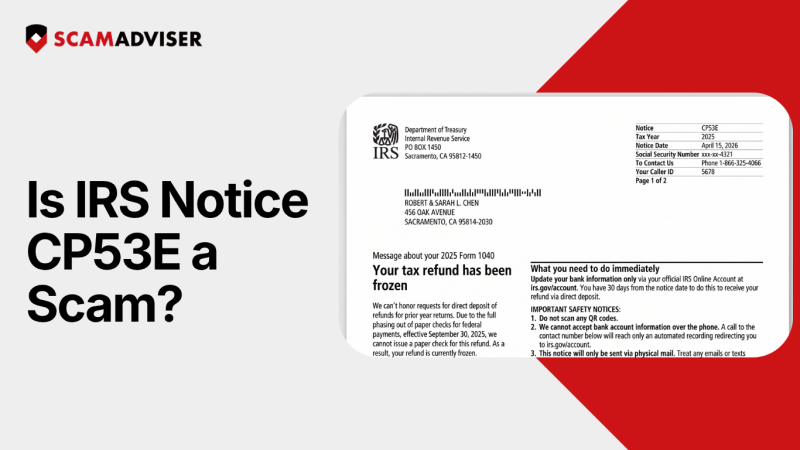
IRS Notice CP53E is an official letter the IRS sends when it has approved your tax refund but cannot deliver it electronically. This happens when:
The reason so many people are getting this notice in 2026 comes down to a single policy change. Under Executive Order 14247, signed by President Trump in March 2025, the Treasury Department was directed to stop issuing paper checks for federal payments — including tax refunds — effective September 30, 2025. This means that if you filed your 2025 return without valid direct deposit information, your refund is now frozen until you provide it.
The scale is significant. By early April 2026, the IRS had sent over 1.4 million CP53E notices, with hundreds of thousands issued in a single week during peak filing season. Members of the House Ways and Means Committee have raised formal concerns about refund delays exceeding 10 weeks for affected taxpayers.
In short: receiving a CP53E is not automatically a reason to panic. But receiving a fake one absolutely is.
Scammers have spotted the same opportunity you are reading about. Because millions of taxpayers are receiving CP53E notices — and millions more are expecting to — fraudulent versions of the letter are now being mailed and circulated online.
Here is what makes the fake version dangerous: it looks nearly identical to the real thing.
Cybersecurity researchers and government watchdogs have identified a fraudulent version of CP53E that differs from the legitimate notice in several key ways.
The fake letter typically includes:
The real IRS Notice CP53E contains none of these features. The legitimate notice directs you to update your banking information only through your IRS Online Account at irs.gov/account. It explicitly states that IRS employees cannot accept bank account information by phone — a line that was notably removed from the fake "altered version" identified by congressional investigators.
Important note on 866-325-4066: This number does appear on the legitimate CP53E notice as a contact option — but callers reach only an automated recording that redirects them to irs.gov/account. The IRS phone line for this notice cannot resolve your situation directly, and it cannot take bank account information. If someone calls you using this number, or a fake letter urges you to call a different number, treat it as a scam.
If the letter matches the profile of the real CP53E:
If you do not respond within 30 days, the IRS will eventually mail a paper check — but the process takes an additional six weeks, meaning your refund could be delayed by more than two and a half months total.
The CP53E situation creates particular hardship for two groups.
IRS Notice CP53E is real, and it is affecting well over a million Americans this filing season. The policy change driving it — the federal shift away from paper checks — is legitimate and ongoing.
But that legitimacy is exactly what makes it a powerful tool for scammers. A letter that looks official, references a real IRS notice, and arrives at a moment when you are already anxious about your refund is far more convincing than a cold phishing email.
The one rule that protects you: never update your banking information through a link, QR code, phone call, or anything other than typing irs.gov/account directly into your browser.
The IRS already knows you got the letter. You do not need to prove anything to them by clicking a code. You just need to log in, update your information, and move on — without giving scammers the chance to intercept your refund first.
Frequently Asked Questions
Will the IRS ever call me about my CP53E?
No. The IRS communicates about this notice exclusively through physical mail. Any phone call, email, or text about your CP53E is a scam.
Is the number 866-325-4066 legit?
That number appears on the actual CP53E notice, but it connects to an automated recording — not a live agent — and cannot help you update your banking information. If you received a call from someone claiming to be the IRS using this number, that is a spoof call. Hang up.
What if I already clicked the QR code or called the number in a fake letter?
Act immediately. Contact your bank to flag any accounts you may have referenced. Change your online banking passwords. File a report with the FTC at reportfraud.ftc.gov and submit the letter to phishing@irs.gov.
Do I have to provide my bank account to the IRS?
No. If you do not respond to a CP53E within 30 days, the IRS will eventually mail a paper check — but the wait time is six or more weeks beyond the notice date. Certain hardship waivers may also apply.
How do I know the letter really came from the IRS?
Check for the red flags listed above. The safest step is always to log in to your IRS Online Account independently at irs.gov/account and verify whether any action is needed — without relying on anything printed in the letter itself.
Have you received a suspicious letter claiming to be from the IRS?
Check phone numbers, websites, and links instantly using the ScamAdviser app before you act on anything. And if you've been targeted, report it so others can be warned.
Related articles you may find useful:
Adam Collins is a cybersecurity researcher at ScamAdviser who operates under a pseudonym for privacy and security. With over four years on the digital frontlines and 1,500+ days spent deconstructing thousands of fraud schemes, he specialises in translating complex threats into actionable advice. His mission: exposing red flags so you can navigate the web with confidence.

