

Harcourt LLP is being used in a fraudulent inheritance and life insurance scheme that targets people with promises of large, unexpected payouts. Reported communications have used names such as Douglas White and Harcourts PLLP, while asking victims to provide personal information or pay supposed legal, tax, or processing fees.
The name may also create confusion with Osler, Hoskin & Harcourt LLP, which is one of Canada's top corporate law firms founded in 1862. However, because they are a famous and trusted firm, scammers sometimes impersonate them or use confusingly similar names (like Harcourt LLP, Harcourts PLLP, or fake domain names) to steal money through inheritance or life insurance scams.
This review examines the reported Harcourt LLP claims, the warning signs surrounding the alleged inheritance offers, and what you should know before responding to such correspondence.
Harcourt LLP, as used in these inheritance related communications, is not a legitimate law firm offering the promised payouts.
Reports have identified names including Douglas White, Harcourt LLP, and Harcourts PLLP in correspondence offering supposed multi million dollar estate or insurance policy left by someone with your last name.
Multiple reports have been logged on the BBB Scam Tracker regarding this fraudulent entity. BBB Scam Tracker report describes a communication from Douglas White of Harcourt LLP involving a supposed $23 million accidental-death benefit. The recipient was allegedly told they could qualify because they shared the deceased person's last name and country of origin. BBB classified the report as phishing.
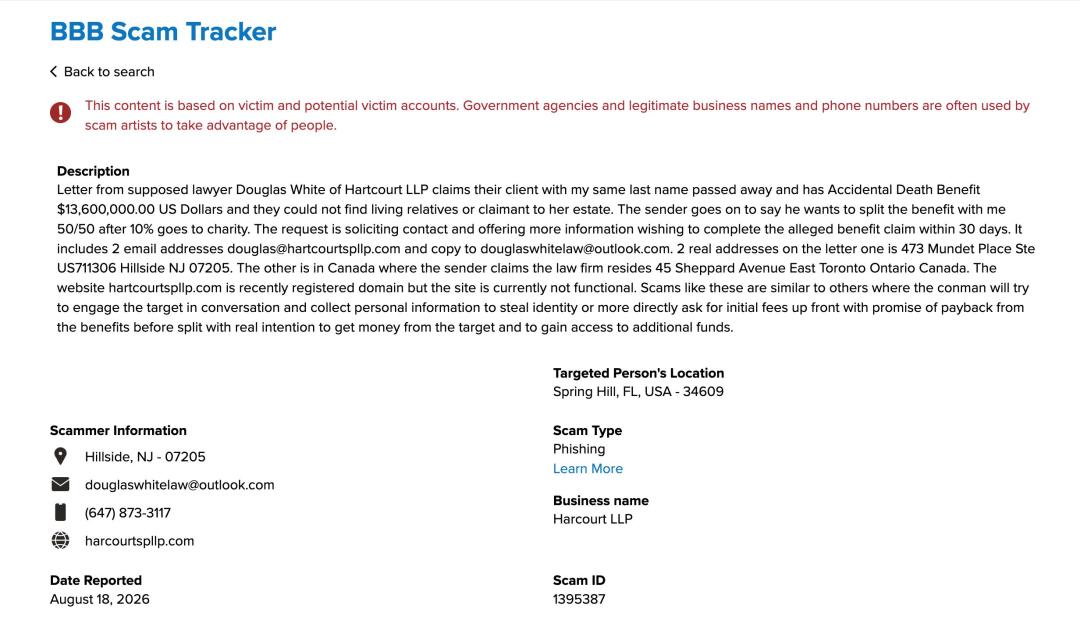
Another BBB Scam Tracker report involving Harcourt LLP described a supposed $13.6 million payout, with the proposed arrangement involving a 10% donation to charity and a 50-50 split of the remaining funds. BBB classified the report as phishing.
A separate BBB Scam Tracker report describes a supposed $13 million insurance policy, with the recipient allegedly identified as the deceased person's next of kin. The report lists Harcourt LLP and harcourtspllp.com and was classified by BBB as phishing.
BBB Scam Tracker also contains a report involving Douglas White and Harcourt LLP in which a letter allegedly used a deceased person with the recipient's same last name to support an inheritance claim. BBB classified the report as phishing.
The FTC has separately warned consumers about the broader pattern of fake lawyers claiming that someone with the recipient's last name died and left behind a multi-million-dollar life insurance policy.
This is where the name can cause confusion. Osler, Hoskin & Harcourt LLP, commonly known as Osler, is a genuine and leading Canadian business law firm. Its official website is Osler.com.
The firm has a long history dating back to 1862 and focuses on business and corporate legal work.
This means:
Osler, Hoskin & Harcourt LLP = legitimate law firm
Harcourt LLP / Harcourts PLLP used in these inheritance letters = fraudulent identity
Scammers can exploit the similarity between these names. Someone who searches for Harcourt law firm may find the real Osler firm and assume that the unsolicited letter is connected to it.
That assumption would be incorrect.
The scheme follows a recognizable inheritance and advance fee scam pattern as follows:
The communication may arrive through physical mail, email, or another online channel. The sender presents themselves as an attorney or legal representative of Harcourt LLP or Harcourts PLLP.
The name Douglas White may also appear as the supposed lawyer, sometimes with a title such as Principal Solicitor. The important point is that you did not contact this person or ask for help with an inheritance.
The sender claims that one of their clients has died and left behind an unclaimed life insurance policy, estate, or other financial asset. The deceased person supposedly has the same surname as you. You may then be told that you are a possible next of kin or beneficiary.
The supposed lawyer may suggest dividing the money between you, the law firm, and a charity. This may sound attractive because the victim is apparently being offered millions of dollars without having done anything.
But this is the hook. The FTC has warned about almost the same type of fraud, where fake lawyers claim that a deceased client left an unclaimed life insurance policy worth millions and that the recipient can share the proceeds. The FTC says the supposed lawyer is actually a scammer and that the promised insurance payout does not exist.
Once the victim responds, the scammer may request personal information.
This can include:
The information may then be used for identity theft or other fraudulent activity.
The scammer may next claim that money must be paid before the inheritance can be released.
The requested payment could supposedly be for:
The victim may be told that the payment is only temporary and that the much larger inheritance will be released afterward. This is the advance fee element of the scam.
One of the most important warning signs is the claim that you can receive millions simply because you share a surname with a deceased stranger. This is not a normal way to establish inheritance rights.
The FTC has repeatedly warned consumers about letters using this exact story. In its 2026 consumer warning, the FTC said people were again receiving letters from supposed law firms claiming that a client with the recipient's last name had died and that the recipient was the heir to a multi million dollar life insurance policy.
The FTC explains that contacting these senders can lead to requests for personal information, bank details, and money.
A website can be made to look professional while having no genuine connection to a real law firm.
The reported harcourtspllp.com domain appearing in BBB reports is one example associated with these communications.
If you are being contacted by someone claiming to be from Osler, Hoskin & Harcourt LLP, verify their legitimacy using these criteria:
If you receive a communication involving Harcourt LLP, Harcourts PLLP, or Douglas White and an unexpected inheritance or insurance payout:
The FTC specifically recommends not responding, not sharing personal information, and not sending money when receiving these fake inheritance or life insurance offers. Reports can be submitted through ReportFraud.ftc.gov.
Harcourt LLP, when used in the inheritance and life insurance communications described above, is part of a scam and should not be treated as a legitimate law firm offering you a multi million dollar payout.
The combination of an unsolicited approach, a deceased person with your surname, a supposed multi million dollar insurance or inheritance payout, the names Douglas White and Harcourts PLLP, and requests for personal information or upfront payments are major warning signs.
At the same time, Osler, Hoskin & Harcourt LLP is a legitimate and established Canadian business law firm. Its genuine website and offices are independently verifiable.
The similarity between the names is deliberately used by scammers to create confusion, which is why extra caution is necessary.
If you receive an unexpected Harcourt LLP inheritance letter, do not respond, do not send money, and do not provide personal information. Verify the claim independently through the genuine law firm's official channels and report the suspicious communication.
Disclaimer: The information in this article is provided for educational and awareness purposes. Company names, phone numbers, sender names, and other details referenced may have been impersonated, spoofed, or otherwise misused by scammers. Their appearance in this article does not necessarily identify the legitimate company, owner of a phone number or account as being involved in fraudulent activity.
This article has been written by a Scam Fighter Contributor, De-Reviews.com Team. If you believe the article above contains inaccuracies or needs to include relevant information, please contact ScamAdviser.com using this form.
De-Reviews.com Team is a group of scam researchers, editors, and online safety advocates dedicated to exposing online fraud and helping consumers stay safe online. The team has been investigating scams, fraudulent websites, phishing campaigns, and other online threats since 2014. Read the Full Author Profile.
