

Short answer: Paid2watch.co is likely not a genuine way to earn money. The site promises cash for watching short videos, but its trust signals do not hold up. Payout pop-ups appear designed to persuade rather than inform, the claimed member base leaves almost no trace in public reviews, and the domain is only about a week old.
The pitch is simple: "Watch reels and short videos to earn real money." For anyone who already scrolls through TikTok or Instagram for hours, getting paid for it sounds like easy money.
That simplicity is the hook. Advertisers do pay for attention, but they rarely pay individual viewers meaningful sums just for watching. When a site offers real cash for a passive activity, it is worth asking where that money is supposed to come from.
While you browse, small notifications slide onto the screen showing other "members" being paid. Examples include:
These pop-ups are a well-known persuasion tactic called social proof. They make it look as though money is flowing out to ordinary people every few minutes. Nothing on the site lets a visitor confirm that these people exist or that any payment was made. Scripts that generate fake names and random amounts are cheap and easy to install, so pop-ups like these prove nothing on their own. A $1,000 payout for watching short videos would also be far beyond what genuine reward apps typically pay.
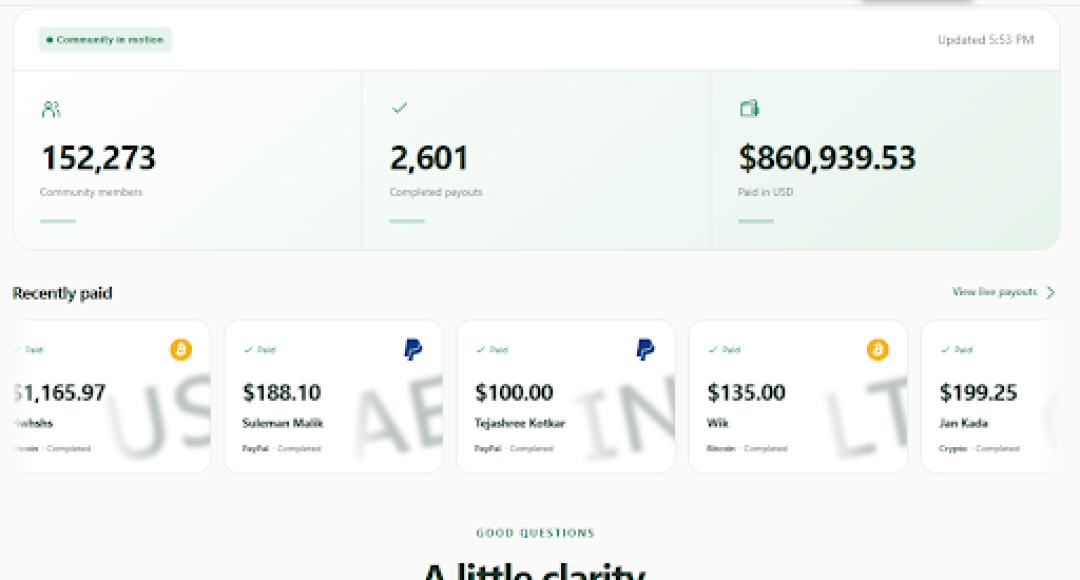
Paid2watch.co claims to have more than 150,000 members. If that were true, at least some of them would be expected to share their experience online. Yet the site's Trustpilot page has zero reviews. The profile is unclaimed and lists Colombia as its location.
A silent review page does not prove a site is fake. But a huge, highly paid membership that leaves no public footprint at all is hard to square with the numbers the site advertises.
The ScamAdviser report for paid2watch.co gives the site a low TrustScore. Part of the reason is that it is a relatively new website. Plus, the idea of watching videos to earn money has long been established as a task scam.
The domain was registered on 30 September 2026, making it roughly one week old. Its traffic rank is low, and its registrar is also used by many low-scoring sites. ScamAdviser itself advises taking extra time to check very young sites, since scam sites often disappear after a few months.
That timeline matters. A week-old site advertising 150,000+ members and payouts of up to $1,000 is making claims that its own age makes very hard to believe.
There is a high possibility that Paid2watch.co is not what it claims to be. "Watch to earn" sites commonly follow a familiar pattern: your balance grows quickly, but cashing out requires a minimum threshold, a verification fee, an upgrade or recruiting friends. The payout never quite arrives, and the time or money you put in is lost.
Before signing up for any earn-money site, check its age and reviews with a website checker and look for real, detailed user experiences. Never pay a fee to unlock a withdrawal, and never share card details, crypto wallet keys or ID documents with a site you cannot verify.
If you already joined, stop putting in time or money. Change any password you reused there. If you paid anything, contact your bank or payment provider straight away, and Report a Scam to help warn others.
Likely unsafe as a way to earn money. A one-week-old site with unverifiable payout pop-ups, a claimed 150k+ members and no reviews shows several classic warning signs. Its fair technical rating means the site is not obviously malicious to visit, not that its earnings promise is real.
This article has been written by a scam fighter volunteer. If you believe the article above contains inaccuracies or needs to include relevant information, please contact ScamAdviser.com using this form.
Adam Collins is a cybersecurity researcher at ScamAdviser who operates under a pseudonym for privacy and security. With over four years on the digital frontlines, he specialises in translating complex threats into actionable advice. His mission: exposing red flags so you can navigate the web with confidence.
