
Millions of shoppers swear by Temu's unbelievably low prices, but is every bargain really worth the risk? Before you fill your cart, here's what regulators, customer complaints, and ScamAdviser's data reveal about one of the world's most controversial shopping apps.
In a Nutshell
Temu is a legitimate marketplace - but "legitimate" does not mean "risk-free." ScamAdviser rates Temu.com as Very Likely Safe, with a strong Trust Score of 100. It has strong signals including a high-traffic domain registered since 2003, valid SSL, and reliable payment methods. At the same time, the European Commission fined Temu €200 million on May 28, 2026 for failing to prevent illegal products on its platform, and 95% of toys tested by EU consumer groups failed safety regulations. Here is what you need to know before you shop.
Temu is an online marketplace owned by Whaleco Inc., a subsidiary of PDD Holdings - one of the world's largest e-commerce companies, which also operates Pinduoduo in China. Temu launched in the United States in September 2022 and now operates in 79 countries.
Its business model is built on ultra-low prices through direct factory-to-consumer shipping, cutting out traditional retail middlemen. That is why a kitchen gadget that costs $25 on Amazon can appear on Temu for $4.
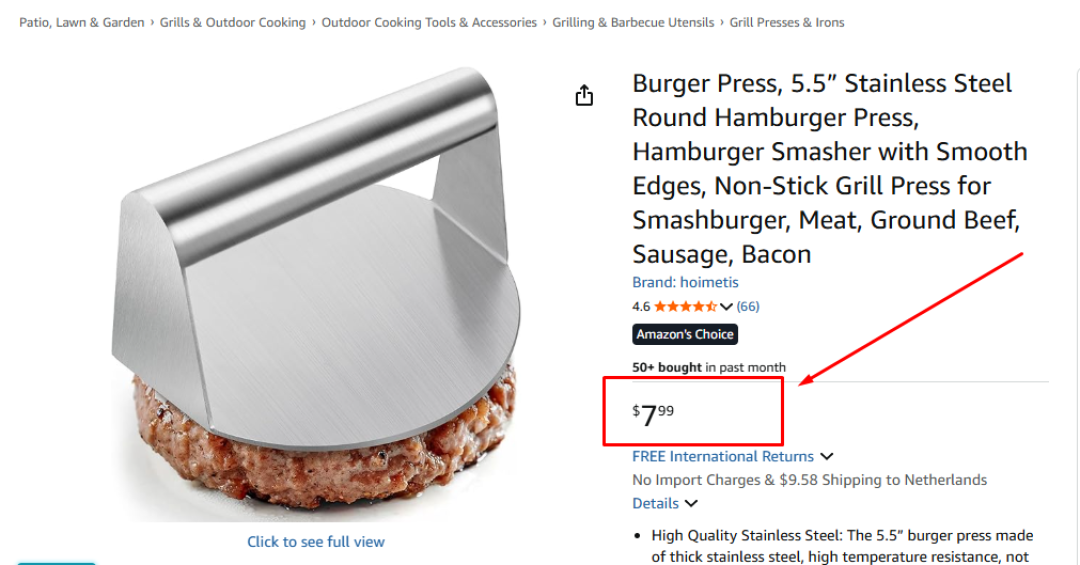
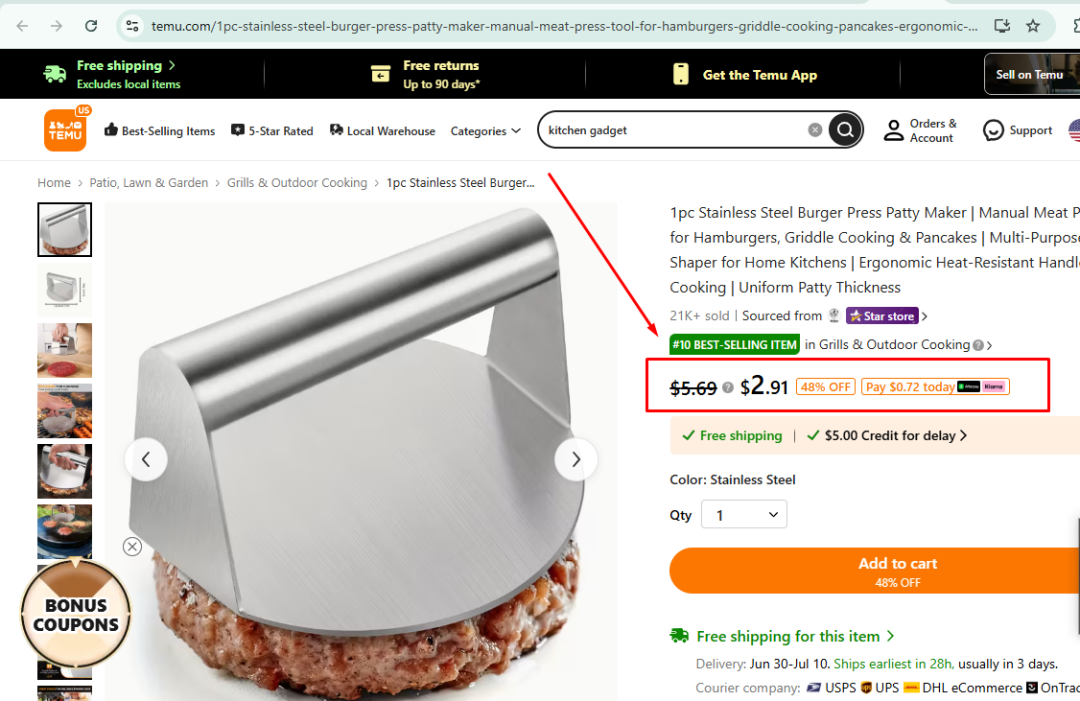
The platform is headquartered in Dublin, Ireland, and is legally incorporated in the United States under Whaleco Inc.
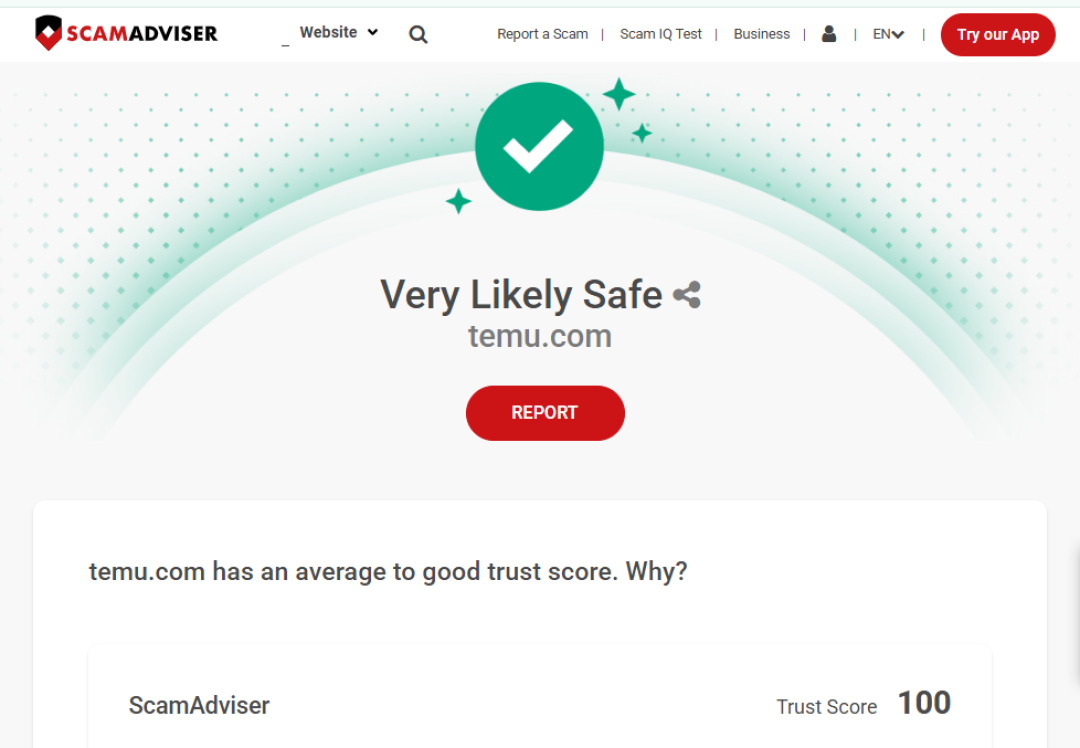
ScamAdviser rates Temu.com as Very Likely Safe with a TrustScore of 100. Here is what drives that rating:
The bottom line from ScamAdviser: Temu is not a scam website. It is a real, operating marketplace. The risks are not about whether your order will arrive - they are about product safety in specific categories and how your personal data is handled.
The honest answer depends entirely on what you are buying.
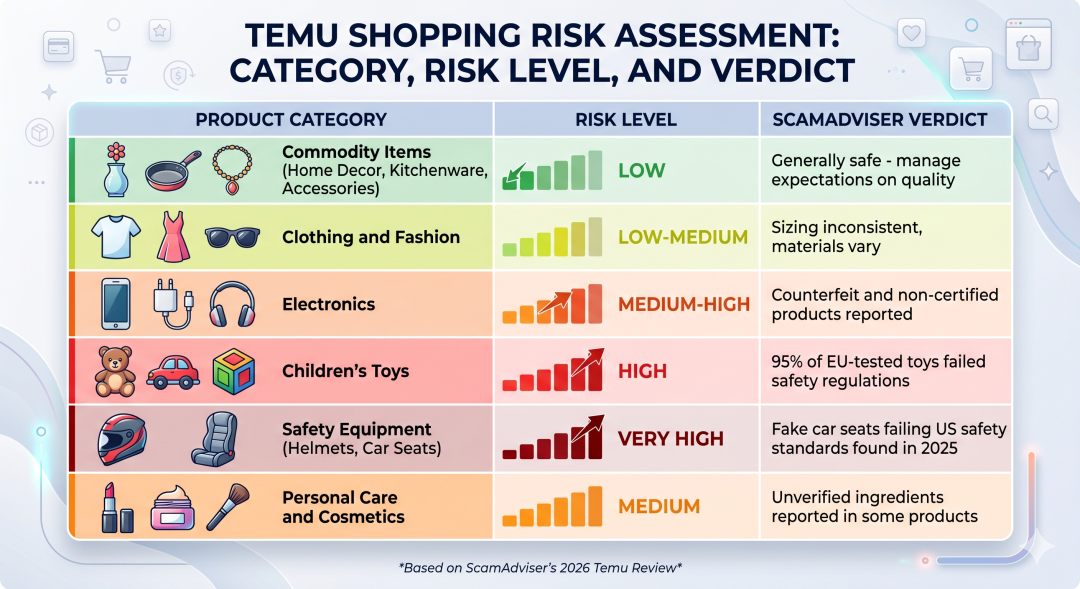
The platform itself will process your order, ship your goods, and offer a refund window. What it cannot guarantee is that every third-party seller on its marketplace meets safety standards - and that is exactly what regulators have been penalizing it for.
On May 28, 2026, the European Commission issued a €200 million fine against Temu under the Digital Services Act (DSA).
The finding: Temu failed to diligently identify, analyze, and assess the systemic risks of illegal products being offered on its platform. The Commission's investigation - which began in October 2024 and relied on EU customs data, mystery shopping exercises, and third-party testing - found that Temu's own risk assessments were "inaccurate and relying on general industry information rather than specific details about its own marketplace."
In plain terms: Temu knew dangerous products were on its platform and did not do enough to stop them.
Temu has until August 28, 2026 to submit a remediation plan. Failure to comply could result in additional periodic penalties.
This followed an earlier US enforcement action. In September 2025, the FTC settled with Whaleco Inc. for $2 million - the first-ever INFORM Consumers Act enforcement case - for failing to provide shoppers with required transparency tools and seller identification on its platform.
This is where the picture becomes more complicated.
Temu's parent company, PDD Holdings, is the subject of active legal allegations that its Chinese app Pinduoduo embedded malware and spyware. While Temu and Pinduoduo are separate applications, they share the same parent company and corporate infrastructure.
What is confirmed about Temu's data practices:
None of the spyware allegations against Pinduoduo have been proven in court as of mid-2026. However, the pattern of data collection is well-documented, and limiting your exposure is a reasonable precaution regardless of the legal outcome.
Practical steps to protect your data on Temu:
Temu itself is not a scam - but scammers actively exploit its popularity. These are the most reported scams associated with the platform:
Temu's own gamified shopping experience (wheel spins, free gift offers) is frequently mimicked by scammers on social media. Real Temu promotions exist inside the app only - any external site or ad promising free Temu credits should be treated as suspicious.
Scammers create fake Temu discount codes on TikTok, Instagram, and Facebook that redirect to phishing sites. Always verify codes through the official Temu app or Temu.com directly.
Sellers on Temu's marketplace are not all verified. Branded goods - particularly electronics, sportswear, and cosmetics - carry a significant risk of being counterfeit.
Scammers pose as Temu support agents via email or WhatsApp, asking for account credentials or payment details. Temu support only operates through its official in-app chat.
Temu has a legitimate affiliate program, but fake affiliate links circulate widely on social media. Always verify that a Temu link leads to Temu.com before clicking.
The customer review picture is mixed, and the platform you look at matters.
Trustpilot: 1.9 out of 5 stars from over 52k reviews (as of June 2026). Most common complaints: orders not received or significantly delayed, products not matching descriptions, refund difficulties, and misleading promotional games. A minority of reviewers report positive experiences, typically for low-cost commodity items.
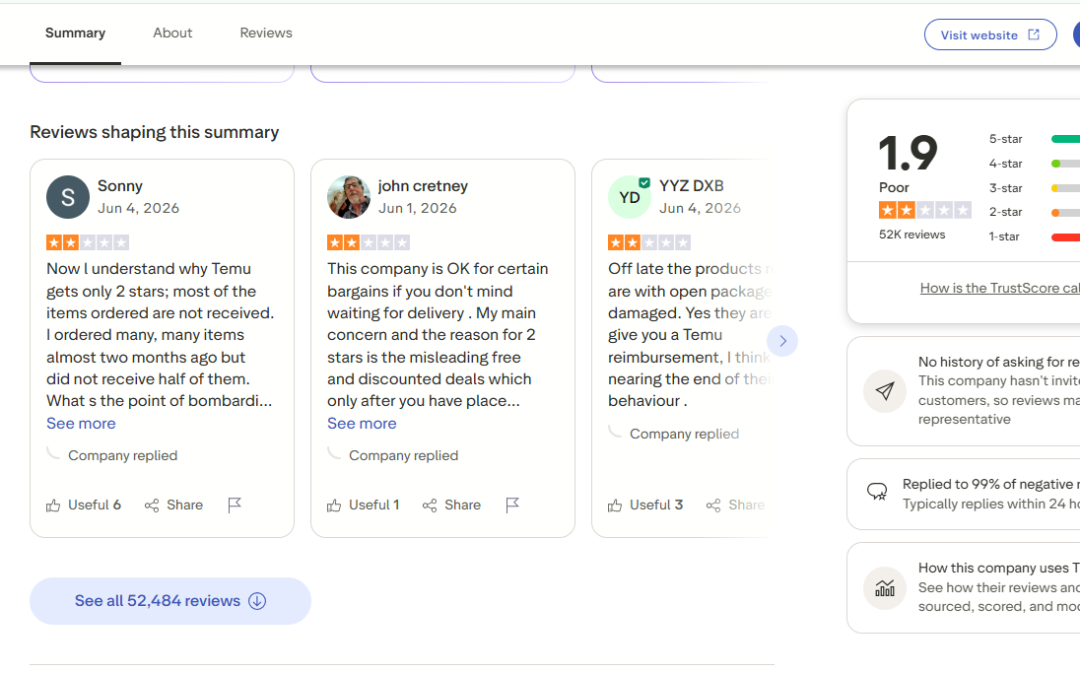
A counterpoint worth noting: Temu made USA TODAY's America's Best Customer Service 2026 list for the second consecutive year. This is an independently verified ranking, suggesting that official customer service channels perform better than the BBB and Trustpilot data implies. The gap likely reflects the difference between users who engaged official support versus those who did not.
The pattern that emerges: Temu is reasonably reliable for cheap commodity items where quality expectations are low. It becomes significantly riskier for higher-value purchases, safety-regulated products, or situations requiring refunds.
If you choose to shop on Temu, these steps will meaningfully reduce your risk:
Temu is legitimate. It is not risk-free.
The platform is a real, operating marketplace backed by one of the world's largest technology companies. Your order will, in most cases, arrive. The prices are genuinely low for commodity items.
The risks are real and specific: product safety in regulated categories is a documented problem, confirmed by EU regulators and independent testing. Data privacy deserves caution given the parent company's legal history. Refunds can be difficult to obtain. Promotional games are frequently misleading.
Use Temu for what it is good at - inexpensive household items, accessories, and non-safety-critical goods - with appropriate precautions. Avoid it for anything where safety, quality, or data security genuinely matters.
Frequently Asked Questions
Is Temu a scam?
No. Temu is a legitimate marketplace operated by Whaleco Inc., a subsidiary of PDD Holdings. ScamAdviser rates Temu.com as Very Likely Safe. However, scammers actively impersonate Temu through fake promotions, counterfeit social media accounts, and phishing sites. The platform itself is real - the risks come from third-party sellers and external scammers exploiting its popularity.
Is Temu safe to buy from?
Temu is generally safe for low-cost commodity items such as home accessories, kitchenware, and basic clothing. It carries significantly higher risk for safety-regulated products including children's toys, helmets, car seats, and electronics. The EU fined Temu €200 million in May 2026 for failing to prevent illegal products in these categories.
Why did the EU fine Temu?
The European Commission fined Temu €200 million on May 28, 2026 under the Digital Services Act. The finding was that Temu failed to properly assess the systemic risks of illegal products on its platform. EU consumer testing found that 95% of toys purchased on Temu violated EU safety regulations. Temu has until August 28, 2026 to submit a remediation plan.
Is Temu owned by China?
Temu's parent company, PDD Holdings, was founded in China and operates Pinduoduo, China's largest agricultural e-commerce platform. PDD Holdings is now incorporated in Ireland and listed on the Nasdaq. Temu itself operates in the US under Whaleco Inc. The company has Chinese origins but operates as a global, publicly listed entity.
Is Temu safe for my personal data?
There are legitimate concerns. Temu collects significant device and behavioral data, shares it with third-party brokers, and users report spam increases after signing up. Temu's parent company faces ongoing legal allegations about data practices in its Chinese app. To minimize risk: use an alias email, restrict app permissions, and pay through PayPal or Apple Pay rather than storing card details in the app.
What is Temu's trust score on ScamAdviser?
ScamAdviser rates Temu.com as Very Likely Safe. Positive factors include its high global traffic ranking (Tranco 950), domain age of over 23 years, valid SSL certificate, and acceptance of buyer-protected payment methods. The hidden WHOIS data and low-tier SSL type are noted as minor concerns but do not affect the overall rating.
What should I never buy on Temu?
Based on EU regulatory findings and independent testing, avoid purchasing children's toys, car seats, bike helmets, lava lamps, and other safety-regulated electrical items from Temu. These categories have the highest documented rates of non-compliance with safety standards.
How do I report a scam related to Temu?
If you encounter a fake Temu website, phishing email, or fraudulent seller, report it to ScamAdviser here. You can also report to the FTC at reportfraud.ftc.gov (US) or your national consumer protection authority.
See Some Interesting Articles from ScamAdviser:
Spotted a scam connected to Temu? Report it to ScamAdviser and help protect other shoppers.
Check any website's trust score instantly at ScamAdviser.com
Adam Collins is a cybersecurity researcher at ScamAdviser who operates under a pseudonym for privacy and security. With over four years on the digital frontlines, he specialises in translating complex threats into actionable advice. His mission: exposing red flags so you can navigate the web with confidence.
