
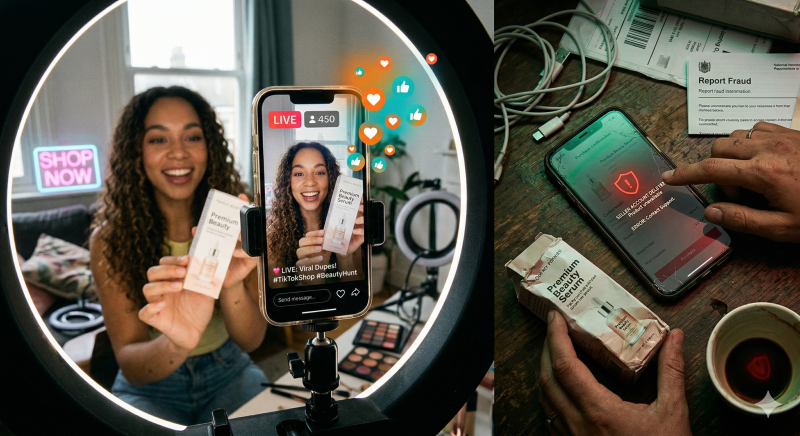
TikTok Shop processed a staggering $64.3 billion in merchandise sales in 2025. While millions of users receive exactly what they ordered, the marketplace has also become a primary target for sophisticated retail fraud. In the first half of 2025 alone, TikTok shut down 700,000 seller accounts for violating safety and authenticity policies. So, is TikTok Shop safe? The answer is: it can be — but the burden of verification falls heavily on you.
In a Nutshell
The core danger of TikTok Shop is not the platform itself, but the speed at which it operates. Scammers exploit the "viral" algorithm to push low-quality goods to millions of people before moderators can react. Here are the four primary ways shoppers lose money on the app today.
Finally, security researchers documented 15,000 fake TikTok Shop domains in 2025 — part of a campaign dubbed "FraudOnTok" — designed to steal credentials and deliver malware. These sites look identical to the real TikTok interface but harvest credit card data or install spyware. These links usually arrive via unsolicited DMs or external ads rather than through the official app.
TikTok is not ignoring the problem; the platform's survival depends on user trust. According to TikTok's own Shop Safety Report, the company has implemented several layers of defence. Knowing these limits helps you understand where you need to take over the verification process yourself.
Strict seller verification is the first line of defence. Every seller must provide government-issued ID or official business registration documents to open a shop. In the first half of 2025, TikTok declined 1.4 million registrations because applicants could not meet these standards.
AI moderation screens every listing before it goes live, looking for banned keywords, suspicious pricing, and stolen imagery. This system blocked 70 million individual products from being listed in early 2025 — a 40% increase from the previous six months — preventing millions of potential scams from ever reaching consumers.
The Buyer Protection Program provides a safety net for those who do get burned. It offers a 30-day return window on most items and a 90-day window to dispute undelivered or misrepresented products. In the US, the platform has partnered with 55,000 drop-off locations to make returns easier for defrauded customers.
However, these protections have a hard boundary. They do not cover any transaction made outside the official checkout button. If you follow a link to an external website or pay a seller directly through a messaging app, TikTok cannot — and will not — help you recover your money. This is why platform hopping, from TikTok to maybe WhatsApp, is a very bad idea.
You should never rely solely on a viral video to judge a seller's legitimacy. Scammers are experts at making fake products look convincing on camera. Work through this checklist before you hit "buy."
Check for the blue verified tick on the seller's profile. If a shop claims to be an official "Apple" or "Nike" reseller but lacks verification, it is almost certainly a scam.
Analyse the pattern of reviews, not just the star rating. TikTok only allows reviews after a confirmed delivery, but scammers still find ways to buy fake reviews. Multiple reviews posted on the same day using similar language is a classic red flag for a manipulated rating.
Check the shop's registration date. A seller that registered two weeks ago but already has thousands of "authentic" luxury items is a high-risk entity. Legitimate distributors of high-end goods have a long-standing digital footprint and a history of consistent sales.
Verify any external website independently. If a TikTok creator points you to a "link in bio" instead of the TikTok Shop tab, check that URL against TikTok's own counterfeiting guidance and paste it into ScamAdviser's search bar. Our Trust Score checks the domain's age, server location, and whether it has been flagged for malware or phishing.
Use the ScamAdviser app for real-time protection. If a seller sends you a discount link in a DM, the app can identify whether that link leads to one of the thousands of fake domains documented in 2025. A ten-second check is the difference between a successful purchase and a stolen identity.
Not all products on TikTok Shop carry the same risk. These categories are scam magnets because they are easy to fake and carry high profit margins.
FAQs
Is TikTok Shop safe for your credit card?
Yes—payments are secure within the app, but avoid entering details on external links pretending to be TikTok.
Why is TikTok Shop so cheap?
Prices are low due to subsidies and direct-from-manufacturer selling, but unreal deals often signal fakes or scams.
What happens if you get scammed on TikTok Shop?
Report it in-app, gather evidence, and contact your bank or local fraud authorities immediately.
Does TikTok Shop have buyer protection?
Yes, but only if you keep payments and communication within the platform.
Are TikTok Shop products real?
Many are, but always verify the seller since counterfeit and policy-violating items still exist.
Is TikTok Shop safe?
It is safe if you verify the seller — and risky if you trust the algorithm.
Adam Collins is a cybersecurity researcher at ScamAdviser who operates under a pseudonym for privacy and security. With over four years on the digital frontlines and 1,500+ days spent deconstructing thousands of fraud schemes, he specialises in translating complex threats into actionable advice. His mission: exposing red flags so you can navigate the web with confidence.
