
Xenpaid.com shows the warning signs of a task scam combined with a referral pyramid, and we recommend you do not join it or deposit money. The domain was registered on 16 September 2026, yet the homepage claims more than 2.4 million members in 115+ countries. ScamAdviser gives xenpaid.com a Trust Score of 56.
XenPaid calls itself a Singapore community and advertising platform. It says members earn USDT for watching ads, checking in daily, sharing stories and inviting friends. Payouts only start at a $100 balance and go to a USDT (BEP20) wallet. Support runs through a Telegram bot.
If you landed here asking "is this website legit?", this guide walks through what XenPaid claims, why the model looks like schemes we have covered before, and how to check a site yourself.
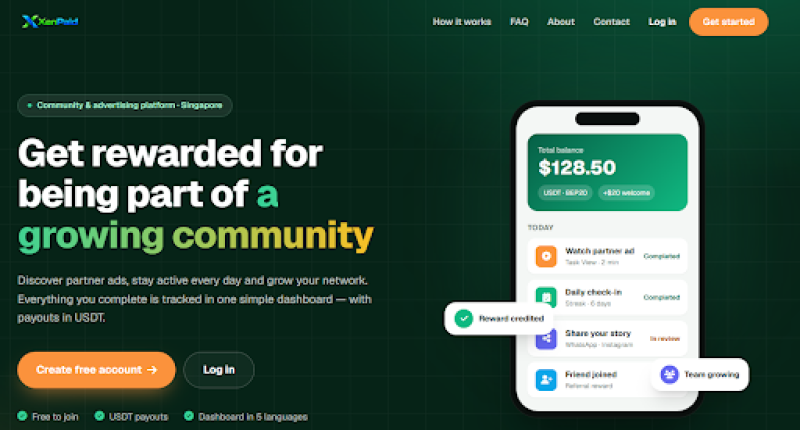
Xenpaid.com says it pays ordinary people in USDT for small online actions that help advertisers. Its About page describes a Singapore company at 138 Robinson Road that connects advertisers with members who view their content.
The homepage lays out four steps:
The dashboard preview on the homepage shows a 128.50balancewitha"+20 welcome" bonus. Spanish-language YouTube promoters advertise a 10 USDT sign-up gift and post their own referral links. The dashboard runs in English, Vietnamese, Korean, Spanish and Filipino.
The site also promotes an XNP token on BNB Smart Chain. It launched on 26 September 2026 with 10 million tokens. XenPaid holds 4 million of them (40%) in a "project wallet" for community milestone rewards, such as building a team of active members.
What this means for ordinary users: every income stream on this list is either a repetitive click task or a reward for bringing in new people. None of them is something a real advertiser has a clear reason to pay for.
Xenpaid.com matches the task scam pattern described by US regulators almost point for point. The FBI's June 2024 warning, Alert I-060424-PSA, describes fake work built on simple repeated tasks, a confusing pay structure, crypto payments and a dashboard that shows earnings you cannot actually cash out. Here is how XenPaid lines up.
XenPaid says its ad tasks, check-ins and story shares are each tracked in your dashboard. Advertisers pay for real customers, and a daily check-in creates nothing for them. Story shares that promote XenPaid itself are advertising for the platform, paid for by the platform
Key distinction: real ad networks pay publishers who own websites or channels with audiences. They do not pay random sign-ups to tap a button every morning.
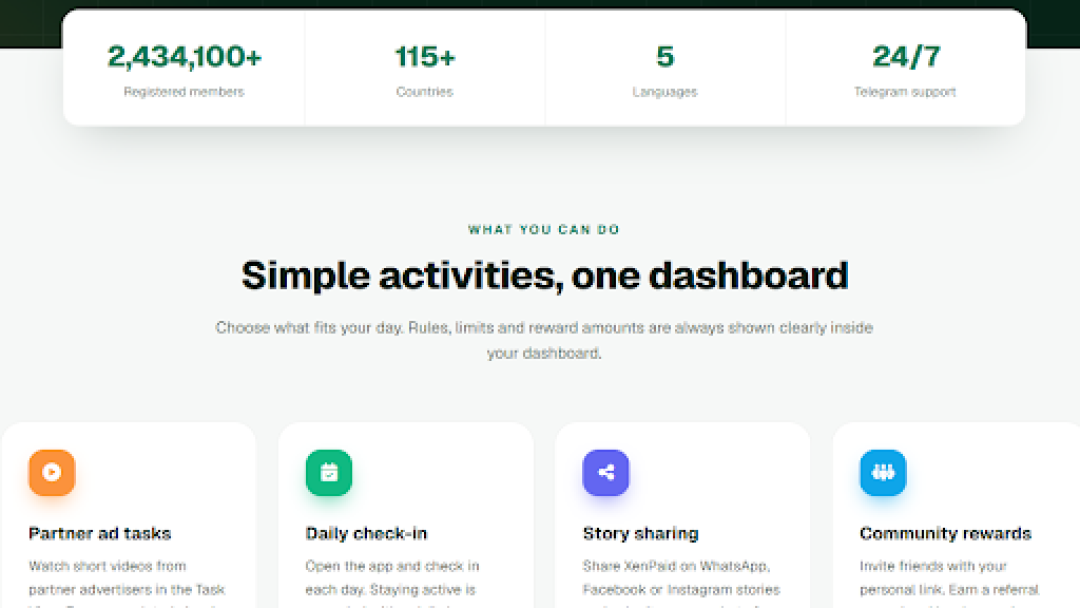
The WHOIS registration date for xenpaid.com is 16 September 2026, per ScamAdviser. The homepage claims 2,425,900+ members. That figure also changed between our checks, from 2,430,600+ in an earlier snapshot to 2,425,900+ on 7 October 2026. Real member counts do not go down while a site is advertising growth.
The dashboard shows a starting balance and a $20 welcome bonus. The FBI warns that task scams use exactly this kind of fake interface to show earnings that never become withdrawable.
A high cash-out floor means most users must keep working, or keep recruiting, before they can test a single withdrawal. Many task scams also ask for a "fee" or "tax" once users near the threshold.
The FAQ says registration is "currently free" and that any fee change will be announced on Telegram. Legit platforms that pay you for work do not plan to start charging you to join.
The core danger: every one of these features moves trust and money in one direction, toward the operator. Is this website safe to give your phone number, email and wallet address? Based on these signs, we do not think so.
XenPaid pays members for recruiting other members, which is the main warning sign of a pyramid scheme. Step 3 on the homepage tells users to share their referral link and "build your team". The site promises a referral reward per friend plus level rewards as the team grows, and its XNP token is handed out for team-building milestones.
In a pyramid, the money flowing out to early members comes from new members, not from outside customers. Once sign-ups slow, payouts stop, and the people at the bottom lose the most. Your friends and family become the next layer.
The US Securities and Exchange Commission described this exact setup in its case against Forsage. On 1 August 2022 the SEC charged 11 people over a crypto pyramid and Ponzi scheme that raised more than $300 million from millions of investors. Forsage ran on smart contracts on Ethereum, Tron and Binance chains, and members earned by recruiting others.
Key distinction: a "verified" or "ownerless" token contract only describes the code. XenPaid's token page lists these features, but code audits say nothing about where the reward money comes from or whether the business is real.
What this means for ordinary users: if most of the money you could earn depends on signing up people you know, you are being asked to sell the scheme, and they carry the risk.
Paying only in USDT on BNB Smart Chain and offering support only through Telegram leaves members with no way to recover money if something goes wrong. Crypto transfers cannot be reversed, and a Telegram bot can vanish overnight.
The FBI's 2025 Internet Crime Report logged 181,565 complaints involving cryptocurrency, with more than $11.36 billion in losses. That is over half of the $20.877 billion in total losses reported to the FBI that year. The FTC's December 2024 Data Spotlight found crypto losses to job scams reached about $41 million in the first half of 2024 alone, close to double the roughly $21 million reported for all of 2023.
XenPaid lists the bot @xenpaidsupportbot and in-app tickets as its help options. There is no phone number and no named staff. If withdrawals stop, a Telegram channel can be deleted or renamed in seconds.
The site gives a Singapore street address but we did not find a company registration number (UEN) on the homepage, About page or Token page. Any real Singapore company can be looked up on Bizfile, the official ACRA business registry. An address on a footer proves nothing by itself.
The core danger: when the only way in is a wallet address and the only way to complain is a chatbot, the operator holds every card.
Most task scams follow the same arc: small early rewards build trust, then withdrawals get blocked until the victim pays more. The FTC's Data Spotlight found task scam reports rose from zero in 2020 to 5,000 in 2023, then to about 20,000 in just the first half of 2024. Task scams made up nearly 40% of job scam reports in that period, and total reported job scam losses passed $220 million in those six months.
The typical stages look like this:
CBEX was a USDT-based platform popular in Nigeria and Kenya that paid referral bonuses and promised fast returns. TechCabal reported that withdrawal problems surfaced around 10 April 2025 and the collapse was widely acknowledged by 15 April. Early local estimates put losses as high as ₦1.3 trillion, about $800 million, though other analysts say the true figure is lower. Legit.ng reported that CBEX then told users to deposit a further $100 or $200 to unlock their frozen funds.
What this means for ordinary users: CBEX ran for about 9 months before it froze. XenPaid has been online for about 3 weeks. Early payouts from any such platform prove only that new money is still coming in.
You can tell if a site is legit in about 10 minutes by checking its age, its business details and how it makes money. Run these checks on XenPaid or any "earn by tasks" platform before you hand over personal details.
Key distinction: a valid SSL padlock only means the connection is encrypted. ScamAdviser found xenpaid.com uses a free, domain-validated Let's Encrypt certificate, which anyone can get in minutes.
ScamAdviser gives you a free scam checker that grades any site in seconds, so you do not have to dig through WHOIS records yourself. Enter a domain and it pulls together domain age, registrar risk, hosting reputation, SSL type and user reviews into one Trust Score.
For xenpaid.com, the ScamAdviser report flags four negatives: a low Tranco traffic rank, a registrar with a high share of spam and fraud sites, a very young domain, and a host with a bad reputation. The only positives are a valid SSL certificate and a clean result from DNSFilter.
A few other ScamAdviser resources fit this situation:
What this means for ordinary users: one search on a URL checker would have shown that xenpaid.com was born in mid-September 2026. That alone is enough reason to stop.
Stop depositing money, stop recruiting, and secure your accounts today. Never pay a fee, tax or "upgrade" to release a balance. In the CBEX case, that unlock payment was the final step of the scam.
The core danger: victims of one scam are the top target for the next one. Anyone who contacts you promising to recover your USDT for a fee is almost certainly a scammer.
We found no evidence that Xenpaid.com is a legit advertising platform. It is 3 weeks old, scores 56 on ScamAdviser, names no advertisers and pays mainly for tasks and recruitment.
Some users may receive small early payouts. The FTC says task scams often pay small amounts at first to build confidence before asking for larger deposits.
XenPaid says it does not sell investments or promise fixed returns. Calling a scheme "not an investment" does not change how it works if the payouts depend on new members.
Even without a deposit, you hand over your name, email, phone number and wallet address. That data can be sold or used for targeted scams.
XNP is a BNB Smart Chain token XenPaid launched on 26 September 2026. XenPaid controls 40% of the supply and gives it out as rewards for team-building.
Paste it into a website safety checker like ScamAdviser. Look at the trust score, domain age and whether the owner is hidden.
This article has been written by a scam fighter volunteer. If you believe the article above contains inaccuracies or needs to include relevant information, please contact ScamAdviser.com using this form.
Adam Collins is a cybersecurity researcher at ScamAdviser who operates under a pseudonym for privacy and security. With over four years on the digital frontlines, he specialises in translating complex threats into actionable advice. His mission: exposing red flags so you can navigate the web with confidence.
