
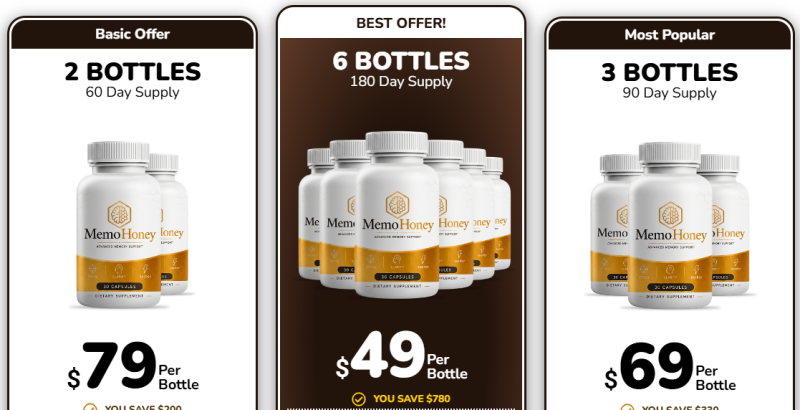
If you're asking is this website safe before ordering MemoHoney, here's what we found. The brand leans on FDA and GMP logos it can't back up, lists a support email that doesn't match its own domain, and offers no independent evidence for its memory claims. None of that confirms fraud outright, but it's enough to slow down before you buy.
In a nutshell
MemoHoney's marketing uses FDA, GMP, and GMO logos on its pages. We found no supporting documentation tying MemoHoney to actual FDA approval. This matters because dietary supplements fall outside the FDA's pre-market approval process entirely. The FDA doesn't review or approve supplements before they go on sale, the way it does with prescription drugs. A logo suggesting otherwise is decoration, not certification, and it's a trick that shows up again and again across this corner of the supplement industry.
MemoHoney is marketed as a capsule developed for oral use, manufactured in the USA, and positioned to support daily mental clarity, sustained energy, and general cognitive well-being without causing anxiety. That's a specific set of promises.
We found no independent research, clinical trial, or peer-reviewed study backing MemoHoney's specific formula or the exact claims made about memory, focus, or cognitive health. Ingredients common to this category of product show up across the supplement industry generally, but common doesn't mean proven, especially not for one brand's particular blend and dosage.
MemoHoney's listed support address is contact@customercs.com, which has nothing to do with the MemoHoney domain itself. A generic, unrelated support email is a small detail on its own, but it's a common thread across supplement operations that run several near-identical shop fronts under one back office. If something goes wrong with your order, you're emailing an address that isn't tied to the brand you thought you bought from, which makes any dispute harder to trace.
Here's how to check if a website is legit before you order something like MemoHoney.
Look up the support email and compare it against the website's own domain name. A mismatch, especially a generic one like "customercs," is worth noting.
Search the product name alongside terms like "reviews" or "complaints" and see whether it's sold across several different domains with slightly different branding. That pattern shows up often with supplements marketed this way.
Treat FDA, GMP, and GMO logos as claims to verify, not proof on their own. A real certification can usually be confirmed through the relevant agency directly.
Run the site through a website safety checker such as ScamAdviser. Even when a specific listing isn't available yet for a newer domain, checking the parent brand or related shop URLs can surface useful signals.
FAQs
Does MemoHoney have FDA approval?
No. Supplements as a category aren't FDA approved, and we found nothing supporting the FDA, GMP, or GMO logos used on MemoHoney's pages beyond the logos themselves.
Does MemoHoney actually improve memory or focus?
There's no independent clinical evidence for MemoHoney's specific formula. General ingredients used across the cognitive supplement category haven't been shown to work in this exact combination or dosage.
Why does MemoHoney use a different email than its own website?
The listed support address, contact@customercs.com, doesn't match the MemoHoney domain. This kind of mismatch is common among operations running multiple similar-looking supplement storefronts from one shared back office.
Is MemoHoney safe to order from?
Given the unverified certification claims and the mismatched contact email, it's worth treating this purchase with real caution and paying with a method that allows for a dispute if needed.
How do I check if a supplement website like this is safe to use?
Compare the support email to the site's own domain, search for the product name to see if it's sold across multiple lookalike websites, and verify any FDA or GMP claims directly rather than trusting the logo.
Bottom Line: Is MemoHoney Safe?
Overall, we have doubts about MemoHoney. Here is why:
This article has been written by a scam fighter volunteer. If you believe the article above contains inaccuracies or needs to include relevant information, please contact ScamAdviser.com using this form.
Adam Collins is a cybersecurity researcher at ScamAdviser who operates under a pseudonym for privacy and security. With over four years on the digital frontlines, he specialises in translating complex threats into actionable advice. His mission: exposing red flags so you can navigate the web with confidence.
