
In a Nutshell
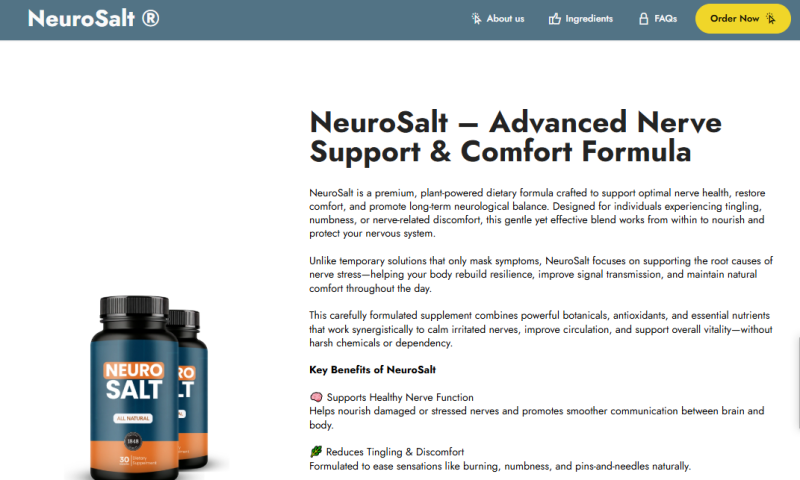
You land on the NeuroSalt website, looking for a way to clear your brain fog. The site promises a natural brain supplement that nourishes your mind, improves nerve signaling, and acts as a premium stress support supplement. At first glance, NeuroSalt looks like a clean, science-backed product ready to deliver real cognitive support. But a closer look at their fine print raises a glaring question — why is a brain health company using a customer support email linked to a weight loss site?
The site designers know exactly how to manufacture trust. NeuroSalt wraps itself in medical aesthetics, using scientific-style wording about "neuro-optimization" alongside a clean, modern layout. They even slap FDA-style logos near the checkout button. If you are skimming quickly, these visual cues signal that you are buying a heavily researched, vetted NeuroSalt supplement.
This is the detail worth slowing down for. NeuroSalt's listed customer support email — the address you'd use if you needed help, had a billing question, or wanted a refund — is reportedly:
Product name: NeuroSalt
Support email domain :en-en-en--burnslim.com
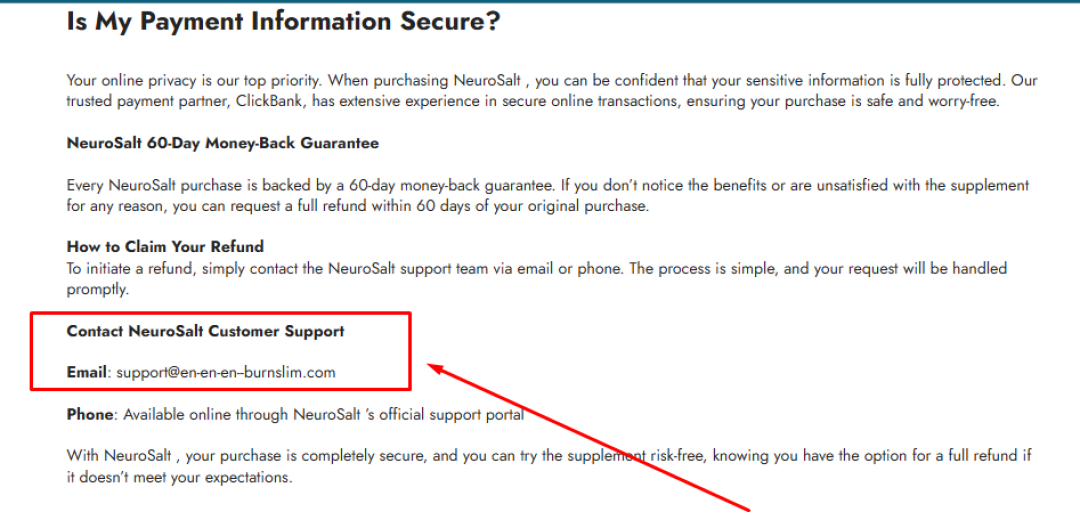
A legitimate brand typically operates its customer support through its own domain. An email address pointing to an unrelated domain — particularly one referencing a different product entirely — is a meaningful inconsistency.
To be precise about what this means: it doesn't prove fraud. But it does raise a direct, answerable question about who is actually operating behind the NeuroSalt brand. When the support email references "burnslim" — a completely unrelated product category — it suggests that NeuroSalt may be one product among many produced by the same operation under different names.
"When a support email references a completely different product, it suggests you're not dealing with a dedicated company — you're dealing with a template."
Multi-product supplement operations are common. They're not inherently illegal. But they do mean the brand story — the carefully designed website, the specific focus on brain health — is mostly a marketing layer. The infrastructure underneath serves many products at once, which has implications for how customer service, refunds, and accountability actually work.
NeuroSalt fits a well-documented approach: scientific aesthetics without scientific accountability. Use the visual language of credibility — clean design, authority signals, terminology borrowed from neuroscience — and rely on the fact that most people won't pause to check whether the email domain matches the brand, or read the FDA disclaimer in the footer, or search for a clinical trial by product name.
Tactics seen across similar supplements
— Borrowed credibility: FDA-style imagery paired with non-evaluated claims
— Brand inconsistency: support infrastructure that points elsewhere
— Generic benefit claims with no product-specific evidence
— Marketing-first design that creates an impression before the product can deliver one
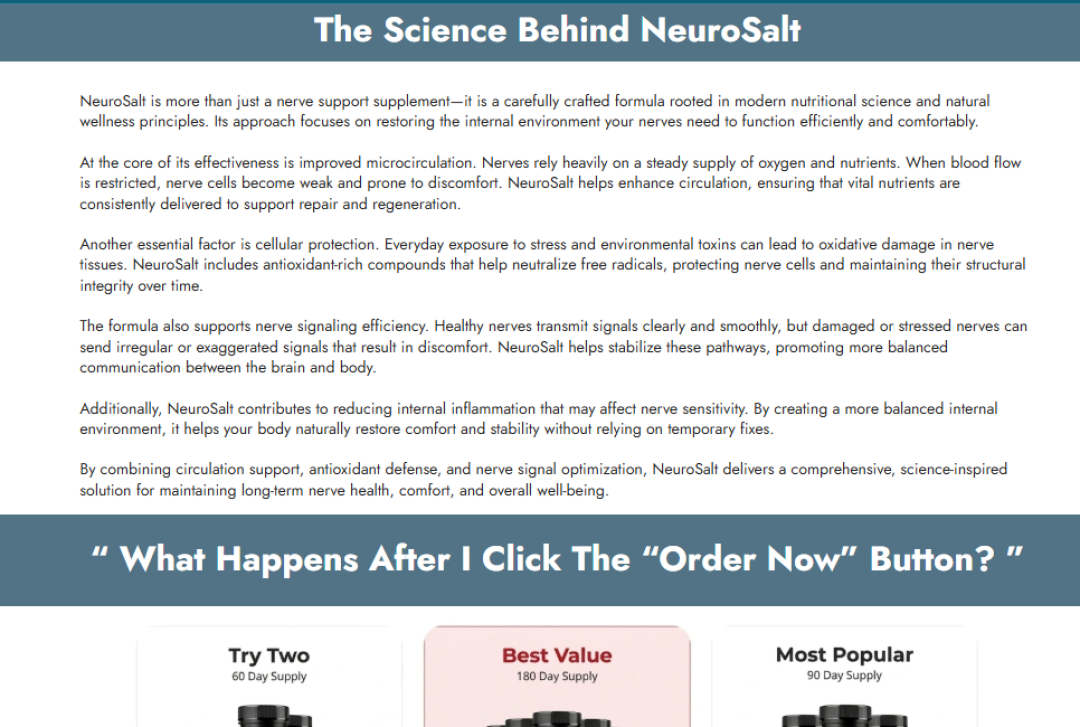
NeuroSalt fits perfectly into a well-documented pattern of marketing-first supplement funnels. These operations borrow credibility using stock medical imagery, make massive claims about NeuroSalt ingredients, and obscure who actually runs the company. They build temporary brands designed to capture your credit card information before the negative reviews start rolling in.
We have seen this before in FlashBurn Review & Theslimpic.com Review.
If you order, you will likely just receive a generic, ineffective vitamin blend. The real danger is financial. Because the support email is tied to a burner domain, getting help when your order goes missing or requesting a refund is nearly impossible. Many of these sites also bury auto-renewal clauses in the checkout process, quietly trapping you in a monthly subscription loop.
Before buying any natural brain supplement, verify the basics. Check if the support email matches the brand domain, look for published clinical trials rather than vague promises, and search for transparent company ownership. If you already bought NeuroSalt and suspect a hidden subscription, check your bank statements immediately. Do not waste time emailing a "burnslim" address for a refund — call your credit card provider directly and dispute the charge.
Questioning a site with mismatched emails and contradictory FDA badges is just good sense. You can report deceptive marketing tactics to the FTC at ReportFraud.ftc.gov or your national consumer protection body.
Products like NeuroSalt don't just rely on what they claim — they rely on you not looking too closely at their fine print.
This article has been written by a scam fighter volunteer. If you believe the article above contains inaccuracies or needs to include relevant information, please contact ScamAdviser.com using this form.
Adam Collins is a cybersecurity researcher at ScamAdviser who operates under a pseudonym for privacy and security. With over four years on the digital frontlines and 1,500+ days spent deconstructing thousands of fraud schemes, he specialises in translating complex threats into actionable advice. His mission: exposing red flags so you can navigate the web with confidence
