
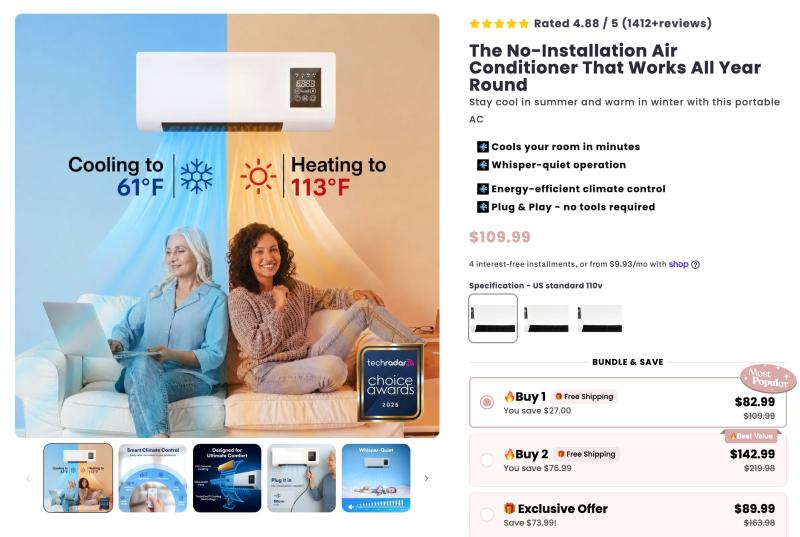
Online shoppers have recently been seeing social media advertisements for a sleek, wall mounted device promoted as "The No-Installation Air Conditioner That Works All Year Round." The product is marketed under several changing storefront names, including Stycove, GGV (Ggvbeauty), and Lazzda.
The advertisements present the device as a simple, all season solution. According to the claims, it can cool a room down to 61°F and heat it up to 113°F, while requiring no drilling, window hose, or external vent. It is also presented as a plug and play appliance that can be installed without the usual setup associated with air conditioners.
Well, this may sound convenient but shoppers should look beyond the advertising and understand what the device is actually capable of doing, as well as the concerns surrounding the websites selling it.
The product is a small, wall mounted appliance that combines a heating element with a fan. Its heating function is based on PTC ceramic heating technology, while its advertised cooling function relies on airflow rather than the type of cooling system normally found in a conventional air conditioner.
This distinction is important because the product's marketing presents it as something that can provide genuine room cooling and heating throughout the year.
Before buying, it is essential to understand the physical capabilities of this device compared to traditional climate control appliances.Let's look at both functions separately.
The heating side of the product is the more straightforward part. According to the technical specifications shown by the storefronts, the device uses PTC ceramic heating elements. PTC, or Positive Temperature Coefficient, ceramic heating is a standard method used in electric heaters.
When the appliance is plugged into a standard wall outlet, the internal ceramic element heats up. A built-in fan then pushes the warm air into the surrounding area. As a result, the device can function as a small space heater.
This means it may provide useful warmth in the immediate area around the appliance, particularly when used as an auxiliary winter fan heater. Its small size and wall mounted design also make it easy to use without taking up much floor space.
However, this heating function should not be confused with a full home heating system. The information available supports its use as a localized electric heater rather than a replacement for larger heating equipment.
Now, the cooling claims require much more attention. A genuine air conditioner does not simply blow air around a room. It needs to remove heat from indoor air and transfer that heat outside.
True thermodynamic air conditioning systems accomplish this through a closed loop system containing components such as a compressor, chemical refrigerant, and an exhaust mechanism. This is why many portable air conditioners have an exhaust hose connected to a window. The system needs somewhere to send the heat removed from the room.
The advertisements for this product make a different promise. They emphasize that there is no need for drilling, hoses, windows, or external vents. That creates a basic problem with the claim of genuine air conditioning.
Without an external mechanism for carrying heat away, the device cannot operate like a conventional refrigerant based air conditioner. When the product is placed inside a closed room, the electrical energy used by the appliance ultimately becomes heat.
In the advertised cooling mode, the heating elements are not used, and the device mainly works by circulating air with its built-in fan. The moving air can make a person feel cooler on the skin because of the wind chill effect. However, this is different from actually lowering the temperature of the room.
Therefore, the claim that the appliance can cool a room down to 61°F should be treated carefully. Based on the way the device operates, it cannot provide the same type of room cooling as a conventional air conditioner.
For anyone looking for genuine room wide climate control, this is perhaps the most important point to understand before making a purchase.
The technical claims are not the only issue worth considering. Publicly available evidence reveals several standard operational patterns commonly associated with high risk drop-shipping networks, such as:
Stycove, GGV, and Lazzda seem to use identical or highly similar storefront templates. Their promotional materials contain matching graphic assets, advertising copy, structural formatting, and layout elements.
The promotional graphics also feature the same images of consumers sitting on a couch, along with identical layout boxes and customer review statistics.
When several different storefronts use the same promotional material and presentation, shoppers should take a closer look at the relationship between the stores and the product being sold.
Visual teardowns and cross references indicate that the product is a mass produced, low cost space heater. Similar models can be found on wholesale platforms such as Alibaba for approximately $9 to $11 per unit. The storefronts discussed in this review, however, advertise the product for approximately $82.99 to $109.99.
Retailers can naturally charge more than wholesale suppliers because of advertising, shipping, operating costs, and other expenses. But, the difference is significant enough that shoppers should know what type of product they are purchasing and compare the advertised price with similar products available elsewhere.
The larger concern is that a product presented as advanced all year climate control technology appears to correspond visually with a relatively inexpensive, mass produced heater and fan.
Another notable point is the award badge displayed on the product landing pages. The advertisements claim that the product won the "TechRadar Choice Awards 2025."
TechRadar is a well known technology publication, so an award from the publication could naturally make a product look more credible to potential buyers. However, a search of the official TechRadar information does not show this unknown white-label appliance receiving the claimed award.
The lack of an independently verifiable award listing means consumers should be careful about treating this badge as proof of product quality or recognition.
There is also the issue of changing storefront names. Independent consumer advocacy channels, including the De-Reviews YouTube investigation video, have discussed stores such as Stycove and their use of heavily discounted, trending gadgets promoted through aggressive short term social media advertising.
The investigation also highlights a pattern in which stores may abandon an older domain when customer complaints or return requests increase and then launch a similar storefront under a different name.
For consumers, this can create an additional problem. If a website changes its name or domain after a purchase, customers may find it more difficult to locate the original seller when they need help with a return, refund, or warranty claim.
This is a factor shoppers should consider when deciding how much confidence to place in a newly encountered online store.
Pros:
Cons:
While buyers will generally receive a physical package containing a basic wall mountable appliance that functions as a standard heater and fan for small, localized areas, the marketing claims regarding its air-conditioning capabilities do not align with the basic principles of how genuine air conditioning works.
Consumers looking for genuine, room wide climate control are strongly advised to consider standard portable air conditioners that include a dedicated window exhaust kit.
This article has been written by a Scam Fighter Contributor, De-Reviews.com Team. If you believe the article above contains inaccuracies or needs to include relevant information, please contact ScamAdviser.com using this form.
De-Reviews.com Team is a group of scam researchers, editors, and online safety advocates dedicated to exposing online fraud and helping consumers stay safe online. The team has been investigating scams, fraudulent websites, phishing campaigns, and other online threats since 2014. Read the Full Author Profile.
