
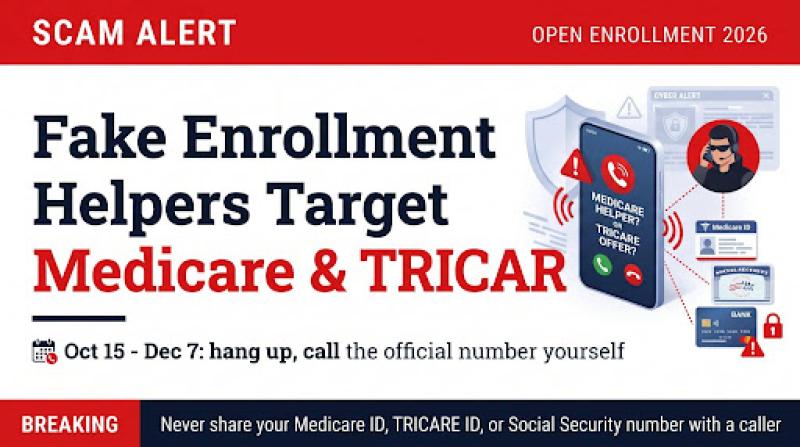
It is open enrollment season in the US, the time of year when millions of people buy, renew or change their health insurance for the year ahead. Medicare open enrollment runs from October 15 to December 7, the Health Insurance Marketplace (HealthCare.gov) opens shortly after, and military families have their own TRICARE Open Season.
That makes it peak season for open enrollment scams. Fraudsters know people are expecting calls, letters and emails about their coverage, so they pose as Medicare agents, TRICARE representatives or friendly "enrollment helpers" offering to find a cheaper plan. Their real goal is your Medicare number, Social Security number, bank details or a payment for help that should be free.
A fake enrollment helper is a scammer who offers to guide you through choosing or switching a health plan. They may call, text, email or even knock on your door. They often sound professional, know your name and address, and promise savings or extra benefits. Once they have your personal information, it can be used for identity theft or to bill Medicare and other insurers for care you never received.
Military families are a favourite target. The TRICARE Newsroom has issued a fresh warning, "Don't Be a Target of Scams About TRICARE", ahead of TRICARE Open Season, which usually opens in November.
TRICARE's long-standing advice is simple: if someone contacts you by phone or email asking for personal or health information, do not give it. In an earlier TRICARE Newsroom article, the Defense Health Agency's fraud division noted that most providers are honest, but some deliberately mislead beneficiaries to bill for services they do not need.
Common TRICARE scam examples, as described by Military.com, include:
Remember that no one from TRICARE will ever call to recommend a particular product or medicine.
In Bakersfield, California, 23ABC News reporter Mike Hart spoke with Joe Ducey of the Better Business Bureau about how scammers exploit Medicare open enrollment. The story highlights reports sent to BBB Scam Tracker, including:
According to the BBB, callers who keep you on the line usually claim they can switch you to a cheaper plan with the same services. All they need is your Medicare ID and Social Security number. That information is exactly what identity thieves want.
Embed: https://www.youtube.com/watch?v=CTlPlSbywzQ
Most open enrollment scams follow a few familiar scripts:
If you think you have been targeted, call 1-800-MEDICARE for Medicare concerns, or the Health Insurance Marketplace at 800-318-2596 for HealthCare.gov plans. TRICARE beneficiaries can report suspected fraud to the Defense Health Agency. You can also share your experience on BBB Scam Tracker and Report a Scam to warn others.
Open enrollment is when fake enrollment helpers are busiest. Real Medicare, TRICARE and Marketplace helpers will not call out of the blue, charge for assistance or ask for your numbers over the phone. When in doubt, hang up and go to the official source yourself.
Adam Collins is a cybersecurity researcher at ScamAdviser who operates under a pseudonym for privacy and security. With over four years on the digital frontlines, he specialises in translating complex threats into actionable advice. His mission: exposing red flags so you can navigate the web with confidence.
Sources: TRICARE Newsroom, 23ABC News (KERO Bakersfield) and the Better Business Bureau, Military.com.
