
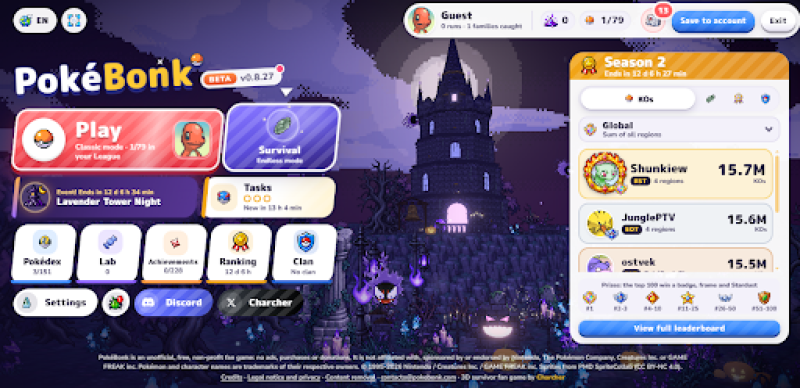
Short answer: Pokebonk.com appears to be a genuine fan project rather than a scam, and it says it has no ads, purchases or donations. But it is an unofficial game built on Nintendo's and The Pokémon Company's characters, and unofficial games carry their own risks. You will get to play, but it could disappear at any moment, and copycat sites using its name may not be as harmless.
PokéBonk describes itself as a free 3D "survivor" game that runs in your browser and features the original 151 Pokémon from the Kanto region. Players survive waves of wild Pokémon, evolve, launch an "Ultimate" attack and unlock a League mode. It needs JavaScript and WebGL to run, and can be added to a phone's home screen like an app.
The game is credited to a developer called Charcher. The site defaults to Spanish, uses a Spanish-language contact address and offers eight other languages, including English, Portuguese, French, Japanese, Chinese, Korean and Russian. It also links to a Discord community. The name and style suggest it is inspired by the indie survivor game Megabonk.
PokéBonk is unusually open about what it is. Its footer describes it as an unofficial, free, non-profit fan game with no ads, purchases or donations, and says it is not affiliated with, sponsored by or endorsed by Nintendo, The Pokémon Company, Creatures Inc. or GAME FREAK inc. It credits its Pokémon sprites to PMD SpriteCollab under a CC BY-NC 4.0 licence and lists contacto@pokebonk.com for content removal.
The site's legal and privacy page, written in Spanish, adds more detail:
That honesty is a good sign. It also makes clear that the game exists only as long as Nintendo and The Pokémon Company allow it to.
Yes, the game itself appears to be real and playable. Dexerto reported that creator Charcher introduced PokéBonk on October 14, 2026, describing it in Spanish as heavily inspired by Megabonk's mechanics and vertical 3D world. Players can enter as a guest, pick Bulbasaur, Charmander or Squirtle, and fight off hordes while their partner attacks automatically. Digg, citing RetroGems, said the site was running beta version 0.6.3 at the time.
Dexerto also noted that Charcher disclosed using AI tools during development. The legal page confirms this: scenery, 3D models, effects, interface icons and music were created with image and audio generation tools and Blender, while Pokémon data comes from PokeAPI.
On the privacy side, the legal page says:
The main caveat is age. The game only launched in mid-October 2026, so it has very little track record.
PokéBonk itself looks harmless. The bigger risks come from the world that grows up around unofficial games.
Nintendo and The Pokémon Company are known for protecting their characters. Over the years, they have pulled well-known fan projects such as Pokémon Uranium and Pokémon Prism, and Nintendo had hundreds of fan games removed from the Game Jolt platform in 2018. PokéBonk has already promised to shut down within 72 hours if asked. If that happens, your trainer profile, clan, scores and unlocked Pokémon will go with it.
Popular free games attract imitators. Scammers often copy a game's name and artwork to push fake "apps," "APKs," "PC versions" or "mod menus" that contain malware, adware or subscription traps. PokéBonk says it is not distributed as a download or in any app store, and can only be played at pokebonk.com. Any PokéBonk download, app store listing or "premium" version is not official.
If a game is taken down, clones often appear on new domains claiming to be the "new official site." These can carry pop-up ads, push notification prompts or redirect chains. A similar pattern appeared with unofficial GTA V browser ports, where copies sprang up after the originals were removed.
PokéBonk accounts only need a trainer name and password. If you reuse a password from another account, a leak on any small fan site could expose it. Fan Discord servers can also attract fake "admins" sending links to free items, giveaways or Discord Nitro, which are common phishing tricks.
The game is free, but you still give it your time, progress and trust. The cost of an unofficial game is not usually money, but uncertainty: it may vanish, be cloned or be used as bait by someone else.
Before visiting any unofficial game site or clone, run it through a website checker. If a fake PokéBonk site or app takes your money or details, contact your bank and Report a Scam.
Pokebonk.com appears to be a genuine, free fan game with no ads or purchases, and its privacy policy is clearer than most. But it is unofficial, only days old, and could be taken down by Nintendo or The Pokémon Company at any time. Play it on the official site only, keep your account details unique, and treat any PokéBonk download or paid offer as a likely scam.
This article has been written by a scam fighter volunteer. If you believe the article above contains inaccuracies or needs to include relevant information, please contact ScamAdviser.com using this form.
Adam Collins is a cybersecurity researcher at ScamAdviser who operates under a pseudonym for privacy and security. With over four years on the digital frontlines, he specialises in translating complex threats into actionable advice. His mission: exposing red flags so you can navigate the web with confidence.
