
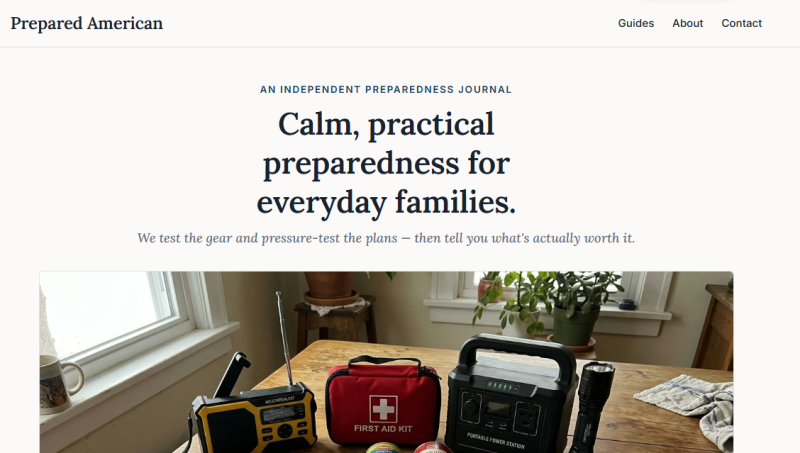
Short answer: Preparedamerican.org looks like a polished emergency preparedness blog, but it raises more doubts than it first appears. It does not sell products directly, which lowers the risk for visitors. However, it lists a virtual mailbox as its address, independent trust checkers give it low scores, and its articles are dated before the domain was even registered. Read its advice with caution.
Prepared American describes itself as an independent resource hub for practical emergency preparedness, featuring gear it says it has tested and plans it actually uses. The site positions itself as a calm alternative to fear-driven "prepper" marketing.
Its guides cover go-bags, home backup power, emergency water storage, 72-hour food supplies, blackout drills, emergency radios and first aid kits, plus a page explaining how it tests gear. The site also links to an affiliate disclosure, editorial standards, privacy and terms pages, and lists a support email and a phone number with a 518 area code.
The site says it is published by Oathill Media LLC, with an address at 459 Columbus Ave #4025, New York, NY 10024, USA.
That address is the one point of concern. 459 Columbus Avenue is a commercial mailbox location at a FedEx Authorized ShipCenter operated by Manhattan Express Shipping. The unit number, #4025, works as a virtual business address and mailbox rather than an office or storefront. The same address appears on other company websites, such as ClearedRx, which suggests it is shared by many businesses.
Using a virtual address is common and legal, especially for small online publishers who work remotely and do not want to publish a home address. It is not proof of wrongdoing. However, it does mean the address tells you little about who is behind the site or where they are based. The phone number also uses a 518 area code, which covers upstate New York rather than Manhattan.
Independent website checkers are not impressed. ScamDoc gives preparedamerican.org a "very low" trust score and notes:
One ScamDoc user comment goes further, claiming that Oathill Media LLC does not appear in New York State's public register of active companies, and that the same site template and legal pages are used under other brand names, including honestconsumer.org and wow-discounts.com. These claims come from a user and have not been independently confirmed, but they are worth checking before trusting the site.
Scam Detector also flags the site as suspicious, with a score of 21.8 out of 100.
The registration date raises an obvious question. The site's guides are dated from March to May 2026, and several describe long-term testing, such as carrying a go-bag for a year and running monthly blackout drills for a year. Yet the domain itself was only created in late June 2026. That does not prove the tests never happened, but it does make the site's "tested in real homes" story harder to verify.
Treat Prepared American's guides as a starting point for ideas, not a final authority. Compare any gear recommendation with independent reviews and the manufacturer's own safety guidance, and buy only from retailers you already trust. For emergency planning, use official checklists from Ready.gov or your local emergency management office.
If you are a business approached by the site, or by Oathill Media LLC, for a paid placement or partnership, ask for verifiable company details first and confirm the business registration yourself. You can also run the site through a website checker before sharing any payment or personal details.
It is not clearly a scam, and simply reading it is unlikely to harm you. But a virtual mailbox address, low trust scores, a domain registered in June 2026 and articles dated months earlier mean there are real doubts about how genuine its "tested" claims are. Read it with caution and double-check anything safety-related.
This article has been written by a scam fighter volunteer. If you believe the article above contains inaccuracies or needs to include relevant information, please contact ScamAdviser.com using this form.
Adam Collins is a cybersecurity researcher at ScamAdviser who operates under a pseudonym for privacy and security. With over four years on the digital frontlines, he specialises in translating complex threats into actionable advice. His mission: exposing red flags so you can navigate the web with confidence.
