
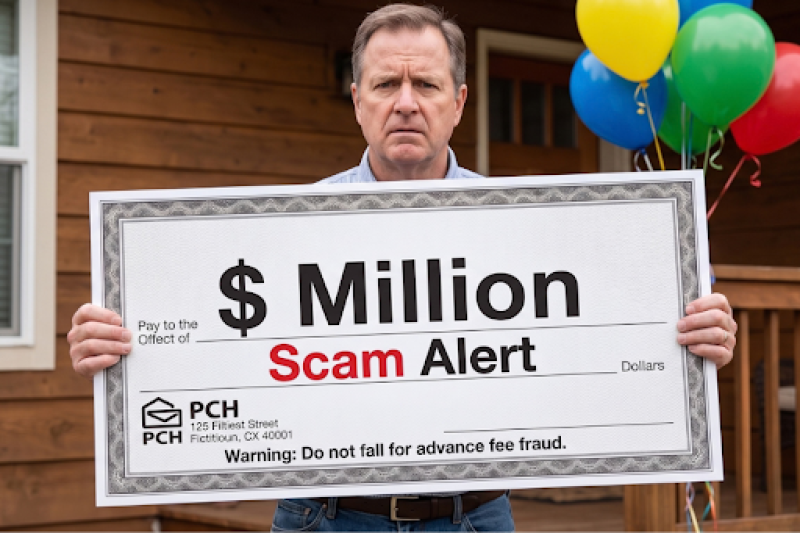
ou get a text message. It says you've won $7 million from Publishers Clearing House. All you need to do is pay a small delivery fee, and the Prize Patrol will be at your door.
It feels real. Publishers Clearing House has been awarding life-changing prizes since 1953. The Prize Patrol, the oversized check, the balloons at your front door, it's all part of American pop culture. That familiarity is exactly what makes PCH one of the most exploited brand names in fraud today.
The hard truth: According to the Federal Trade Commission, Americans filed 97,350 reports of prize, sweepstakes, and lottery fraud in 2024, with total reported losses reaching $351 million and a median loss of $1,000 per victim. The real figure is almost certainly higher, since the vast majority of fraud goes unreported.
This guide explains how Publishers Clearing House scams actually work, what every version looks like, and what to do if you or someone you care about has been targeted.
A Publishers Clearing House scam is a type of advance fee fraud. Criminals impersonate the real PCH brand to convince victims they have won a large cash prize, then demand payment of "fees" before the prize can be delivered. No prize exists. Once the victim pays, the money is gone.
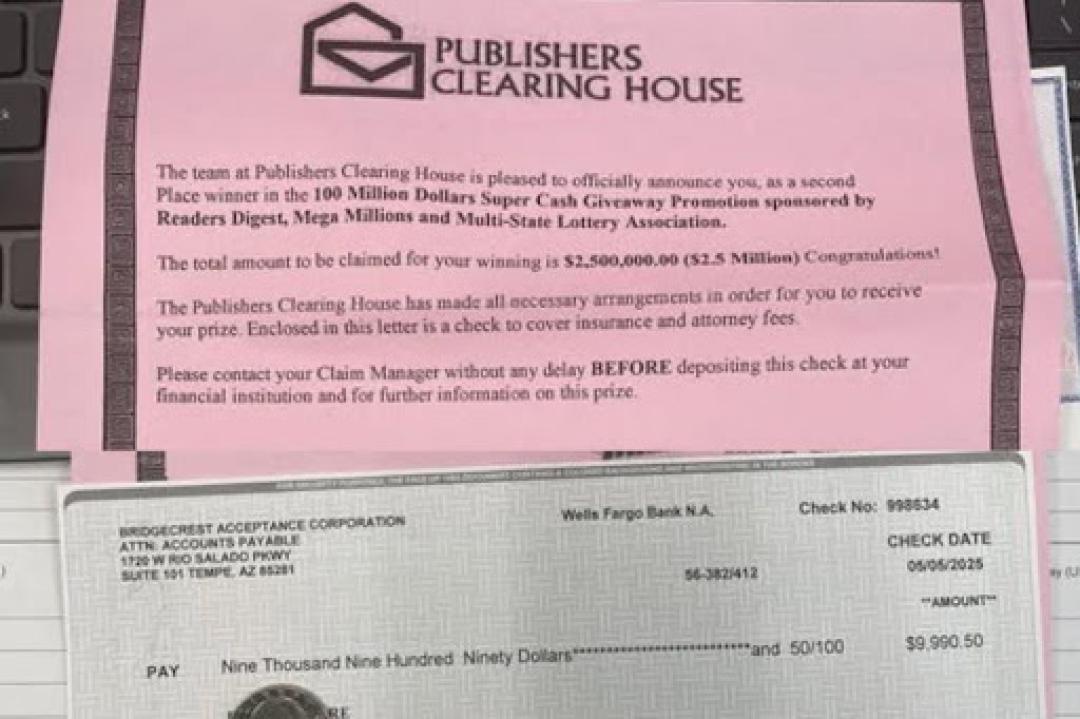
Source: fb
The real Publishers Clearing House is a legitimate sweepstakes company founded in 1953 and headquartered in Jericho, New York. It does award real prizes, and its Prize Patrol does show up at winners' doors with oversized checks. But PCH has a firm policy: winners are never contacted by phone, email, or text message, and no payment is ever required to claim a prize.
That gap between the real PCH and what scammers claim is where the fraud lives.
"If the prize isn't free, and you're expected to send some type of payment to claim it, you're being SCAMMED." — Publishers Clearing House, official fraud protection page
PCH scams fall under a broader category of fraud that ScamAdviser tracks extensively. They share the same core mechanic as lottery scams and giveaway scams: manufacture excitement, create urgency, and collect money before the victim has time to think.
Every PCH scam follows a predictable script. Understanding it makes it far easier to spot before any money changes hands.
The scammer reaches out through one of several channels. Each method is designed to feel legitimate enough to get you engaged:
Once the scammer has your attention, they introduce the obstacle: before the prize can be released, you must pay a fee. The framing changes, but the demand is always the same.
The real IRS never collects taxes through a sweepstakes company. If you owe taxes on a legitimate prize, you pay the government directly when you file your return. Any company demanding tax payment upfront as a condition of releasing your prize is running a scam.
Scammers steer victims toward payment methods that are nearly impossible to reverse. The FTC warns that only a scammer will demand payment via:
Gift cards are the preferred tool because the code can be read over the phone and the funds are instantly accessible. ScamAdviser has documented this pattern in detail in its guide to gift card scams.
The most damaging part of the PCH scam is what happens after the first payment. Scammers rarely stop at one fee. Once a victim has paid, they are marked as cooperative. The criminal returns with additional demands: a second tax fee, a legal clearance charge, a customs release payment. Victims who have already invested money are psychologically primed to pay again to protect what they believe they've already spent.
This escalation pattern has produced devastating losses. One documented case involved a veteran who lost approximately $180,000 over six months before FBI investigators intervened.
Most PCH scams can be identified in seconds if you know what to look for. None of these signs require technical knowledge. They are behavioral patterns that no legitimate sweepstakes company would ever use.
1. Any contact by phone, text, email, or social media claiming you won
The real Publishers Clearing House Prize Patrol notifies major prize winners in person, arriving at their home with an oversized check, balloons, and a camera crew. Smaller prizes are communicated through official U.S. mail. PCH does not call, text, email, or message winners on social media before a prize delivery. If the contact came through any of those channels, it is a scam.
2. A fee required before you receive your prize
This is the defining characteristic of advance fee fraud. No legitimate sweepstakes, lottery, or prize program charges winners to receive their winnings. The fee may be framed as taxes, shipping, processing, activation, or insurance. The label does not matter. The demand for upfront payment is always fraudulent.
3. Pressure to pay with gift cards
Legitimate organizations do not accept gift cards as payment for any purpose. If someone instructs you to go to a store, buy gift cards, and read the codesover the phone, that person is a scammer. This applies regardless of how official they sound or what documentation they claim to have.
4. You won a contest you never entered
Publishers Clearing House requires participants to enter its sweepstakes. You cannot win without entering. If you receive notification of a prize for a contest you have no memory of entering, treat it as fraudulent.
5. Urgency and secrecy
Scammers manufacture time pressure to prevent victims from thinking clearly or consulting others. Phrases like "you must claim your prize within 24 hours" or "do not tell anyone or you will forfeit your winnings" are control tactics. Real prize notifications do not come with countdown clocks or secrecy requirements.
Key rule: Real sweepstakes are free to enter and free to win. Any deviation from that is fraud.
PCH impersonation scams are not random. Criminals select this brand deliberately because it carries decades of cultural credibility and reaches an audience that is statistically more likely to engage with sweepstakes content.
According to FTC data on older consumers, older adults are nearly three times more likely than younger adults to report a financial loss from a prize, sweepstakes, or lottery scam. The Better Business Bureau found that more than 80% of the money lost in sweepstakes scams reported to its Scam Tracker came from people over 65. Fraud losses by older adults overall rose from approximately $600 million in 2020 to $2.4 billion in 2024, a 300% increase over four years.
The brand's effectiveness as a fraud vehicle comes down to three factors:
It is worth noting that the real Publishers Clearing House has also faced regulatory scrutiny of its own business practices. In April 2025, the FTC sent more than $18 million in refunds to 281,274 consumers who were harmed by PCH's own deceptive email practices. The FTC charged that PCH misled older and lower-income consumers into believing they could not enter sweepstakes without purchasing products, and sent emails with deceptive subject lines designed to look like official government documents.
This does not mean PCH is a scam company. But it does mean the brand has a complicated history that scammers exploit further, and that even legitimate sweepstakes companies can engage in practices that blur the line for consumers.
The right response depends on whether you have already paid or are still in the early stages of contact.
The action here is simple: disengage immediately.
Act quickly. Some payments can still be stopped or partially recovered, but the window is short.
Important: Reporting rarely recovers lost funds on its own, but it is what enables law enforcement to identify patterns, pursue prosecutions, and warn others. Every report matters.
ScamAdviser also encourages users to report suspicious websites and contacts directly through our platform, adding to the database that protects millions of other users globally.
Avoiding PCH scams and similar prize fraud comes down to a few habits that are easy to maintain once they become automatic.
Scammers who collect personal data during a prize scam often use it for identity theft long after the initial contact. Never share your Social Security number, bank routing number, or credit card details to "verify your identity" for a prize claim.
Scammers rely on isolation and urgency. Before taking any action on a prize notification, tell a family member or trusted friend. A second perspective almost always breaks the spell. If the scammer specifically told you to keep the prize secret, that instruction alone confirms it is a fraud.
Many PCH scams direct victims to websites that look official but are fraudulent. Before clicking any link in a prize notification, check the website's trust score. ScamAdviser scans websites in real time, checking domain age, hosting reputation, blacklist status, and dozens of other signals to identify whether a site is likely fraudulent.
The ScamAdviser browser extension and mobile app provide this protection automatically, flagging suspicious sites before you interact with them.
Related reading on ScamAdviser:
Prize and sweepstakes scams are not going away. Criminals will continue using trusted brand names like Publishers Clearing House because the formula works: a familiar name, a life-changing prize, a small fee, and urgency. The losses are real, and they fall hardest on people who can least afford them.
The single most effective defense is knowing the rules before you receive the call, the text, or the letter. Real sweepstakes are free to enter and free to win. Any contact that deviates from that is fraud, regardless of how official it looks.
Download the free ScamAdviser app to automatically check websites, links, and contacts before you engage with them. ScamAdviser analyzes over 1 million new websites every month and has identified more than 2.6 million scam websites in its database. The app is available free on iOS and Android and works in the background to flag suspicious sites before they can do damage.
If you believe you have encountered a fraudulent website or contact claiming to be Publishers Clearing House or any other brand, report it at scamadviser.com so other users can be warned.
Adam Collins is a cybersecurity researcher at ScamAdviser who operates under a pseudonym for privacy and security. With over four years on the digital frontlines, he specialises in translating complex threats into actionable advice. His mission: exposing red flags so you can navigate the web with confidence.
