
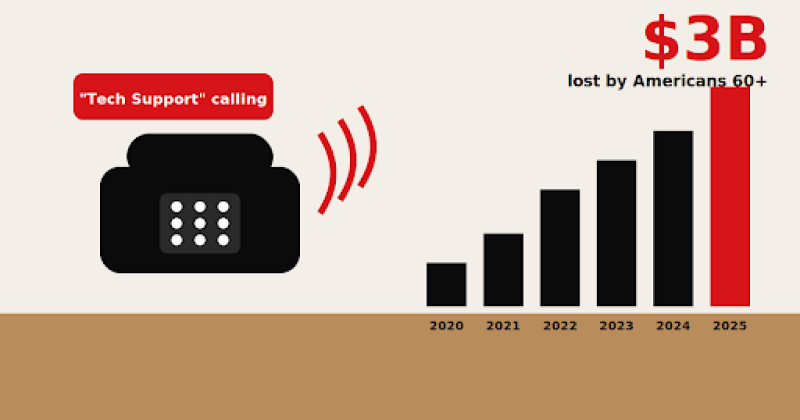
Fraud targeting older Americans continues to grow more aggressive and financially devastating. Money that individuals aged 60 and older reported losing to scams surged from $600 million in 2020 to $3 billion in 2025, according to the Federal Trade Commission's annual report to Congress, recently covered by Gizmodo's Matt Novak.
The agency's findings, released on Monday, October 19, 2026, caution that the official tally reflects only a fraction of the real damage because most fraud incidents go unreported. Depending on the modeling used, the FTC estimates that the actual annual cost of fraud targeting older adults in 2025 ranged between $13.3 billion and $119.5 billion—an increase of up to 47% compared to 2024. Investment fraud alone rose 42% over the prior year.
The largest losses remain heavily concentrated among high-value targets. Aggregate losses among older victims who lost more than $100,000 jumped nearly sevenfold between 2020 and 2025. While these severe cases accounted for just 6% of loss reports, they made up 70% of all reported stolen funds.
The fraud types inflicting the most financial damage on older adults include fraudulent investment schemes, government impersonation, and business imposter scams. While social media served as the primary initial contact point, schemes initiated over phone calls resulted in substantially higher median losses.
The FTC report highlights distinct generational vulnerabilities:
Complaints reviewed by Gizmodo illustrate how severe romance and celebrity impersonation scams have become. In one filing, a Washington woman in her 70s lost $63,000 to an imposter posing as Elon Musk. Other complaints detailed women losing hundreds of thousands of dollars to fake Johnny Depp profiles—including an Alabama resident in her 60s who surrendered $350,000, and a Michigan woman in her 70s who sent $175,000 while under strict instructions to keep the transactions secret from her family.
While the FTC’s current dataset does not isolate generative AI tools, security researchers emphasize that voice cloning, deepfakes, and automated social-engineering agents will likely make impersonation schemes significantly harder for any demographic to detect.
Manufactured secrecy remains a primary red flag. Criminals routinely coach victims to hide withdrawals, supply false explanations to bank tellers, and keep investments secret from relatives and financial advisors. Families can build effective defenses through consistent, open discussions:
If you or a family member has sent money to an unfamiliar entity, notify your banking institution immediately to freeze accounts or dispute transfers. Document all correspondence, file a complaint with federal regulators at ReportFraud.ftc.gov, and submit the site details to ScamAdviser’s Report a Scam platform to assist active community fraud monitoring.
Source: Matt Novak, "New Data Show How Much Worse Scams Are Getting for Americans Over 60," Gizmodo, October 19, 2026, citing the Federal Trade Commission’s Annual Report to Congress on Protecting Older Adults.
