
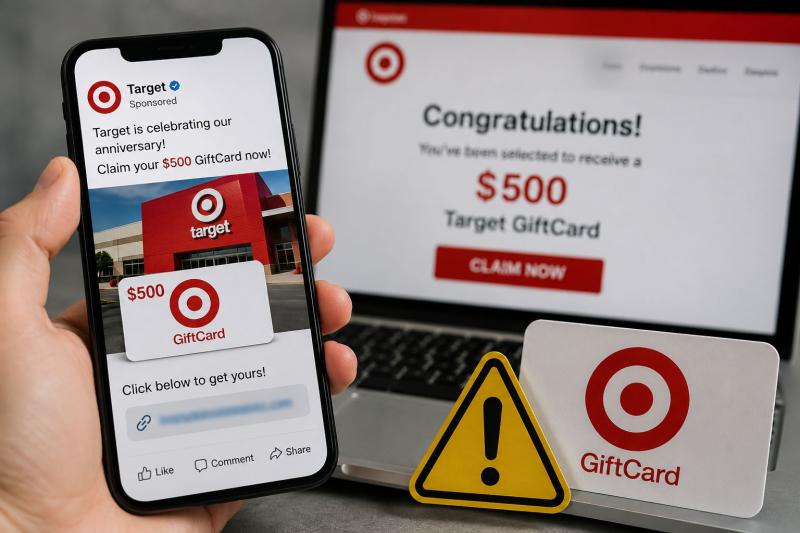
Have you seen a social media post or message claiming that Target is giving away a free $500 gift card to celebrate an anniversary or special event? Be careful. These posts can be part of a phishing scheme that misuses Target’s name to make the offer look genuine.
The message may direct you to a link, ask you to complete a survey, or request that you share the post before you can supposedly receive the reward. The real goal may be to collect your personal information, steal your login details, access your accounts, or expose your device to harmful software. Target does not run these free $500 anniversary giveaways, so it is important to verify such claims through Target’s official website or app before clicking any link.
The Target Anniversary Gift Card scam is a type of phishing scam that uses fake promotions to attract victims. A typical message or social media post may say something like: "Target is celebrating its anniversary! We are giving away $500 Target GiftCards. Click below to claim yours."
Another version may say:
These messages can appear on Facebook, Instagram, TikTok, email, text messages, or other online platforms. The wording may change, but the basic trick remains the same, use a familiar brand and an attractive reward to make people click quickly.
A genuine $500 Target GiftCard does exist. Target currently sells legitimate $500 gift cards through its official channels. That fact can make fake $500 giveaway posts look more believable. However, the existence of a real $500 Target GiftCard does not mean that every social media post claims are genuine.
The suspicious part is the claim that Target is giving people a free $500 card simply for clicking a random link, completing an unrelated survey, sharing a post, or providing personal information. Consumers should verify any promotion directly through Target's official website or app instead of trusting a social media link.
The first step usually happens on social media. Fraudsters create posts, advertisements, pages, or messages that use the Target name, logo, colors, or other familiar branding. The post may say that Target has reached an anniversary or another major milestone. The post may include attractive images of Target stores or gift cards to make it look official.
The next step is the reward. A $500 gift card sounds valuable, and the word free makes the offer even more tempting.
The scammers may create urgency by saying:
This pressure encourages people to act before they stop to verify the claim.
After clicking the post, users may land on a website that looks professional. The page may contain Target style graphics, fake customer comments, countdown timers, surveys, reward boxes, or a large “Claim Reward” button. But the website have no connection to Target.
Target warns that fraudsters can create fake websites that imitate Target.com or fake gift card websites and use them to collect people's information.
The fake website may ask visitors to answer several simple questions.
For example:
The questions may seem harmless. After completing them, the website may claim that the visitor has qualified for the $500 reward. This creates the feeling that the reward is almost ready.
The site may then request information such as:
In some versions, the victim may be asked to create an account or enter payment details supposedly for shipping or verification. That is a major warning sign. The real purpose can be to collect information that criminals can use for phishing, account attacks, identity-related fraud, or other unwanted activity.
Target specifically warns that phishing, voice calls, and text scams can misuse its brand to trick people into sharing usernames, passwords, account numbers, and other personal information.
These fake Target offers can appear in several forms. The story may change, but the goal is often to make victims click a link, share information, or send money.
The criminals do not need to create a completely unknown brand. They borrow the reputation of a company people already recognize.
The fake page may use:
This can make the promotion feel real at first glance. That is why the safest approach is to verify the offer independently instead of trusting the advertisement itself.
Be especially careful when a supposed Target promotion:
One important point: a professional looking website does not prove that an offer is legitimate.
Ignore and Delete Suspicious Giveaway Messages:
If a social media post promises free money or a high value gift card through an unexpected link, the safest option is to ignore it and delete it. Do not click simply because the message uses Target's name.
Check Target's Official Website or App:
If you see a promotion, open Target's official website or app yourself. Do not use the link supplied in the suspicious post. Target provides official resources for identifying and reporting suspicious contacts and websites.
Never Pay to Receive a FreePrize:
A legitimate free reward should not require you to buy gift cards, pay an unexplained fee, or provide gift card codes to receive it. Target also warns consumers about unsolicited requests to purchase gift cards to pay debts, fines, taxes, or other fees.
Protect Your Passwords:
Never enter your Target password or another important account password on a website reached through an unexpected giveaway link. If you already entered a password, change it through the legitimate website and review your account for suspicious activity.
Do Not Share Gift Card Codes:
Treat gift card numbers and access codes like money. Target advises consumers not to purchase, sell, or check Target GiftCard balances outside Target.com.
Target provides a dedicated channel for reporting suspicious emails, text messages, phone calls, and malicious websites. Its security page lists abuse@target.com and official customer-service numbers for security concerns.
The Target Anniversary Gift Card & Rewards scam uses an attractive promise: a free $500 Target GiftCard. The story may involve an anniversary, birthday, celebration, customer reward, survey, social media contest, or limited time promotion. The details can change, but the danger stays the same when an unverified link asks for personal information, passwords, payment details, gift card codes, or money.
Target does offer legitimate $500 GiftCards, but that does not make random $500 giveaway posts genuine. The safest rule is simple: do not trust the link but rather verify the offer directly with Target.
If a supposed Target promotion sounds unbelievably generous and asks you to act immediately, slow down. A few seconds of checking can prevent much bigger problems later.
Author Information:
This article has been written by a Scam Fighter Contributor, De-Reviews.com Team. If you believe the article above contains inaccuracies or needs to include relevant information, please contact ScamAdviser.com using this form.
De-Reviews.com Team is a group of scam researchers, editors, and online safety advocates dedicated to exposing online fraud and helping consumers stay safe online. The team has been investigating scams, fraudulent websites, phishing campaigns, and other online threats since 2014. Read the Full Author Profile.
