
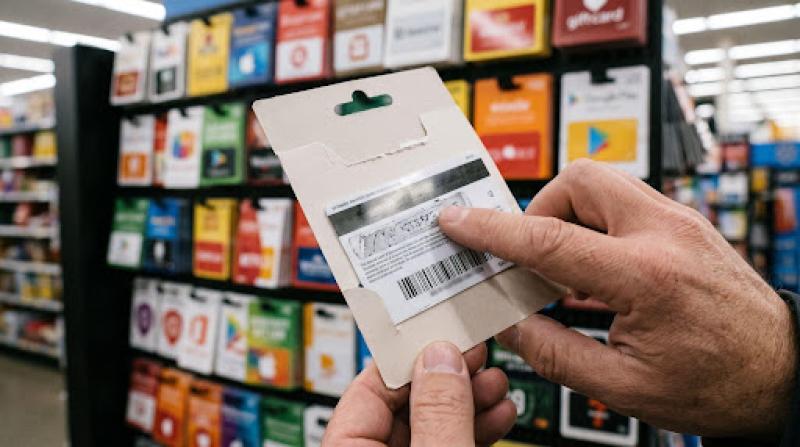
You grab a gift card from a carousel at the grocery store, have the cashier scan it, pay at the register, and slip it into an envelope. A few weeks later, the recipient tries to redeem it—only to discover the balance is zero.
Your credit card was not compromised, your purse was not stolen, and no one broke into your account. The card was compromised long before you picked it up.
This crime is called gift card draining (or card tampering), and it has grown from a minor retail annoyance into an organized, multimillion-dollar cyber operation targeting physical store displays nationwide.
Unlike traditional shoplifting, perpetrators do not walk out with merchandise. Instead, they weaponize legitimate store racks:
The second an unsuspecting shopper has the card scanned and loaded at checkout, the bot detects the active funds and routes the balance to purchase electronics, cryptocurrency, or secondary digital gift cards within minutes.
By the time the recipient scratches off the card on a birthday or holiday, the funds have already been spent. Because the buyer completed a legitimate transaction at the checkout counter, recovering the money from retailers or card issuers is often an uphill battle.
While card draining was once carried out on a small, local scale, law enforcement agencies are increasingly uncovering sophisticated, interstate crime rings behind the practice.
A clear example occurred when California resident Siyuan Song pleaded no contest to Conducting a Criminal Enterprise in Michigan after investigators tied him to an operation targeting major regional store chains. State and federal task forces, including the U.S. Postal Inspection Service and the Michigan State Police, seized thousands of tampered cards that had been returned to shelves across multiple retail locations.
Cases like this highlight the scale of the problem: organized groups now manufacture high-quality counterfeit packaging, print replacement security strips, and manage distributed networks to swap cards out in bulk across multiple states.
Because the goal of the fraudster is to make the card appear pristine, you must inspect the packaging closely before taking it to the register.
Examine the Scratch-Off Film: Run your fingernail over the PIN area on the back. The protective coating should feel uniform and flush with the card surface. If it feels thick, uneven, loosely taped, or visibly mismatched with the surrounding design, the original strip has likely been replaced.
Inspect the Seams: Look for signs of glue reapplication, paper tearing, or slight paper wrinkles along the edges of the cardboard carrier.
Verify the Barcodes Match: Some scammers simply paste a fake barcode sticker over the legitimate one. If the visible barcode on the card does not match the serial numbers visible through the cardboard sleeve, do not buy it.
Avoid the Front of the Display: Thieves tend to hang tampered cards at the front of the peg for quick turnover. If buying in-store, choose cards hanging further back in the display.
Taking a few proactive steps can significantly lower the risk of losing money to card-draining schemes:
If you or a recipient discover a zero balance on a newly loaded card:
Adam Collins is a cybersecurity researcher at ScamAdviser who operates under a pseudonym for privacy and security. With over four years on the digital frontlines, he specialises in translating complex threats into actionable advice. His mission: exposing red flags so you can navigate the web with confidence.
