
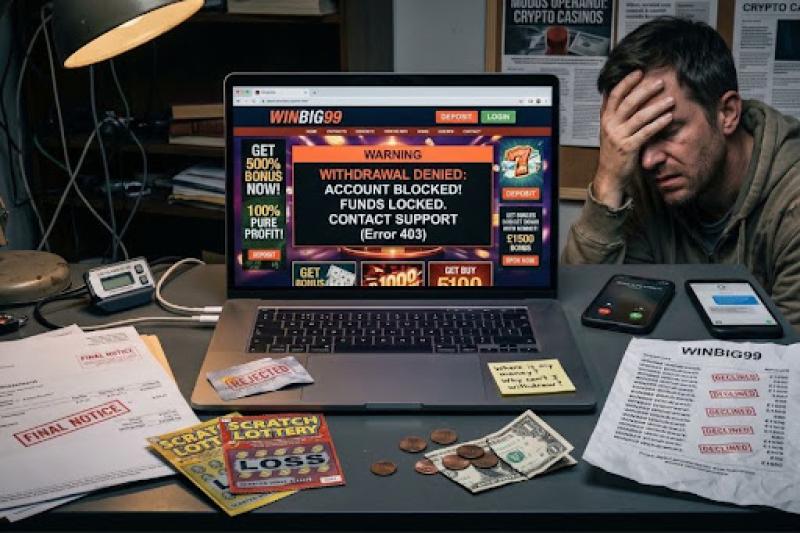
When an online casino demands an upfront tax payment or security fee before letting you withdraw your winnings, the money you originally deposited is already gone.
Fraudsters rely on a simple psychological trap to run this crime. If you believe you have $50,000 sitting in a casino account, you will gladly pay a $5,000 tax to unlock it.
Online gambling scams are designed to make victims believe they are making money when they are actually sending more and more of their own funds to criminals. The scam often starts with a small deposit, but the losses can quickly escalate once a victim believes a large balance is waiting to be withdrawn.
Fraudulent gambling platforms use several tactics to get victims to keep paying. Some display fake winnings that exist only on the screen. Others block withdrawals and demand additional payments for taxes, account verification, security deposits, processing fees, or compliance checks. Each payment is presented as the final step needed to release the victim's money.
The FBI's Internet Crime Complaint Center has documented a similar pattern in cryptocurrency investment scams, where victims are shown fabricated profits on fraudulent platforms before being pressured to pay additional fees or taxes. Reported cryptocurrency investment fraud losses increased from $5.8 billion in 2024 to more than $7.2 billion in 2025, showing the enormous financial impact of scams built around fake online balances and blocked withdrawals.
The problem can become even worse when victims are targeted a second time. The FBI has warned that people who lose money to fraudulent platforms may later be contacted by fake lawyers, recovery companies, or government representatives promising to retrieve their funds. Between February 2023 and February 2024, victims in one such recovery scam reported losing more than $9.9 million in additional fees.
The basic pattern is simple: deposit money, see fake winnings, attempt to withdraw, get hit with a fee, and pay again. The promised payout never arrives because the balance was never real in the first place.
Criminals build this trap in a few distinct steps.
The setup begins when you are directed to a casino platform through a social media ad, a dating app match, or a direct message. You create an account and deposit cryptocurrency or fiat currency.
The illusion takes over once you start playing. You win big on a few games. The dashboard updates to show a large balance. The platform backend is programmed to make sure you win.
The trap triggers when you try to withdraw your winnings. The transaction fails or sits in a pending state indefinitely.
The extortion starts when customer support contacts you. They say that because of international tax laws, compliance rules, or a VIP security protocol, you must deposit an additional 10 to 20 percent of your balance to verify your account or pay taxes.
The loop continues if you pay the fee. They simply invent a new one. The withdrawal is never processed.
The Washington State Department of Financial Institutions issued an alert in April 2026 about BG Wealth Sharing, a crypto trading platform, not a licensed casino, that promised guaranteed monthly returns and showed investors large fake profits. In May 2026, the agency updated the alert to warn that BG Wealth had disabled withdrawals and was demanding an "exit tax" before investors could access their funds. Investors who paid the fee still could not withdraw, and some were later directed to a second platform and told to pay again to "move" their balance. The tactic is identical to what fake gambling sites use, even though the platform itself is an investment scheme rather than a casino.
Real Online Gambling and Withdrawal Scam Cases
At ScamAdviser, we have seen an influx of online gambling sites and casinos that come and go just as quickly, often luring players in with elaborate deposit bonuses only to block withdrawals later. Recently, we have tracked a surge in social media ads featuring deepfake or unauthorized celebrity endorsements, such as fake promotional clips of Elon Musk. We covered this tactic extensively in our Fazowin.com Review, which highlights a predatory blueprint that is nearly identical to platforms like Fabowin and Hawanex.com.

Other sites operate on a much more fly-by-night basis, relying on mass-generated networks, fake social media buttons, or unrealistic win-rate claims to trap users before disappearing. Suspicious platforms like Homebet88win.online and Slotmega313.online exemplify this risk, routinely redirecting traffic to unverified third-party operators without providing any payout guarantees.
To protect yourself, remember that transparency is critical when evaluating any online slot or gambling platform. Legitimate, trustworthy sites will always clearly display:
You can spot a fraudulent casino by looking for these specific behaviors.
Take these actions the moment a platform asks you for a withdrawal fee.
When you need to check a website's safety, paste the casino URL into the ScamAdviser search bar. The website safety checker looks at domain age, server location, SSL certificate validity, and known phishing databases. If ScamAdviser shows a low trust score, hidden owner details, and a domain age of only a few weeks, that is a clear answer on whether the site is legit. The output gives you the objective proof you need to walk away before sending any more funds.
Strangers on the internet do not have secret systems to beat online casinos. If someone messages you on a dating app or social media with a guaranteed way to win money on a specific betting site, they are part of the scam. They are recruiting you to deposit money into a platform they control.
Legitimate gambling platforms operate under strict financial regulations. If you owe tax on real gambling winnings, the platform will either withhold the amount directly from your payout or report the winnings to your government so you can pay the tax authority later. A real casino will never ask you to send a separate cryptocurrency deposit to cover a tax bill.
Funds sent to fake crypto casinos are hard to recover because cryptocurrency transactions are permanent by design. From the BG Wealth exit-tax alerts to the seizures tied to Myanmar-based scam networks, the underlying tactic stays the same. Protect yourself before the first deposit is made.
In the world of online gambling, the house always has an edge, but a platform demanding a deposit just to let you leave is not a casino at all. It is a hostage situation.
Adam Collins is a cybersecurity researcher at ScamAdviser who operates under a pseudonym for privacy and security. With over four years on the digital frontlines, he specialises in translating complex threats into actionable advice. His mission: exposing red flags so you can navigate the web with confidence.
