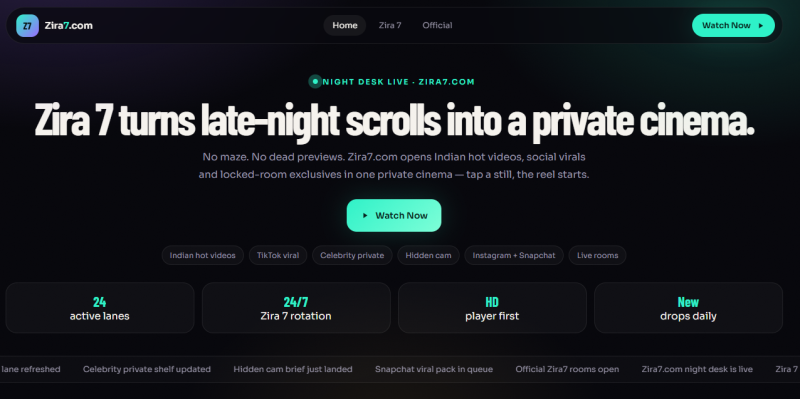
Short answer: No. Zira7.com is built around the same model as dozens of other "leaked video" sites. It promotes content people never agreed to share, and the site itself carries the usual technical warning signs of a redirect-driven ad operation. Even if a trust checker gave it a decent score, the content list alone is reason enough to stay away.
The site markets itself as a private cinema for Indian hot videos, social virals, and locked-room exclusives. That phrasing is doing a lot of work. "Locked-room exclusives" is a dressed-up way of describing footage that was recorded without the knowledge or consent of the people in it, then distributed for strangers to watch. Calling it a "private cinema" doesn't change what it actually is.
Read past the marketing language and ask a simple question: how did this footage end up on a public website? For most of what's being advertised here, the honest answer involves a hidden camera, a stolen phone, a hacked cloud account, or a partner sharing something they had no right to share.
Try to watch anything on a site like this and you rarely land on the video itself. Instead you get bounced to another domain, usually one running aggressive ads, a fake "update your player" prompt, or a script quietly trying to run in the background. This is standard behavior for sites whose real business is ad traffic and malware distribution, not video hosting.
A few things worth knowing about this pattern:
Copyright infringement is one issue here. Original footage, whether from social media or elsewhere, is being reposted without permission, which is a legal problem for the operator.
But there's a deeper issue that matters more. Content described as "locked-room exclusives" or footage taken in private settings usually means someone's personal life is being distributed without their agreement. That isn't a copyright dispute. It's closer to the pattern behind non-consensual image sharing, sometimes called revenge porn. Hosting it, monetizing it, and marketing it as "exclusive" content makes a site complicit in real harm to real people, separate from any question of trademark or licensing.
If someone is telling you they'll post your private images or video unless you pay them or send more, here's what actually helps:
If images have already been shared or you're worried they will be, StopNCII.org can create a digital fingerprint of the image that participating platforms use to block it, without you having to upload the image anywhere public.
Tell someone you trust. Sextortion works by isolating people and relying on shame to keep them quiet.
The same basic checks apply here as with any unfamiliar website. Look at how the domain behaves, not just what it claims. A young domain, a first click that sends you somewhere unexpected, and a business model built on content nobody agreed to share are all signals worth taking seriously, on their own and together.
Running the domain through a checker like ScamAdviser will show you registration age, hosting history, and any scam reports already filed against it. That's useful information, but it shouldn't be the only thing you weigh. A site can register clean and still be built around harmful, non-consensual content.
Overall, Zira7.com is unlikely safe. Zira7.com combines two problems that reinforce each other: a redirect-heavy setup typical of ad fraud and malware delivery, and a content library built on footage people almost certainly never agreed to have shared. Neither one needs the other to be a reason to close the tab.
See More interesting articles from ScamAdviser:
This article has been written by a scam fighter volunteer. If you believe the article above contains inaccuracies or needs to include relevant information, please contact ScamAdviser.com using this form.
Adam Collins is a cybersecurity researcher at ScamAdviser who operates under a pseudonym for privacy and security. With over four years on the digital frontlines, he specialises in translating complex threats into actionable advice. His mission: exposing red flags so you can navigate the web with confidence.