
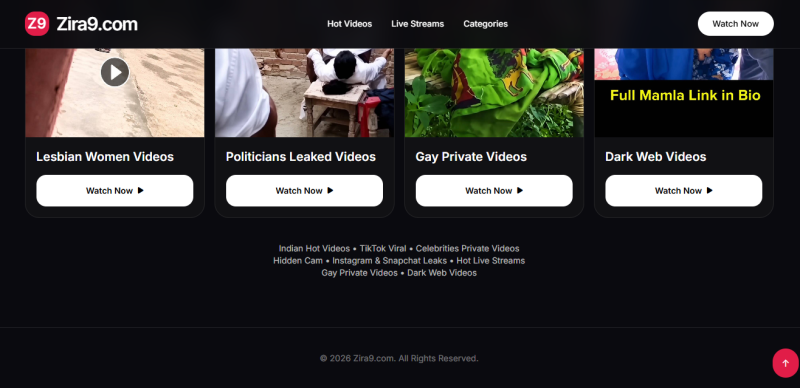
Short answer: There is a high possibility that Zira9.com is unsafe. A site advertising "premium leaks" of private and stolen content is not a safe website to use, regardless of what trust score a checker tool gives it. If you are asking is this website legit, the content it promotes alone answers that question.
The site advertises itself with a list that includes Indian hot videos, TikTok viral clips, celebrities' private videos, hidden cam footage, Instagram and Snapchat leaks, hot live streams, gay private videos, and dark web videos.
Read that list again. Several of these categories describe content that was never meant to be shared publicly. "Private videos" and "leaks" means someone's personal footage, obtained without consent, being distributed for other people to watch. That is not a gray area. It is the exact pattern behind revenge porn distribution and non-consensual image sharing.
Click any of the watch videos and you get redirected. Same pattern as most sites in this category. The video you think you are about to watch is not actually hosted where you clicked. Instead the page sends you to another domain, often one running ads, fake player prompts, or scripts designed to install something on your device. The redirect itself is a signal the operator is not running a straightforward video site. They are running traffic through a chain designed to make money off every click, regardless of what happens to you next.
Beyond copyright, there is a bigger problem here. Copyright infringement is real when platform content is redistributed without permission. But "leaks" and "hidden cam" content raises a separate and more serious issue: consent. If the people in these videos did not agree to have them recorded or shared, hosting and promoting that content is not just a legal risk for the website, it causes direct harm to real people.
Anyone landing on a site like this should ask a basic question before clicking further: would the person in this video want it here? If the answer is no, the smart move is to close the tab.
If someone is threatening to leak your nudes or private images or videos unless you pay them or send more content, here is what actually helps.
~ Do not pay. Payment rarely ends the threat. It usually confirms you will pay again, and the demands often continue or increase.
~ Stop responding to the person making the threat. Continued contact gives them more material to work with and more leverage.
~ Save everything. Screenshot the messages, usernames, profile links, and any images sent to you, before you block the account. This becomes evidence.
~ Report it. In the US, contact the FBI's Internet Crime Complaint Center (ic3.gov) and, if you are under 18 or the images involve a minor, the National Center for Missing and Exploited Children's CyberTipline (report.cybertip.org). Many countries have an equivalent cybercrime reporting unit, so search for your national one if you are outside the US.
~ Use StopNCII.org if the images have already been taken or shared, or if you are worried they might be. It creates a digital fingerprint of the image that participating platforms use to block it from being uploaded, without you having to send the image itself anywhere.
~ Tell someone you trust. A parent, a friend, a school counselor, whoever you would normally go to. Sextortion relies on isolation and shame to keep victims quiet. Breaking that silence takes away the leverage the person is counting on.
This is a stressful situation, but it is also a common one and there are real paths through it that do not involve giving in to the demand.
Beyond the ethical problem with the content itself, run the same technical checks you would on any unfamiliar site before clicking around:
Check how old the domain is. Sites built around leaked or pirated content tend to churn through domains quickly since they get taken down or blacklisted.
Notice what happens on your first click. Getting redirected to a different site is a strong signal something other than video playback is happening in the background.
Run the domain through a website safety checker like ScamAdviser before you interact with it further. It will show you registration details, hosting history, and any existing scam reports tied to the domain.
Consider the content itself. A website safety check should never be the only test. If the business model depends on content people did not agree to share, no trust score changes that.
Zira9.com combines two separate problems. The technical pattern of a redirect-driven ad site, and a content list built around leaked, non-consensual, and likely copyright-infringing material. Even a site with a decent technical trust score would still be worth avoiding on the content alone. If you ended up here because someone is threatening you with images or video, the steps above are your actual next move, not clicking around this kind of site looking for answers.
See more interesting articles from ScamAdviser:
This article has been written by a scam fighter volunteer. If you believe the article above contains inaccuracies or needs to include relevant information, please contact ScamAdviser.com using this form.
Adam Collins is a cybersecurity researcher at ScamAdviser who operates under a pseudonym for privacy and security. With over four years on the digital frontlines, he specialises in translating complex threats into actionable advice. His mission: exposing red flags so you can navigate the web with confidence.
